Risk-Averse Online POMDP Planning: A New Approach Based on Per-Step Immediate Cost CVaR

New framework applies CVaR to per-step POMDP costs, filling the within-belief risk gap while preserving standard MDP structure.
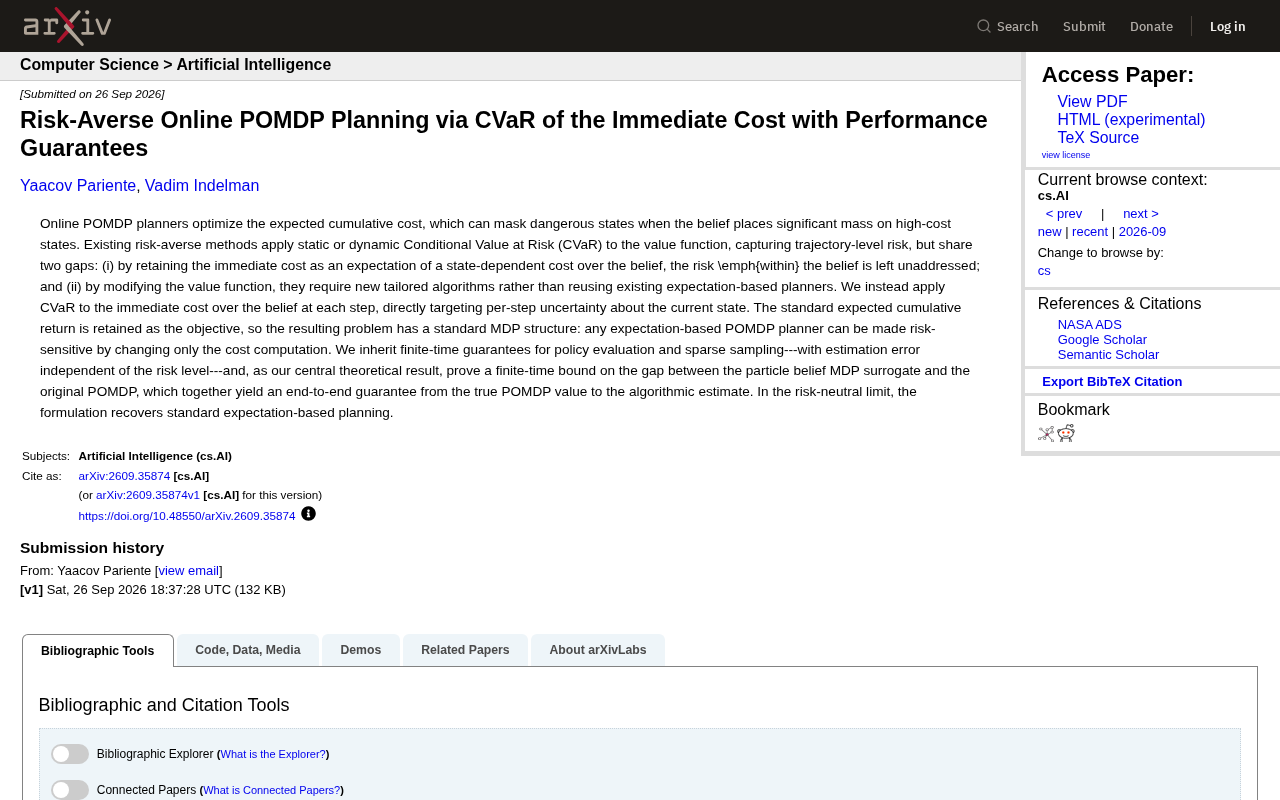
Traditional POMDP planners optimize expected cumulative cost, masking dangerous low-probability, high-cost states within the belief. Existing CVaR methods address trajectory-level risk but ignore within-belief uncertainty and break standard MDP structure, forcing custom algorithm design. This paper applies CVaR directly to immediate costs over the belief at each step, modeling current-state uncertainty while preserving the expected cumulative return structure — enabling any existing expectation-based planner to become risk-sensitive with minimal changes. The paper also proves finite-time error bounds between the particle belief MDP surrogate and the true POMDP, with estimation error independent of risk level, forming a complete end-to-end theoretical guarantee.
Background: Why Expected-Value Optimization Can Mask Dangerous States
In scenarios requiring decision-making under uncertainty — such as robot navigation and autonomous driving — the Partially Observable Markov Decision Process (POMDP) is a foundational modeling tool. Traditional online POMDP planners optimize expected cumulative cost, an approach that works well in most cases but carries a subtle flaw: when a belief state assigns significant probability mass to high-cost states, pure expected-value optimization can mask those potentially dangerous states.
In other words, a policy that performs well "on average" is not necessarily safe in the worst case. For safety-critical applications, this "risk blindspot" introduced by expected-value objectives can lead to catastrophic outcomes. This is precisely the core problem the paper sets out to address.
Partially Observable Markov Decision Processes (POMDPs) are the standard mathematical framework for modeling problems where an agent cannot directly observe the true state of the environment. In a POMDP, the agent maintains a belief state — a probability distribution over all possible current states — and makes decisions based on it. For example, an autonomous vehicle cannot precisely know a pedestrian's intent, and instead maintains a probability distribution inferred from sensor readings. POMDPs are extremely difficult to solve (theoretically PSPACE-hard), so online planners typically use sampling methods such as Monte Carlo Tree Search to find approximately optimal policies within a limited computational budget. Particle filters are a common method for representing belief states: a finite set of samples (particles) approximates the continuous probability distribution, with each particle representing a hypothesis about the true current state. This particle-based approximation is precisely what makes error bound analysis necessary — when the number of particles is finite, the deviation between the approximate belief and the true belief must be quantified and bounded.
Two Gaps in Existing Risk-Averse Approaches
To make planners risk-aware, the research community has developed a range of methods based on Conditional Value at Risk (CVaR). These approaches typically apply static or dynamic CVaR to the value function, capturing risk at the trajectory level. However, the paper identifies two common gaps shared by these methods.
Gap 1: Risk Within the Belief Is Left Unaddressed
Existing methods still treat the immediate cost as the expected value of the state-dependent cost over the belief. This means that while trajectory-level risk is accounted for, risk within the belief is ignored. The agent's uncertainty about its own current state is precisely the most direct and pressing source of risk.
Gap 2: Requires Custom Algorithms, Limiting Reuse
Introducing risk sensitivity by modifying the value function breaks the standard structure of the original problem. The consequence is that researchers must design entirely new, tailor-made algorithms rather than reusing mature, expectation-based planners. This significantly increases the cost of implementation and deployment.
Conditional Value at Risk (CVaR) is a risk metric widely used in financial risk management and has in recent years been introduced into reinforcement learning and planning. Given a confidence level α∈(0,1], CVaR_α measures the average loss in the worst (1-α) fraction of outcomes — intuitively, if α=0.1, CVaR represents the average cost in the worst 10% of cases. Compared to second-order statistics like variance, CVaR possesses subadditivity, making it a "coherent risk measure" with mathematically desirable properties that integrate well into optimization frameworks. When α→1, CVaR reduces to the expected value; when α→0, it approaches worst-case cost. Applying CVaR to the value function (i.e., the distribution of cumulative cost over entire trajectories) is the mainstream approach in prior work. The innovation of this paper lies in applying it to the immediate cost distribution over the belief at each step, capturing the risk of state uncertainty at the current moment while preserving the standard MDP structure.
Core Idea: Applying CVaR to the Immediate Cost at Each Step
The paper's proposed approach makes a crucial shift in its point of intervention: rather than modifying the value function, it applies CVaR to the immediate cost over the belief at each step, directly modeling the per-step uncertainty about the current state.
This change produces an elegant property — the standard expected cumulative return is preserved as the overall objective. As a result, the resulting problem maintains a standard MDP structure. The immediate benefit is:
Any expectation-based POMDP planner can be converted into a risk-sensitive planner simply by modifying the cost computation.
This "minimally invasive" design philosophy allows the new method to integrate seamlessly with existing planning frameworks, avoiding the need to rebuild from scratch.
Theoretical Guarantees: End-to-End Bounds from True POMDP to Algorithmic Estimates
The most substantial contribution of this work lies in its theoretical performance guarantees, rather than stopping at methodological innovation alone. The paper establishes and proves several key properties:
- Finite-time guarantees for policy evaluation and sparse sampling: The estimation error is independent of the risk level, meaning that no matter how high the degree of risk aversion is set, the sampling-induced error does not grow accordingly.
- Finite-time bound on the gap between the particle belief MDP surrogate and the original POMDP: This is the central theoretical result of the paper. In practice, particles are used to approximate beliefs, and the paper proves that the error introduced by this approximation is controllable and bounded.
- End-to-end guarantee: Combining the above results, one can trace the error from the true POMDP value all the way to the algorithm's estimate, forming a complete end-to-end error chain.
These theoretical results elevate the method from "empirically effective" to "provably effective" — a distinction that is especially important in safety-critical applications.
Finite-time bounds and asymptotic convergence guarantees represent two different levels of assurance in reinforcement learning theory. Asymptotic guarantees only state that "the algorithm converges as the sample size approaches infinity," whereas finite-time bounds provide a concrete expression: "with n samples, the estimation error does not exceed f(n) with high probability." The latter is more valuable for practical systems, since computational resources and time are always finite in real deployments. The paper's end-to-end bound decomposes the error into two parts: the error introduced by approximating beliefs with particles (smaller with more particles N), and the statistical error from sparse sampling in the tree search. By combining the two, users can work backward from an allowable error threshold to determine the required number of particles and sampling depth — enabling principled tradeoffs between safety requirements and computational cost, exactly the kind of design guidance that safety-critical engineering systems need.
Compatibility with Risk-Neutral Planning
Worth noting is the method's consistency by design: in the risk-neutral limit, the formulation degrades and recovers the standard expectation-based planning objective. This demonstrates that the new method is a strict generalization of the traditional approach, not a replacement — when risk aversion is unnecessary, its behavior is identical to that of a classical planner, and users can smoothly transition between the two via a single risk parameter.
Significance and Outlook
The value of this research manifests in three main dimensions. Methodologically, it brings the granularity of risk modeling down to the immediate cost within the belief, filling a gap left by prior work that only addressed trajectory-level risk. In terms of engineering practicality, preserving the standard MDP structure means that a large number of existing planners can be upgraded at low cost, lowering the barrier to deploying risk-sensitive planning in practice. In terms of theoretical rigor, the end-to-end finite-time bound provides a solid foundation for algorithmic reliability in real-world systems.
For researchers and engineers working in autonomous driving, robotics, unmanned systems, and related fields, this framework offers a technical pathway that balances safety with implementation convenience. Of course, as a newly released theoretical work, its actual performance in large-scale real-world scenarios remains to be validated by further experiments.
Related articles

JobRunner MCP Server: AI Agents Can Now Fix Failed Java Jobs
JobRunner launches an open-source MCP server enabling AI agents to view cluster status, diagnose failures, and recover Java jobs—incident response from any cloud coding environment or existing agent.

MLAI Digital Launches 9 Security Agents: MCP Server Safeguards the Full Lifecycle of Agentic AI
MLAI Digital launches Security MCP Server with nine built-in specialized security agents covering vulnerability discovery, attack simulation, prompt injection detection, API and infrastructure assessment, and accelerated remediation—embedding security validation across the full Agentic AI lifecycle from development to production.

Running Isaac Lab on H100 GPUs: Exploring Better Approaches
Exploring optimization methods for running Isaac Lab on NVIDIA H100 GPUs, including MIG configuration, mixed precision, TensorRT acceleration, and community experience to improve robotics simulation and reinforcement learning efficiency.