Rivian Spin-off Also Halts E-Bike Deliveries Due to Battery and Software Defects

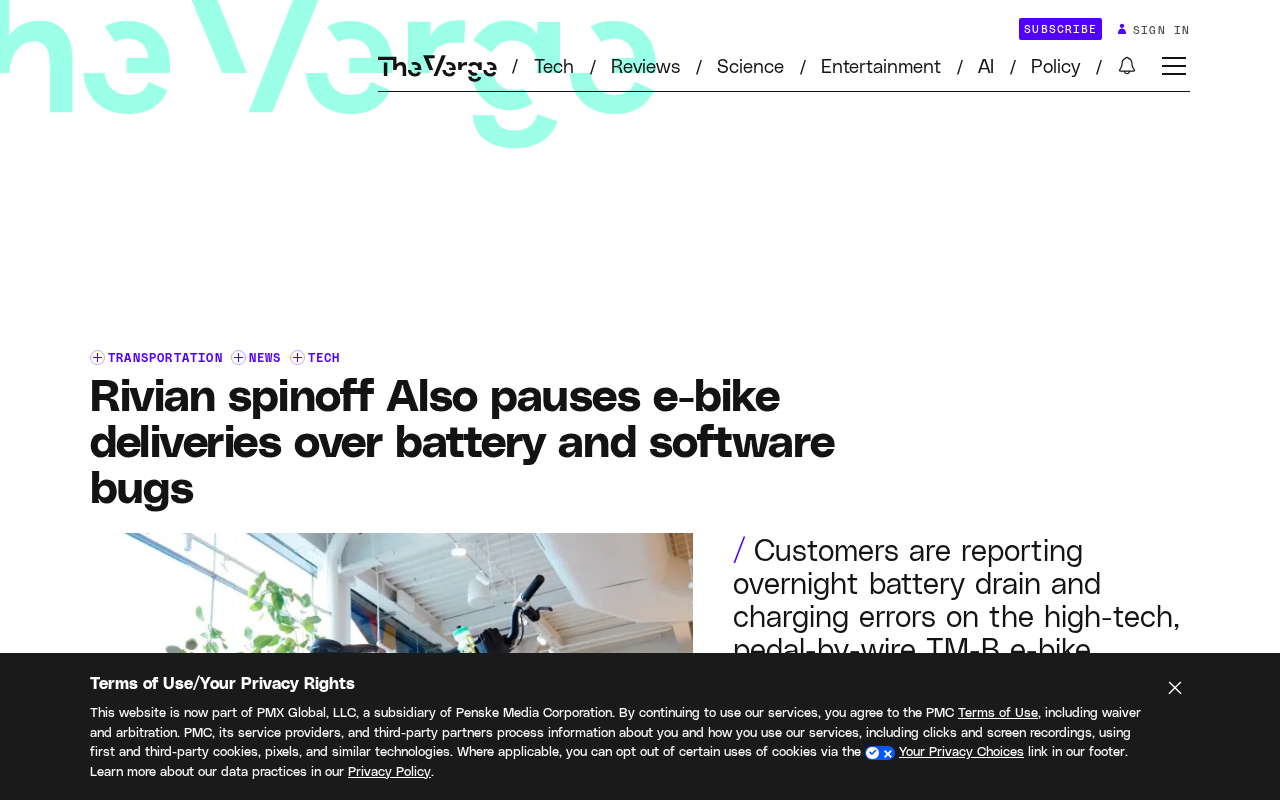
Rivian spin-off Also pauses first e-bike deliveries due to battery and software defects.
Also, a mobility startup spun off from Rivian, has paused deliveries of its first electric bicycle due to battery and software defects. The company was spun off last year, and its product is positioned as an "almost entirely software-driven" futuristic e-bike with extremely high engineering complexity. It had already struggled with supply chain issues in delivering its first products, and now battery and software defects have blocked delivery again. The original report did not disclose specific defect details, the number of affected vehicles, or a repair timeline. The incident highlights long-tail problems in software-defined hardware at mass production and warns smart hardware startups about delivery risks.
A Star Startup from Rivian Hits Delivery Trouble
According to an RSS source, Also, a mobility startup spun off from Rivian, has paused deliveries of its first electric bicycle due to battery and software defects. The company was spun off from Rivian last year and was originally seen as highly promising, but it has now hit another "speed bump."
Also's e-bike is positioned as a futuristic product that is "almost entirely software-driven." While this design philosophy is eye-catching, it also brings extremely high engineering complexity. The report notes that the company had already been struggling with supply chain issues, and the newly emerged battery and software problems have further delayed delivery progress.
Root Cause: The Cost of Software-Defined Hardware
The core contradiction facing Also lies in its product strategy — delegating a large number of functions and experiences to software. This "software-defined" approach has been proven in the automotive industry (such as Tesla's OTA updates), but replicating it on two-wheelers is not easy.
According to the original report, the company had previously struggled to get its first products to customers because of a "series of headaches" in the supply chain and the complexity of building a futuristic bicycle. Now, with battery and software defects compounding, pausing deliveries has become an unavoidable choice. As a detail, the original material did not disclose the specific nature of the defects, the number of affected vehicles, or a repair timeline.
Software-Defined Hardware refers to implementing many of a device's functions, behaviors, and user experiences in software on general-purpose computing platforms rather than dedicated hardware circuits, thereby changing or enhancing hardware capabilities through software updates. This concept has been widely applied in the smartphone and automotive industries; for example, Tesla uses OTA (Over-The-Air) updates to continuously improve vehicle performance, fix defects, and even add new features. Its advantages are high flexibility, fast iteration, and remote maintenance, but the cost is a significant increase in system complexity, more hidden software-hardware coupling issues, greater difficulty in testing and validation, and the risk that software defects may directly affect hardware safety and reliability. For transportation vehicles involving personal safety such as e-bikes, software-defined design means stricter functional safety and cybersecurity requirements must be met, and validation costs and timelines at the mass-production stage also increase significantly.
Implications for the Industry and Users
This incident once again reminds hardware entrepreneurs that software-driven products often face "long-tail problems" at the mass-production stage. As the core safety component of an e-bike, any battery defect could lead to serious consequences; software bugs may affect vehicle control, range display, or connectivity functions.
For users who have already pre-ordered Also's e-bike, the delivery pause means a longer wait. For the entire electric mobility sector, this also shows that even with the backing of a resource-rich parent company like Rivian, building a highly complex smart hardware product from scratch remains full of risks.
Long-Tail Problems in the context of hardware mass production refer to sporadic but diverse defects and anomalies that are difficult to expose in the laboratory or at small-batch stages and only gradually emerge in real-world usage scenarios, large-scale manufacturing, or long-term operation. Such problems are usually sparsely distributed and complex in cause, involving supply chain batch differences, environmental adaptability, diversity in user behavior, and edge cases in software-hardware interaction. For software-driven smart hardware, long-tail problems are especially prominent: software bugs may be triggered only under specific configurations or extreme conditions, and battery defects may stem from fluctuations in raw materials from a certain batch. Solving long-tail problems requires establishing comprehensive test coverage, field data feedback, and rapid iteration mechanisms; otherwise, it will directly slow delivery节奏 and damage brand reputation.
What to Watch Next
Because the original information is relatively brief, it is still unclear how Also will resolve the battery and software issues and when deliveries will resume. What is worth watching next is whether the company issues an official statement, whether a recall or design change is involved, and whether supply chain problems can be alleviated at the same time.
Against the backdrop of increasingly fierce competition in smart e-bikes, Also's delivery setback also sounds a warning for other hardware teams focused on "software-defined" products: the higher the product complexity, the greater the delivery risk.
One-line Summary
Rivian spin-off Also has paused deliveries of its first e-bike due to battery and software defects.
Paragraph Summary
Also, a mobility startup spun off from Rivian, has paused deliveries of its first electric bicycle due to battery and software defects. The company was spun off from Rivian last year, and its product is positioned as a futuristic e-bike that is "almost entirely software-driven," with extremely high engineering complexity. The company had already struggled to deliver its first products to customers because of supply chain issues, and now the combination of battery and software defects has blocked delivery again. The original report did not disclose the specific defect details, the number of affected vehicles, or a repair timeline. This incident highlights the long-tail problems that software-defined hardware faces at the mass-production stage and serves as a delivery-risk warning for hardware startup teams focused on intelligence.
Related articles

Prompt Engineering for Beginners: From Writing Prompts to Engineering Thinking
Starting from the essence and four functions of prompts, this article systematically explains the six-step process, four success criteria, learning value, and practical limitations of prompt engineering to help you build a complete understanding.

Anthropic Launches Nasdaq IPO: AI Giant's Listing and Risk Disclosures
Anthropic officially launches its Nasdaq IPO under ticker ANT, with market valuation expected to potentially exceed SpaceX's record. The prospectus devotes nearly 100 pages to AI risks, while first-half revenue grew over 14x but net losses widened sharply, reigniting the AI bubble debate.

Rust cURL Clone Uses 4,832 unsafe Blocks—Is the Memory Safety Myth Broken?
A Rust cURL clone uses 4,832 unsafe keywords, challenging Rust's memory safety narrative. We analyze what unsafe really means, compare Fil-C, and examine rewrite motives.