Rivian Spinoff Mind Robotics Hires Doug Field as President

Rivian's spun-off robotics company Mind Robotics appoints Doug Field, former head of Apple's Project Titan, as president, reflecting the trend of autonomous driving talent migrating to robotics.
Rivian's spun-off robotics startup Mind Robotics announced the appointment of Doug Field as president. Field previously served as Apple's Vice President of Special Projects and was the de facto head of the autonomous electric vehicle initiative codenamed Project Titan, which never reached mass production. Mind Robotics is currently highly secretive, with its specific product direction undisclosed. The article analyzes several implications: the perception, decision-making, and control capabilities from autonomous driving are highly transferable to general-purpose robotics, and talent flow signals this migration; Rivian's spin-off reflects automakers proactively modularizing internal tech assets; Field's bet on an early-stage stealth project suggests independent product judgment. The article also cautions against overinterpreting a single appointment as an industry bellwether.
Rivian's quietly spun-off robotics company Mind Robotics has just completed a heavyweight hire: Doug Field has been confirmed as the company's president. This news comes from a brief RSS feed item — not much information, but the personnel logic behind it is worth unpacking.
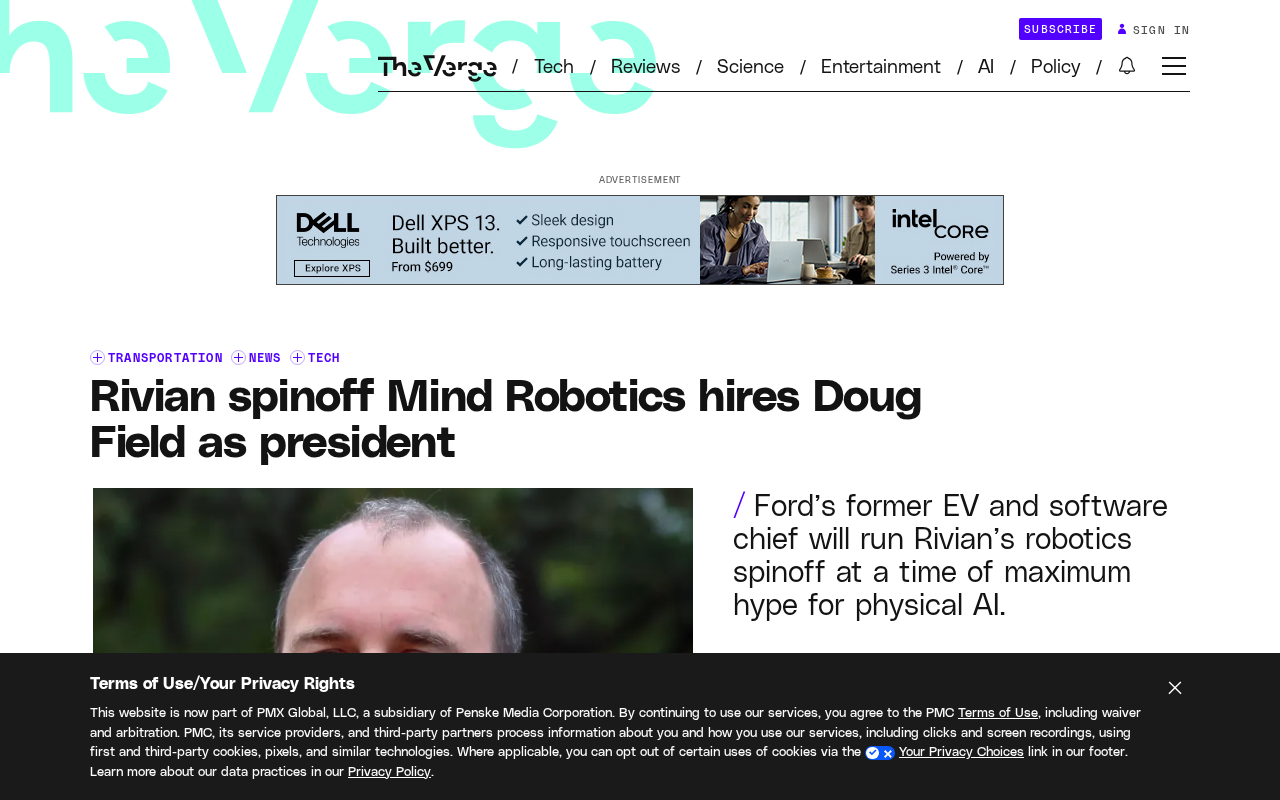
Who Is Doug Field: The De Facto Operator of Apple's Car Project
Before joining Mind Robotics, Field was best known for his title as Apple's Vice President of Special Projects. That somewhat vague job description corresponded to Apple's internally codenamed Project Titan — the autonomous electric vehicle initiative. According to public reports, Field was the de facto head of that project.
Project Titan ultimately never reached mass production, and Apple chose to pull back from the car business. But the head of a failed project does not equal a failed manager — this is especially clear in Silicon Valley's talent market. During his time at Apple, Field oversaw one of the most complex, cross-departmentally challenging hardware projects in the company's history, and that kind of experience is itself a scarce commodity.
Project Titan was Apple's autonomous electric vehicle R&D program, launched around 2014, internally codenamed after the Titan gods of Greek mythology. The project went through multiple strategic pivots: initially aiming to build a complete vehicle, then briefly shifting to an autonomous driving software platform only, then returning to the full-vehicle direction, with team size peaking at several thousand people. During the project, Apple poached numerous engineers and executives from Tesla, Ford, Mercedes, and other automakers. Doug Field took over day-to-day management of the project after returning to Apple from Tesla in 2018. In early 2024, Apple officially announced the termination of its car plan, with some personnel moving to the generative AI division. Although Project Titan never delivered a production vehicle, the technology patents and engineering experience it accumulated in autonomous driving perception, chip design, and battery management became hidden assets for Apple's subsequent product lines.
Why Rivian, Why Robotics
Mind Robotics is positioned as a robotics startup spun off from Rivian, and publicly disclosed information is quite limited — the RSS feed even describes it as "secretive." But considering Rivian's own situation, this spin-off path isn't hard to understand.
As an EV manufacturer, Rivian has accumulated substantial automation and motion control capabilities in its manufacturing operations. Spinning off the robotics business — which is unrelated to vehicles — as a separate entity for fundraising and independent operation allows the parent company to focus on its core business while giving the robotics team more flexible incentive mechanisms. And a company that wants to build robots (especially products potentially involving autonomous mobility) needs exactly the kind of person who understands hardware, autonomous driving, and large-scale engineering management. Field's résumé is almost tailor-made for this need.
Rivian is an American electric vehicle manufacturer founded in 2009, which entered the market with the electric pickup R1T and electric SUV R1S, and received strategic investments from Amazon, Ford, and others. Rivian has a vehicle assembly plant in Illinois, and its production lines are highly dependent on self-developed automation equipment and motion control algorithms. These capabilities share a底层 technology stack with robotics R&D, including motor control, sensor fusion, and path planning. Spinning off the robotics business as an independent company also has clear advantages in capital operations: the startup can raise funds independently, be valued separately, the team can receive an independent option pool, and the parent company avoids having high robotics R&D investment drag down the financial statements of its vehicle business. This approach of "corporatizing technology assets" is not unprecedented in the automotive industry, but Rivian is one of the earlier automakers to operate its robotics direction independently.
What This Appointment Signals
A personnel brief of just a few lines, read in the context of the industry, reveals several layers of meaning.
First, the talent war in the robotics sector is spreading to the automotive and consumer electronics industries. The perception, decision-making, and control capabilities accumulated in autonomous driving share a substantial transferable technology foundation with general-purpose robotics, and talent flow is the most direct signal of this technology migration.
Second, Rivian's move to spin off robotics shows that automakers are taking a more proactive approach to the spillover value of their internal technology assets. No longer just keeping technology inside the vehicle, but modularizing and corporatizing capabilities.
Third, Field's choice to join a still-stealth startup rather than an established major company after Project Titan ended is itself noteworthy. When a seasoned hardware executive is willing to bet on an early-stage project, it usually means he has his own judgment about the product direction.
Technology migration between autonomous driving and robotics is not a new topic, but it has become particularly concrete in the past two years. Autonomous driving systems typically include three major modules: perception (lidar, cameras, millimeter-wave radar), decision-making (path planning, behavior prediction), and control (steering, braking, acceleration). General-purpose mobile robots also need these capabilities — only the operating environment changes from open roads to structured spaces like warehouses, factories, or homes. This means algorithm engineers, sensor specialists, and system architects trained in autonomous driving can transition into the robotics industry at relatively low learning cost. There have been several similar talent flow cases in recent years, such as multiple core members from Waymo, Cruise, and Tesla's Autopilot team joining robotics startups. This flow accelerates the reuse of the technology foundation and pushes the competitive landscape of the robotics sector to align more quickly with the engineering standards of the automotive industry.
What Remains Unclear
To be honest, the currently confirmable information is limited to the appointment itself. What form of robot Mind Robotics specifically builds, what scenarios it targets, and how broad Field's authority is — none of this has been made public. The "secretive" description in the RSS feed confirms this.
Interpreting a single executive appointment as an industry bellwether is easy to overreach. A more measured view: this is a signal point worth continuously tracking, and Field's next moves — the direction of team building, the pace of product launches — will be the key to judging Mind Robotics' true intentions.
One-line Summary
Rivian's spun-off robotics company Mind Robotics has appointed Doug Field, former head of Apple's Project Titan, as president, reflecting the trend of autonomous driving talent migrating to the robotics sector.
Paragraph Summary
Rivian's spun-off robotics startup Mind Robotics announced the appointment of Doug Field as president. Field previously served as Apple's Vice President of Special Projects and was the de facto head of the autonomous electric vehicle initiative codenamed Project Titan, which ultimately never reached mass production. Mind Robotics is currently in a highly secretive state, with its specific product direction undisclosed. The article analyzes several layers of meaning behind this appointment: the perception, decision-making, and control capabilities accumulated in autonomous driving share a substantial transferable technology foundation with general-purpose robotics, and talent flow is a direct signal of this migration; Rivian's spin-off of its robotics business into an independent operation reflects automakers beginning to proactively modularize and corporatize their internal technology assets; Field's choice to bet on an early-stage stealth project rather than an established major company suggests he has independent judgment about the product direction. At the same time, the article cautions that the currently confirmable information is limited to the appointment itself, and it should not be overinterpreted as an industry bellwether.
Related articles

Felix Rieseberg Personal Homepage
Felix Rieseberg's personal homepage sparks attention on Hacker News. This article covers the Slack engineer's technical background, the rise and fall of nativefier, and the value of a developer homepage as a tech calling card.

@ai-sdk/vue 3.0.306 Patch Release Syncs with [email protected] Update
@ai-sdk/vue 3.0.306 released, synced with [email protected]. A routine patch release for the Vercel AI SDK ecosystem with no public API changes; the Vue adapter layer stays version-aligned with the core package.

Gemini 4 Argon API Launches: The Era of Million-Token Output Begins
Google launches Gemini 4 Argon with sparse MoE architecture, up to 1M output tokens, and a 68.90% Vals Index score, available across API, AI Studio, and the Gemini app.