RK3588S Benchmarks Local LLMs: 35B MoE vs. NPU Acceleration — Which Is Faster?

RK3588S tested with four models: 35B MoE generates fastest; NPU excels at prefill but lags in decode.
A Bilibili creator benchmarked four LLMs on the RK3588S development board (8-core ARM, 16GB RAM). On pure CPU, the 4B dense model achieved 22 tokens/s prefill and 5.3 tokens/s generation; the 35B MoE model with IQ2 extreme quantization, activating only ~3B experts per inference, reached 5.8 tokens/s generation — surpassing the dense model; a higher-precision UD-Q2 version maintained similar generation speed while improving prefill to 15.4 tokens/s. The NPU-accelerated QN1.5 4B (W8A8) hit 26 tokens/s prefill but only 3.4 tokens/s generation. Conclusion: matching model architecture and quantization strategy matters more than hardware acceleration alone — NPU suits long-input short-output scenarios, while pure CPU is more balanced for continuous dialogue.
Running large language models locally on edge devices has always been constrained by both compute power and memory. Can the RK3588S — an 8-core ARM development board with 16GB of RAM — handle it? A Bilibili creator tested four models and delivered quantitative comparison data.
Test Environment and Model Selection
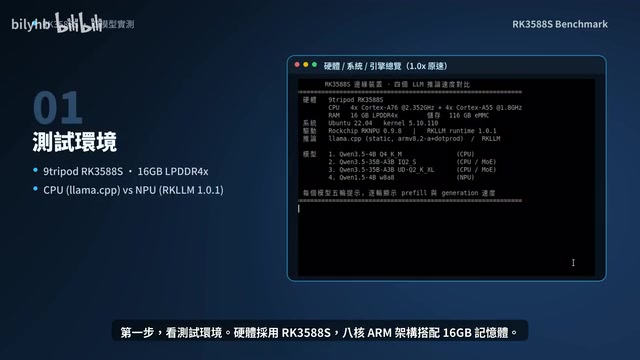
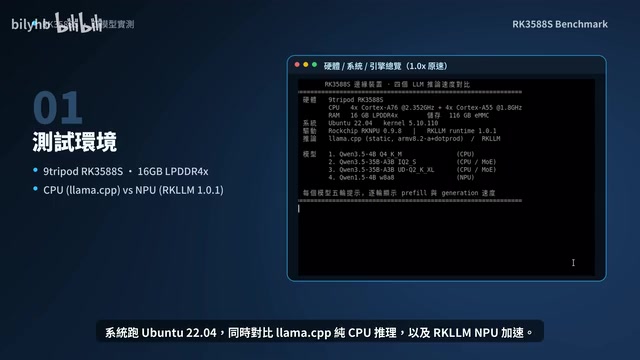
The test platform was the RK3588S development board, running OpenTo22.04 (as stated in the original) with 16GB of memory. The creator compared two approaches — pure CPU inference (based on Llama CPP) and NPU hardware acceleration (RKLLM) — and selected four models with different parameter scales and quantization strategies:
- Kun 3.5 4B (name as given in the original; presumed to be from the Qwen series), quantized with Q4_K_M, running on pure CPU
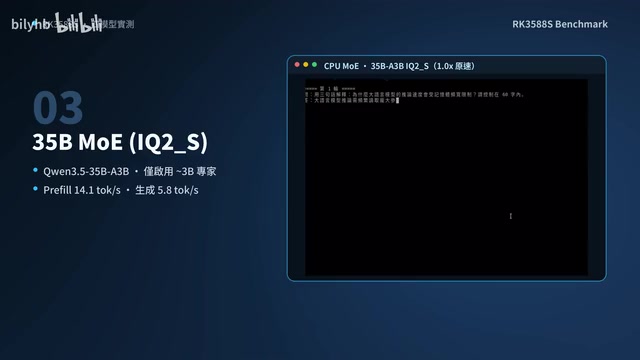
- A 35B-parameter MoE (Mixture of Experts) model, quantized with aggressive IQ2_S, running on pure CPU
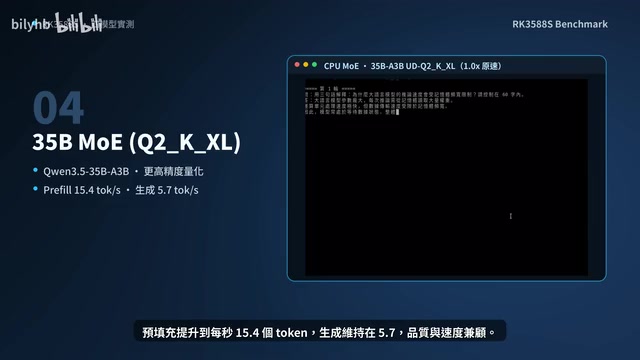
- A higher-precision UD-Q2_K_XL quantized version of the same series
- QN1.5 4B, quantized with W8A8, running on NPU hardware acceleration
Each model underwent 5 rounds of real conversations, measuring throughput in both the prefill and generation (decode) phases.
Prefill and Generation Phases: LLM inference is divided into two stages: prefill and decode (referred to as "generation" in the original). Prefill processes all the user's input tokens in parallel — it's compute-intensive and demands high processing power, with time proportional to input length. Decode generates output tokens one by one autoregressively; each step requires accessing model weights, making it memory-bandwidth-bound, and speed is typically measured in tokens generated per second. On edge devices, NPUs excel at parallel matrix operations, giving them an edge in prefill; while in the decode phase, due to frequent memory access, CPU solutions sometimes outperform.
Quantization Strategies: Quantization compresses model weights and activations from high precision (e.g., FP16) to low-bit integers (e.g., 4-bit, 2-bit) to reduce memory footprint and accelerate inference. Common formats include GPTQ's Q4_K_M, Q2_K, and IQ2 for MoE models. W8A8 means both weights and activations are quantized to 8-bit, balancing precision and hardware compatibility. The more aggressive the quantization (e.g., IQ2), the smaller the model size but the higher the risk of precision loss.
Four Models' Speed Benchmark Data
Pure CPU Group: Small Models vs. MoE
The first contender, Kun 3.5 4B (Q4 quantized), running on pure CPU, achieved prefill speeds up to 22 tokens per second with short prompts, and stable generation speeds of 5.3 tokens per second. This performance shows that 4B-class models on the RK3588S CPU can already provide a usable interactive experience.
More surprising was the second contender: a 35B-parameter MoE model with aggressive IQ2 quantization. Although total parameters reach 35B, each inference only activates about 3B experts, and generation speed actually reached 5.8 tokens per second — slightly higher than the 4B dense model. This demonstrates that MoE sparse architectures have a natural advantage on memory-bandwidth-constrained edge devices: fewer parameters participate in computation, making memory pressure more manageable.
MoE Sparse Architecture: Mixture of Experts (MoE) models consist of multiple "expert" subnetworks and a gating network. During inference, the gating network selects a few experts to activate for each token (e.g., only about 3B of 35B total parameters activated in this case), so the computation is far less than a dense model with the same total parameters. This sparsity greatly reduces memory bandwidth and compute requirements, enabling large-parameter models to run on edge devices. However, all MoE experts still need to be loaded into memory, requiring high memory capacity — running a 35B model on 16GB of RAM depends on aggressive quantization.
The Trade-off Between Precision and Speed
The third contender switched to a higher-precision UD-Q2_K_XL quantized version, with prefill speed rising to 15.4 tokens per second and generation speed maintained at 5.7 tokens/s. Compared to the IQ2 version, precision improved while generation speed remained nearly the same, and prefill was actually faster — the creator rated it as "balancing quality and speed." This suggests that quantization strategy choice significantly impacts the actual experience, and it's not always true that higher precision means slower speed.
NPU Acceleration: Clear Prefill Advantage
The fourth contender, QN1.5 4B, used W8A8 quantization with NPU hardware acceleration, achieving prefill speeds up to 26 tokens per second after conversion — faster than pure CPU — but generation speed of about 3.4 tokens per second. The NPU shows a clear advantage in the parallel-compute-intensive prefill phase, but falls behind the CPU in the token-by-token decode phase.
NPU and RKLLM: NPU (Neural Processing Unit) is a hardware accelerator designed specifically for AI operations like matrix multiply-add, with higher energy efficiency than general-purpose CPUs. The RK3588S integrates a 6 TOPS NPU, but it must be invoked through a dedicated inference framework (e.g., RKLLM), and models must be converted to a specific format and quantized (e.g., W8A8). The NPU excels at the parallel-compute-intensive prefill phase, but during token-by-token decoding, due to scheduling overhead and memory access patterns, it may be less flexible and efficient than the CPU — which explains the observed fast prefill and slow generation.
Test Conclusions and Scenario Recommendations
Averaged over five rounds, the 35B MoE model, thanks to its sparse architecture, achieved the fastest generation speed on pure CPU (5.8 tokens/s); while the NPU's prefill speed reached 26 tokens/s, making it highly suitable for long-input, short-output scenarios such as document summarization and context processing in retrieval-augmented generation (RAG).
For scenarios requiring continuous conversation with word-by-word output, running small models or MoE models on pure CPU is actually more balanced; for tasks that process long text in one pass and quickly provide short answers, the NPU-accelerated prefill advantage is worth leveraging. The creator concluded: "Data speaks — choosing the right model is what makes it fast." On edge devices, matching model architecture with quantization strategy often determines the actual experience more than simply stacking hardware.
It should be noted that the above data comes from a single creator's testing; different system configurations, thermal conditions, and prompt lengths may all affect results. Readers can refer to the methodology and verify independently.
One-line Summary
RK3588S tested with four models: 35B MoE generates fastest; NPU excels at prefill but lags in decode.
Paragraph Summary
A Bilibili creator benchmarked local inference performance of four LLMs on the RK3588S development board (8-core ARM, 16GB RAM). On pure CPU, the 4B dense model achieved 22 tokens/s prefill and 5.3 tokens/s generation; the 35B MoE model with aggressive IQ2 quantization, activating only ~3B experts per inference, reached 5.8 tokens/s generation — surpassing the dense model; a higher-precision UD-Q2 quantized version maintained similar generation speed while improving prefill to 15.4 tokens/s. The NPU-accelerated QN1.5 4B (W8A8 quantized) hit 26 tokens/s prefill but only 3.4 tokens/s generation. The conclusion: matching model architecture with quantization strategy matters more than raw hardware acceleration for edge device experience — NPU suits long-input short-output scenarios, while pure CPU is more balanced for continuous conversation.
Related articles

Xenon Flash Bug Returns: Radxa Dragon Q8B Affected
The Xenon flash bug resurfaces, this time on the Radxa Dragon Q8B board. This article reviews early Hacker News discussion and analyzes the potential impact and community concerns.

ChatGPT Plus Subscription Guide for Users in China: Official Top-Up Channel Walkthrough and Comparison
A complete guide to subscribing to ChatGPT Plus from China via official top-up platforms: plan selection, account login, copying account info, payment verification, plus a comparison of top-up, proxy, and self-supplied card channels.

The Complete Guide to Subscribing to ChatGPT Plus in China: Hands-On Walkthrough of Third-Party Top-Up Channels and Risk Analysis
How can users in China subscribe to ChatGPT Plus? This article breaks down the complete process of third-party top-up platforms, analyzes account security, renewal sustainability, and risk-control risks to help you decide which subscription option suits you better.