RLCD Explained: Using Proper Scoring Rules to Calibrate Confidence in RL Rewards

RLCD replaces binary RL rewards with proper scoring rules to train LLMs toward honest confidence calibration.
Standard RLVR training rewards only correctness, ignoring model confidence and causing policies to drift toward overconfidence. TypeSafe's RLCD replaces rewards with proper scoring rules like the Brier score, so expected reward is maximized only when reported probabilities match true likelihoods. It adds ECE-style per-bin calibration penalties targeting specific confidence ranges. A key engineering pitfall: globally applied penalties are fully absorbed by PPO or GRPO baselines — per-bin attribution is essential for effective gradient signals. An open question remains: does calibration reward truly improve discriminative confidence, or just flatten all outputs to middling probabilities?
Starting with RLVR's Fundamental Flaw
Standard RLVR (Reinforcement Learning with Verifiable Rewards) is deceptively simple: +1 for a correct answer, 0 for a wrong one. This binary reward looks clean and straightforward, but it hides a long-overlooked problem — it completely ignores model confidence.
A lucky guess and a carefully reasoned, high-confidence correct answer receive exactly the same reward under this scheme. Since guessing and genuinely knowing are scored identically, the policy has no incentive to pursue calibration. Over time, the model drifts toward overconfidence: it learns to project certainty on every output, because only correctness affects the reward — the accuracy of confidence carries no cost whatsoever.
This is the core problem that TypeSafe's RLCD (Reinforcement Learning for Calibrated Decisions — the method behind their product Jev) aims to solve.
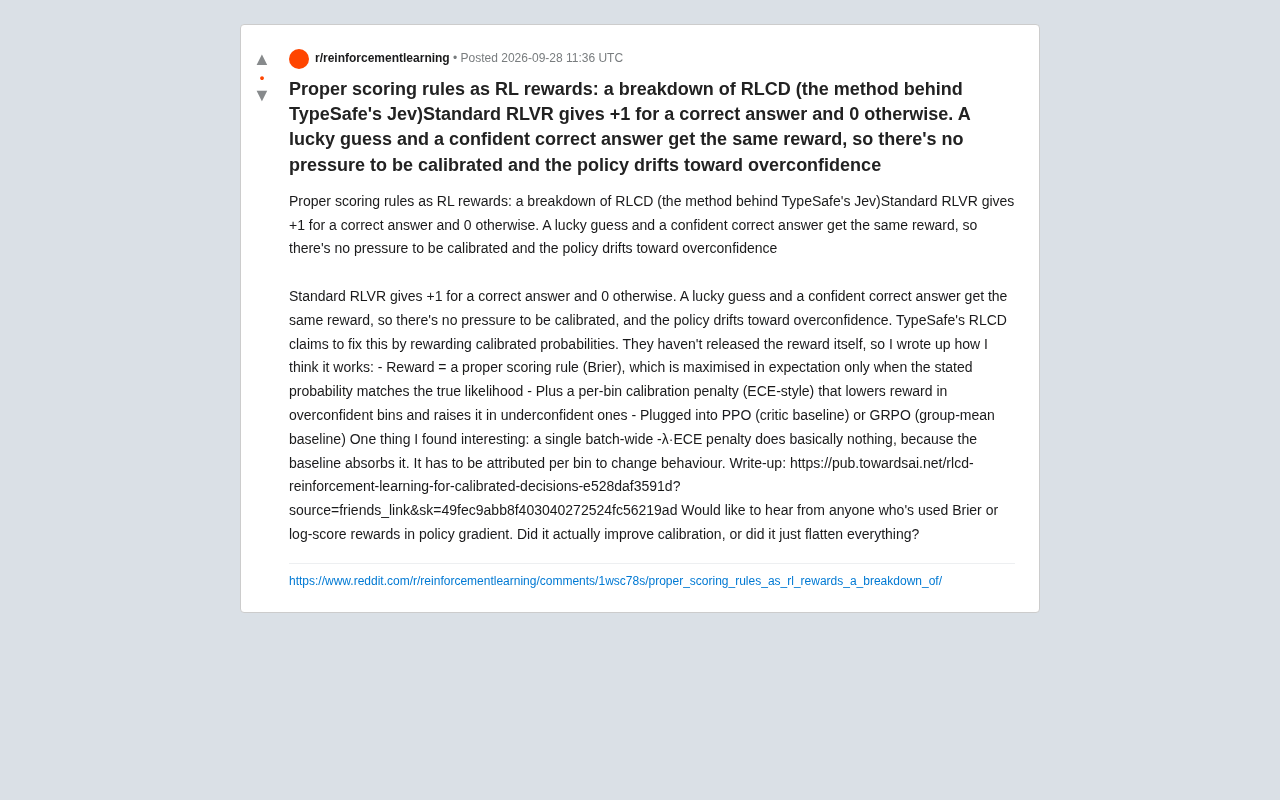
RLCD's Core Idea: Replace Rewards with Proper Scoring Rules
According to a technical breakdown posted on Reddit by a researcher (TypeSafe has not publicly released the specific reward function implementation — what follows is the author's speculative reconstruction), RLCD's key change is replacing the coarse 0/1 reward with a proper scoring rule.
Why the Brier Score
The mathematical property of proper scoring rules is this: their expected value is maximized only when the probability stated by the model matches the true likelihood. In other words, a model cannot game its score by misreporting confidence — to earn a high reward, the probability you report must honestly reflect your true probability of being correct.
The author speculates that RLCD uses the Brier score as this scoring rule. The Brier score measures the mean squared error between predicted probabilities and actual outcomes, naturally penalizing overconfident predictions that "talk big but deliver little," while also discouraging excessive hedging.
The Brier score formula is $BS = \frac{1}{N}\sum_{i=1}^{N}(f_i - o_i)^2$, where $f_i$ is the model's reported probability and $o_i$ is the actual outcome (0 or 1). Lower scores indicate better predictions; a perfect prediction has a Brier score of 0. Compared to 0/1 rewards, its key advantage is continuous penalization of confidence: if a question is answered correctly but the model reports only 0.6 confidence, it earns less reward than it would have with 0.9 confidence; conversely, answering incorrectly while reporting high confidence incurs a double penalty. Another common proper scoring rule is the log-score (cross-entropy), which penalizes extreme errors more aggressively — if a model predicts a wrong answer with probability close to 1.0, the log-score approaches negative infinity. The choice between them affects how sensitive the model becomes to tail risks in practice.
Per-Bin Calibration Penalty
Beyond the Brier score, RLCD stacks an additional per-bin calibration penalty, similar in spirit to ECE (Expected Calibration Error):
- In confidence ranges where the model is overconfident, rewards are reduced;
- In ranges where the model is underconfident, rewards are increased.
This design allows the reward signal to correct biases at specific confidence levels in a targeted way, rather than applying a blunt global correction.
ECE (Expected Calibration Error) works by bucketing all model predictions into bins by confidence interval — e.g., [0, 0.1), [0.1, 0.2) through [0.9, 1.0] — and then measuring the weighted gap between average confidence and actual accuracy within each bin. A perfectly calibrated model making predictions at 0.7 confidence should achieve an accuracy of exactly around 70%. RLCD's per-bin penalty exploits this structure: it identifies which confidence intervals exhibit systematic bias and adjusts rewards for samples within those intervals specifically, rather than applying the same penalty strength to all predictions. This fine-grained attribution enables gradient signals to reach precisely the model behaviors that need correction.
A Common Pitfall: Global Penalties Get Absorbed by the Baseline
One of the most valuable observations in the breakdown concerns the practical details of how to inject the penalty term into policy gradient algorithms.
The author wired the above reward into two mainstream policy optimization frameworks: PPO (using a critic as the baseline) and GRPO (using group mean as the baseline). He discovered a counterintuitive phenomenon: a global -λ·ECE penalty applied across an entire batch has almost no effect.
The reason lies in how baselines work. Whether it's PPO's value function baseline or GRPO's group-mean baseline, the mechanism subtracts a reference value from the reward to reduce variance. A penalty applied uniformly across the entire batch gets directly absorbed by this baseline — it produces no differentiation in the relative advantage of individual samples, so the policy gradient never feels its presence.
The approach that actually works is per-bin attribution of the calibration penalty. Only when the penalty creates reward differences across different confidence intervals does it translate into a meaningful gradient signal that changes model behavior.
This is an important reminder for any engineer looking to introduce calibration rewards into policy gradient training: whether reward shaping works depends on whether it changes the relative advantage between samples — not just the absolute reward values.
PPO (Proximal Policy Optimization) and GRPO (Group Relative Policy Optimization) are the two dominant algorithms for RL training of LLMs today. PPO uses a separately trained value function network (critic) to estimate state value, subtracting it from the raw reward to obtain the advantage estimate. GRPO is more streamlined: it samples a group of responses to the same question and uses the group's average reward as the baseline, with advantage defined as the difference between an individual sample's reward and the group mean. Both methods share the goal of reducing gradient estimation variance — but this mechanism simultaneously means that any reward offset applied uniformly across the batch or within a group will be automatically canceled by the baseline, producing no policy update signal. This is the fundamental reason global calibration penalties fail: they change the absolute reward but not the relative ranking between samples.
An Open Question: Better Calibration, or Just Flattening Everything?
It's worth emphasizing that this method still contains speculative elements — TypeSafe has not released RLCD's actual reward function, and the analysis above is a community researcher's reasonable reconstruction from public information.
The author himself raises an open question in the original post, asking peers who have used Brier or log-score rewards in policy gradient training: do these calibration rewards in practice genuinely improve model calibration, or do they simply flatten all output confidences to a middle value?
This is a critical distinction. A well-calibrated model should give high confidence when it genuinely has strong grounds, and low confidence when it doesn't. A "cheating" model might instead learn to report probabilities close to the average accuracy rate for all outputs — scoring well on ECE metrics while losing the discriminative information that confidence is supposed to convey.
Why This Matters for LLM Applications
Calibration may seem like a technical footnote in the training process, but it has far-reaching implications for deployed AI systems. When a model is used in high-stakes settings like medical assistance, financial decisions, or code review, how certain it is matters as much as whether it's right. A model that knows when it might be wrong can trigger human review, decline to answer, or request more information.
RLCD represents a direction that is receiving growing attention: extending RL rewards from "outcome correctness" to "confidence honesty." Its approach — replacing binary rewards with proper scoring rules and pairing them with fine-grained per-bin penalty attribution — offers a promising technical path toward building more trustworthy AI systems, even as its real-world effectiveness awaits broader public experimental validation.
Related articles

Chain of Thought Isn't Just for AI: How Humans Can Use CoT to Improve Thinking Quality
Chain of Thought isn't just a prompt trick for large models. Starting from a Hacker News discussion, this article analyzes why CoT works for human thinking too, breaks down actionable ways to transfer it, and highlights the key differences between human CoT and machine CoT.
Cloudflare Teams Up with OpenAI: Closi…
Cloudflare Teams Up with OpenAI: Closing the Loop from Vulnerability Discovery to Defense with AI
Cloudflare uses OpenAI Daybreak to investigate security vulnerabilities and generate reviewable remediation plans, while developers use Codex to boost coding efficiency and quality.

Orca Multi-Agent Orchestration in Practice: A Guide to Parallel Collaboration with Claude and Codex
Orca is Stable AI's free open-source agent workbench supporting 34 agents like Claude Code and Codex in parallel. Learn its Git worktree isolation, multi-model orchestration, and mobile management.