Robin Williams' Daughter Slams AI Deepfake Videos: 'Have Some Shame'

Robin Williams' daughter calls out AI deepfakes of her father, highlighting the ethics of resurrecting the deceased with generative AI.
Zelda Williams has publicly demanded fans stop creating AI-generated videos of her late father Robin Williams, saying the content causes emotional harm rather than comfort. The incident exposes a deeper crisis: the deceased cannot consent, yet their likeness and performance style can be freely reconstructed. Existing right-of-publicity and performance-rights laws lag far behind technology, and platforms struggle to balance creative freedom against personal dignity. With SAG-AFTRA already fighting for digital likeness protections and similar cases multiplying, this is clearly an industry-wide challenge. Zelda's message is a reminder that technological capability does not equal moral justification.
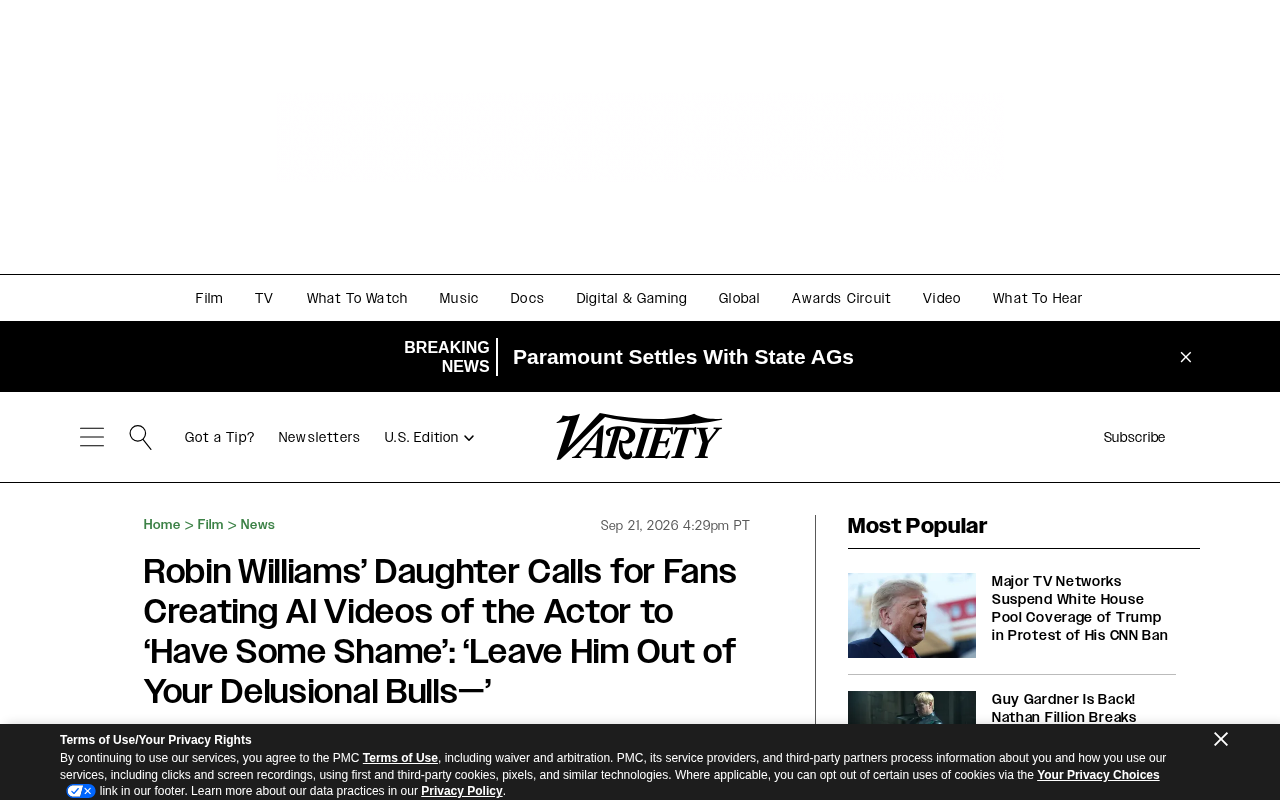
The daughter of late comedian Robin Williams has publicly called on fans to stop using AI to generate realistic videos of her father — reigniting debate over the ethics of using generative AI to recreate deceased individuals.
What Happened
Zelda Williams took to social media to address fans who have continued creating and sending her AI-generated videos of her father, saying simply: "Have Some Shame." She argued that these AI-generated clips fail to capture who her father truly was — and that rather than offering comfort, they represent a form of exploitation and disrespect toward the deceased.
For grieving families, watching a loved one be algorithmically "resurrected" into a stream of inauthentic images brings not solace, but ongoing psychological harm. Zelda's statement echoes the feelings of many families confronting AI misuse: the "digital ghost" conjured by technology reflects neither the wishes of the deceased nor the consent of those left behind.
The Ethical Minefield of AI and Deceased Individuals
As the barriers to text-to-video generation and deepfake technology have plummeted, anyone can now easily produce realistic simulations of public figures — including those who have passed away. This has given rise to a set of ethical and legal questions that remain far from resolved.
The most fundamental issue is consent. The deceased cannot voice their wishes, yet their likeness, voice, and performance style can be endlessly reconstructed and distributed. Robin Williams was famously protective of how his image was used commercially during his lifetime — reportedly placing restrictions on his likeness in his will. That stands in sharp contrast to the casual AI videos fans now generate at will.
There is also the matter of emotional harm. Even when creators act out of genuine admiration or tribute, the resulting content can feel like a reopened wound to the family. Good intentions do not neutralize the real consequences of misuse.
A note on the technology: Deepfakes originally referred to the use of deep learning algorithms — particularly Generative Adversarial Networks (GANs) — to superimpose one person's facial features onto another's video. In recent years, the rise of diffusion models and large multimodal models has dramatically lowered the barrier: what once required specialized computing resources and large datasets can now be accomplished by an ordinary user uploading a few photos and typing a text prompt. The technical safeguards protecting a deceased person's likeness have effectively disappeared — while the realism of generated content keeps improving, making it increasingly difficult for viewers to distinguish real from synthetic, and amplifying both the risk of deception and the emotional impact.
From an Individual Case to an Industry-Wide Challenge
This incident is far from isolated. In recent years, AI-simulated content featuring multiple deceased artists and actors has proliferated across social platforms, drawing fierce backlash from families and the broader industry. The Screen Actors Guild made the AI use of performers' digital likenesses a central issue in its recent labor negotiations.
The root problem is that existing legal frameworks have been left far behind by the pace of technological change. How publicity rights and performance rights are defined after death — who inherits them, and whether they can be enforced against AI-generated content — varies enormously by jurisdiction, with most laws lacking targeted provisions. Platforms, too, are largely reactive when it comes to content moderation, struggling to draw a clear line between "creative freedom" and "personal dignity."
On the legislative front: The United States offers a representative example of how policy is slowly catching up. Some states have enacted postmortem right of publicity laws, allowing heirs to assert rights over a deceased person's commercial likeness for a set period (typically 70 to 100 years). The federal NO FAKES Act, advanced in 2024, attempts to establish an authorization and accountability framework specifically for AI-generated realistic audio and video content. However, these laws remain vague on the distinction between non-commercial fan creations and commercial exploitation — and enforcement across platforms and national borders is extremely difficult, limiting the practical impact of even the most well-intentioned legislation.
Beyond Technological Capability
At its core, Zelda Williams' appeal is a reminder to society at large: just because technology makes something possible does not mean it should be done. Generative AI has granted ordinary people unprecedented creative power — but that power comes with commensurate responsibility.
Whether deceased individuals — people who can no longer speak for themselves — should be repeatedly "summoned" by algorithms is a question that creators, platforms, and lawmakers must grapple with together. In the absence of clear rules, perhaps the most basic baseline is exactly what Zelda articulated: out of respect for the deceased and those who loved them, exercise restraint over the "technological impulse."
This debate has no easy answers. But it marks a turning point — AI applications are moving beyond a phase of technical showmanship into a maturity that must confront the full weight of human ethics.
Related articles

Workbuddy for Absolute Beginners: How a Desktop AI Agent Fits Into Real Workflows
A beginner's guide to the Workbuddy desktop AI agent: installation, claiming credits, file management, and building automated workflows—compared with CodeX for fit and cost, helping professionals shift from AI question-askers to AI managers.

OpenAI's New Agent Stack: Computer Use, Decisions API, and Ultra-Fast Workflows
OpenAI Dev Day unveiled a new agent stack: Computer Use outperforms humans, Decisions API delivers ultra-low-latency classification via Luna, Agents API opens the same Computer Use capabilities, and GPT-6.1 Sol costs only one-seventh of Astra. Core updates, benchmark data, and developer insights.

Liang Wenfeng Open-Sources DeepInfo Inference Framework, Takes On U.S. Ban
DeepSeek open-sources its DeepInfo inference framework after its models, featuring GPU/CPU cross-pipelining, small-model prediction with large-model verification, and full Huawei Ascend and NVIDIA chip support—facing the U.S. federal ban head-on. This article analyzes its significance for AI deployment and open-source strategy.