RoboRSI: A Robot Self-Evolution System with Stable Skill Reuse in Complex Real-World Environments

RoboRSI uses hierarchical skill refinement and multi-role collaboration to help robots organize experience, reuse skills, and continuously self-improve.
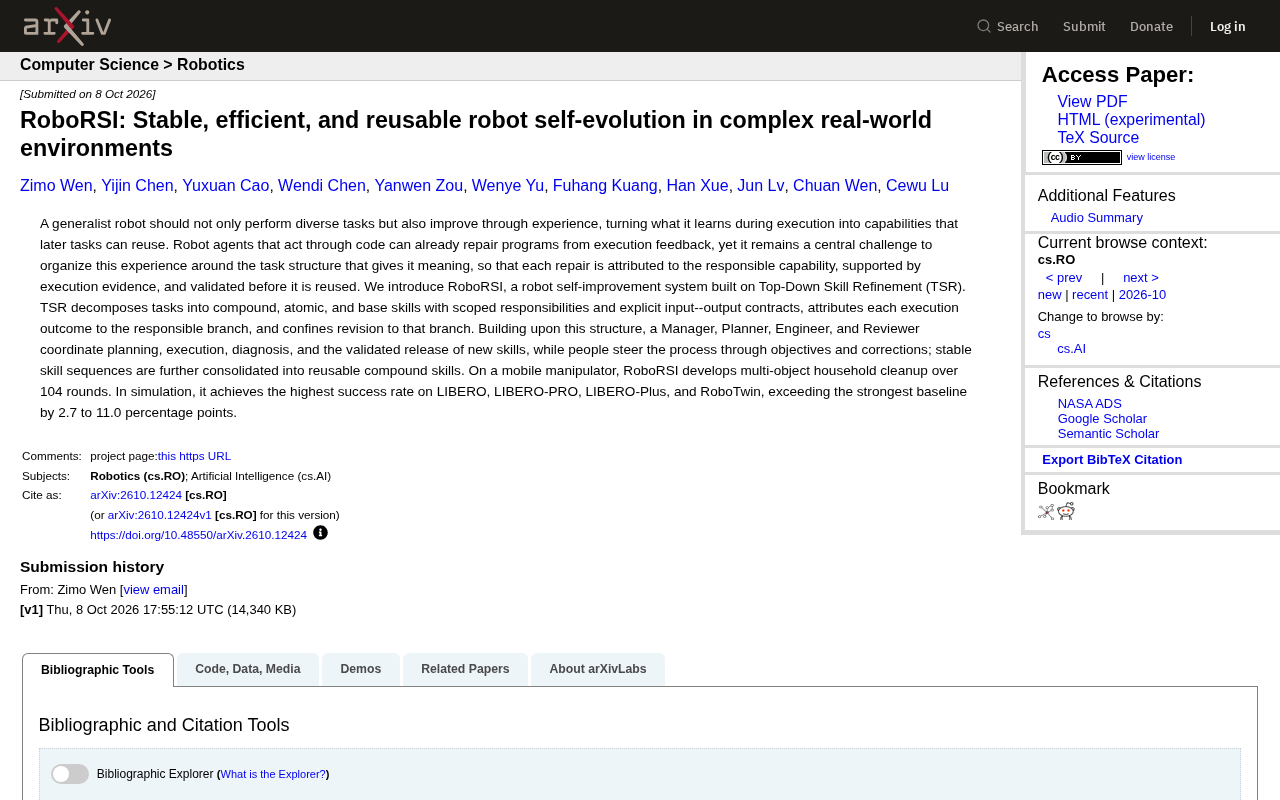
RoboRSI is a system for general-purpose robot self-evolution centered on Top-Down Skill Refinement (TSR): it decomposes tasks into composite, atomic, and primitive skills with clear responsibility scopes and input-output contracts, enabling precise attribution of execution results and localized revisions. With Manager, Planner, Engineer, and Reviewer roles collaborating and humans guiding via goals and corrections, it developed multi-object household cleanup in 104 iterations on a mobile manipulation platform and surpassed the strongest baseline by 2.7-11.0 percentage points on LIBERO, LIBERO-PRO, LIBERO-Plus, and RoboTwin.
The Core Challenge of Robot Self-Evolution
A general-purpose robot should not only perform diverse tasks but also improve its capabilities through experience, turning knowledge learned during execution into skills that can be reused in subsequent tasks. Today, code-as-policy robot agents can already repair programs based on execution feedback, but how to organize this experience around task structure—so that each repair can be attributed to the corresponding capability branch, supported by execution evidence, and verified before reuse—remains a core challenge.
According to the research team, they propose RoboRSI—a robot self-improvement system based on Top-Down Skill Refinement (TSR). The system is designed to address the key problems of experience organization and skill reuse.
Code-as-Policy robot agents are a paradigm in which robots complete tasks by writing and executing programs: the robot agent generates a piece of code (for example, calling primitives such as grasp, move, and place), executes it in a real or simulated environment, and then modifies the code based on observed success or failure feedback. Compared with directly outputting low-level action sequences, this approach offers greater interpretability and reusability, because the program structure itself carries information about the task's logical decomposition. Representative works such as Code-as-Policies and Voyager all let agents improve gradually through a "generate—execute—feedback—repair" loop. However, such methods typically treat the entire program as an indivisible whole to be repaired, lacking explicit modeling of the task's internal structure, which makes it difficult to determine which sub-capability went wrong and whether a repair will affect other capabilities. This is precisely the key gap that RoboRSI attempts to address.
TSR: Hierarchical Skills and Responsibility Attribution
TSR decomposes tasks into composite skills, atomic skills, and primitive skills, where each layer of skill has a clear scope of responsibility and explicit input-output contracts. When an execution result occurs, the system can attribute the result to the responsible branch and restrict revisions to that branch. This structured approach ensures that experience can be effectively organized and reused.
Specifically, each skill has clear boundaries, avoiding the problems of chaotic, hard-to-track experience found in traditional methods. By decomposing tasks into a hierarchical structure, robots can more precisely locate where the problem lies and make targeted improvements.
Skill layering and contract-based interfaces draw on the modular design philosophy of software engineering. In traditional robot systems, skills are often flat and tightly coupled, so the failure of one action may implicate multiple modules, making debugging difficult. TSR's hierarchical structure gives each layer of skill a clear input-output contract: upper-layer skills depend only on the interfaces of lower-layer skills and do not care about their internal implementation. In this way, when an execution fails, the system can trace down the call chain from top to bottom to the branch most likely responsible, modify only that branch, and keep the rest unchanged. This mechanism of "local revision, global stability" avoids catastrophic forgetting and also makes the repair process traceable and verifiable, providing structural guarantees for the subsequent reuse and composition of skills.
Multi-Role Collaboration and Human Guidance
On top of the TSR structure, RoboRSI completes planning, execution, diagnosis, and the verified release of new skills through the collaboration of four roles: Manager, Planner, Engineer, and Reviewer.
Humans guide the entire process through goals and corrections, ensuring that the system evolves in the right direction. Stable skill sequences are further consolidated into reusable composite skills, thereby improving the efficiency of subsequent task execution. This multi-role collaboration mechanism simulates the development workflow of a human team, improving the system's reliability and interpretability.
Performance in the Real World and Simulated Environments
On a mobile manipulation robot platform, RoboRSI developed multi-object household cleanup capability through 104 rounds of iteration. This result demonstrates the system's stability and efficiency in complex real-world environments.
In simulated environments, RoboRSI achieved the highest success rates on benchmarks including LIBERO, LIBERO-PRO, LIBERO-Plus, and RoboTwin, surpassing the strongest baseline by 2.7 to 11.0 percentage points. These results validate the system's generalization ability across different tasks and environments.
The LIBERO series mentioned in the article is a widely used manipulation benchmark in the robot learning field, containing a large number of language-conditioned long-horizon manipulation tasks used to evaluate a policy's generalization and continual learning ability; LIBERO-PRO and LIBERO-Plus are extended versions that strengthen task difficulty, disturbance robustness, or task diversity, respectively. RoboTwin is a simulation benchmark for dual-arm collaborative manipulation, emphasizing two-hand coordination and fine manipulation. Such benchmarks usually use task success rate as the core metric and distinguish between "seen tasks" and "unseen tasks" to examine generalization. RoboRSI achieving the highest success rates on these benchmarks shows that its skill organization method is not only applicable to a single scenario but can also transfer across tasks and environments, which is important evidence for evaluating whether a self-improvement system is truly "general."
Significance and Outlook
RoboRSI offers a new approach to robot self-evolution: through structured skill decomposition and multi-role collaboration, robots can accumulate and reuse experience more efficiently. As the technology develops further, this kind of self-improvement system is expected to play an important role in fields such as home services and industrial automation, advancing the practical application of general-purpose robots.
In the future, the research team may further explore how to extend RoboRSI to more types of tasks and environments, and how to reduce dependence on human guidance to achieve a higher degree of autonomous evolution.
One-line Summary
RoboRSI uses hierarchical skill refinement and multi-role collaboration to help robots organize experience, reuse skills, and continuously self-improve.
Paragraph Summary
RoboRSI is a system for general-purpose robot self-evolution, centered on Top-Down Skill Refinement (TSR): it decomposes tasks into composite, atomic, and primitive skills, each with a clear scope of responsibility and input-output contracts, so that execution results can be precisely attributed to a specific branch and revisions can be limited to that branch. On this structure, the four roles of Manager, Planner, Engineer, and Reviewer collaborate on planning, execution, diagnosis, and verified release, with humans guiding through goals and corrections. On a mobile manipulation platform, the system developed multi-object household cleanup capability through 104 rounds of iteration; on simulation benchmarks such as LIBERO, LIBERO-PRO, LIBERO-Plus, and RoboTwin, its success rate exceeded the strongest baseline by 2.7 to 11.0 percentage points. Stable skill sequences can also be consolidated into reusable composite skills, improving the efficiency of subsequent tasks.
Related articles

Chain of Thought Isn't Just for AI: How Humans Can Use CoT to Improve Thinking Quality
Chain of Thought isn't just a prompt trick for large models. Starting from a Hacker News discussion, this article analyzes why CoT works for human thinking too, breaks down actionable ways to transfer it, and highlights the key differences between human CoT and machine CoT.
Cloudflare Teams Up with OpenAI: Closi…
Cloudflare Teams Up with OpenAI: Closing the Loop from Vulnerability Discovery to Defense with AI
Cloudflare uses OpenAI Daybreak to investigate security vulnerabilities and generate reviewable remediation plans, while developers use Codex to boost coding efficiency and quality.

Orca Multi-Agent Orchestration in Practice: A Guide to Parallel Collaboration with Claude and Codex
Orca is Stable AI's free open-source agent workbench supporting 34 agents like Claude Code and Codex in parallel. Learn its Git worktree isolation, multi-model orchestration, and mobile management.