ROCm Fixes AITER-Tuned GEMM Large-Scale Matrix Overflow Issue on gfx950

vLLM fixes integer overflow risk in AITER-tuned GEMM on gfx950 when M*N≥2^31, using a conditional fallback to ensure correctness.
vLLM v0.33.0rc2 includes a bugfix from an AMD engineer addressing a potential 32-bit integer overflow in AITER-tuned GEMM on gfx950 when the total matrix elements M*N reach 2^31. The fix detects the threshold and skips the tuned path, falling back to the generic GEMM implementation, trading performance for correctness. The article analyzes AITER's role in the ROCm ecosystem, the reasons for binding the threshold to hardware, the performance cost of the fallback, and notes the fix was cherry-picked from mainline to the release branch. For large model inference deployment, it reminds teams to upgrade versions, establish large-size boundary tests, and systematically review index-width assumptions in operator libraries.
Why an Unassuming Edge Case Deserves Attention
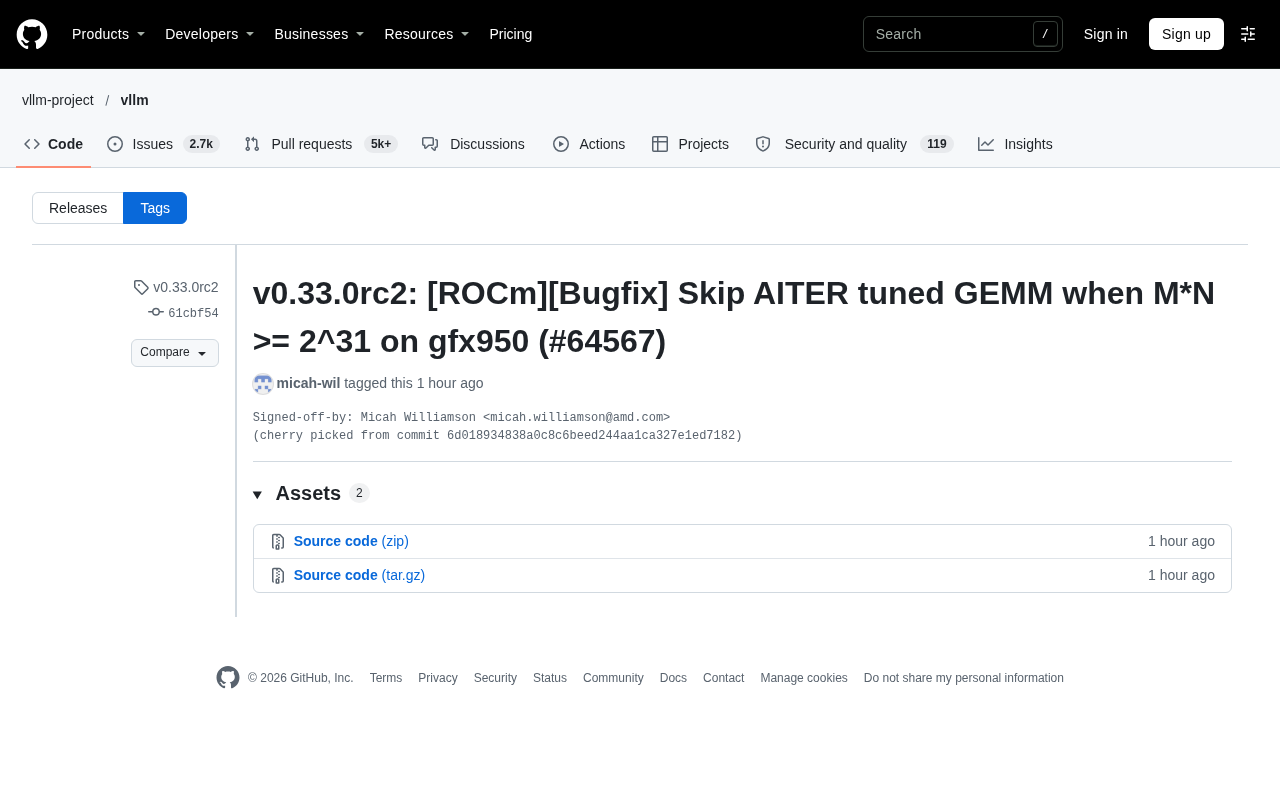
In GPU operator optimization, GEMM (general matrix multiplication) performance tuning usually focuses on tiling strategies, pipeline depth, and memory access patterns. But when matrix sizes cross a certain threshold, the tuning code itself can become a correctness liability. The recently released vLLM v0.33.0rc2 includes a bugfix commit (#64567) from AMD engineer Micah Williamson targeting exactly this problem: on the gfx950 architecture, when M*N for a matrix multiplication is greater than or equal to 2^31, the AITER-tuned GEMM path is skipped.
On the surface, this change is just a single conditional check, but it reflects the engineering challenges posed by the explosion of matrix sizes in large model inference. 2^31 is the boundary of a 32-bit signed integer. Once the total number of elements crosses it, index calculations, offsets, or address arithmetic for internal buffers can overflow, leading to incorrect results or even illegal memory access.
The Role of AITER-Tuned GEMM in the ROCm Ecosystem
AITER is an operator tuning component introduced by AMD for the ROCm platform. Its core idea is to precompile or automatically search for high-performance kernel configurations for specific hardware architectures. For newer GPU architectures like gfx950, AITER can select implementations that better match hardware characteristics based on matrix shape, often delivering substantial throughput gains.
The problem is that tuning paths often assume input sizes fall within a reasonable range. When the product of M and N approaches or exceeds 2^31, if the kernel internally uses 32-bit integers for linear indexing, negative values or wraparound can occur, leading to access to incorrect memory regions. Such bugs are highly insidious: small-scale tests all pass, and only real inference workloads with large batches, long sequences, or very large vocabularies expose them.
According to the commit message, this fix was cherry-picked from upstream commit 6d018934838a0c8c6beed244aa1ca327e1ed7182, indicating the issue had already been verified on the mainline before being backported to the v0.33.0rc2 release branch to ensure the stability of the RC version.
ROCm is AMD's open-source GPU computing platform, positioned as a counterpart to NVIDIA's CUDA ecosystem. It includes compilers, runtimes, math libraries, and tuning tools, and supports mainstream frameworks like PyTorch and TensorFlow on AMD GPUs. AITER (AI Tensor Engine for ROCm) is its operator tuning layer, which generates or precompiles high-performance kernels for specific GPU architectures (such as gfx950) to compensate for the performance shortcomings of generic implementations on new hardware. gfx950 is a GPU core codename in AMD's CDNA architecture, commonly found in MI300 series accelerators, with compute units and memory subsystems optimized for matrix operations. Understanding this ecosystem background helps clarify that AITER-tuned GEMM is not a general-purpose library but a performance acceleration component deeply tied to hardware characteristics, so its internal implementation may carry architecture-specific indexing assumptions.
Fix Strategy: Trading Correctness for Conditional Fallback
The patch's approach is quite direct: on gfx950, it checks whether M*N reaches the 2^31 threshold, and if so, bypasses the AITER-tuned GEMM implementation and falls back to the generic path. This trade-off of "performance giving way to correctness" is standard practice in low-level operator development: better to sacrifice some throughput than to let large-scale inference silently produce wrong results.
From an engineering perspective, this fix has several noteworthy points.
Threshold Selection and Hardware Binding
2^31 is not an arbitrary number; it corresponds to the positive upper limit of a 32-bit signed integer. Tying the check to the gfx950 architecture suggests the issue may be related to specific instructions of that architecture or to the kernel implementations AITER generates for it, rather than being universal across all ROCm devices. This also reminds users of other AMD GPUs that they cannot simply apply this conclusion.
A 32-bit signed integer (int32) ranges from -2^31 to 2^31-1, about 2.147 billion in total. In GPU kernels, linear indexing often uses int32 to save register space and speed up address calculations. When the total number of matrix elements M*N reaches 2^31, the maximum index value exactly crosses the int32 positive upper limit, wrapping to a negative number and causing out-of-bounds access or incorrect computation. Using 64-bit integers (int64) avoids overflow but increases register pressure and address calculation overhead, so tuned kernels often prefer int32 and assume sizes are within safe limits. This trade-off is common in performance-sensitive scenarios but also plants hidden correctness risks for large-scale inputs.
Performance Cost of the Fallback Path
Skipping the tuned GEMM means these very large matrices go through the default implementation, which may perform worse than specially tuned kernels. But for sizes that trigger the threshold, completing the computation correctly clearly takes priority over peak performance. In actual deployment, if workloads do frequently produce GEMMs with M*N exceeding 2^31, it is necessary to evaluate the throughput loss from the fallback and watch for a more fundamental fix (for example, a tuned kernel using 64-bit indexing).
Cherry-pick is a common operation in version control, referring to copying a specific commit from one branch to another. In open-source release workflows, after an RC (Release Candidate) version is frozen, bugfixes found on the mainline that are deemed critical are backported to the release branch via cherry-pick, avoiding the reintroduction of other unverified changes. This mechanism ensures the stability of the RC version while ensuring that fixed issues are not left out of the official release. vLLM adopting this process indicates that the bugfix has passed testing on the mainline, and the backport reduces regression risk for the release branch.
Implications for Large Model Inference Deployment
Although this commit changes only a small amount of code, it has practical reference value for teams running large model services on AMD platforms.
First, upgrading to v0.33.0rc2 or an official release containing this fix can avoid potential correctness issues with very large GEMMs on gfx950. Second, it reminds us that beyond performance tuning, we need to establish boundary test cases for large-size inputs, especially for kernels involving 32-bit indexing. Third, when choosing a tuning path for an operator library, you need to confirm its coverage of large-scale shapes rather than looking only at small- and medium-scale benchmark numbers.
From a broader perspective, as context windows and batch sizes continue to grow, scenarios where M*N crosses 2^31 will become increasingly common. Such boundary bugs may occur more frequently, and operator developers need to systematically examine assumptions about index width rather than patching them one by one.
Summary
This ROCm bugfix in v0.33.0rc2 uses a conditional fallback to resolve the correctness risk of AITER-tuned GEMM on gfx950 when M*N≥2^31. It reminds us that in the pursuit of GEMM performance, classic problems like integer overflow still lurk in tuning code, and large-scale inference workloads are the litmus test that exposes them.
Related articles

Cursor Launches Agent SDK: Letting Teams Build Custom AI Agents
Cursor launches the Agent SDK, enabling teams to build and continuously refine custom AI agents for their own workflows instead of relying on preset solutions. This article examines its positioning, impact on AI coding workflows, and practical considerations.

Anthropic Initiates IPO: AI Giant Goes Public and Industry Shakeup
Anthropic files S-1 to start IPO process, community discussion exceeds 1,600 likes; alongside three new fundamental science discoveries, Microsoft offers buyouts to about a quarter of its employees, and Sebastian Raschka releases a course on building reasoning models from scratch. A roundup of the latest AI industry developments.

Orca in Action: One Prompt Pits Claude Code Against Cursor
Hands-on test of the open-source Orca tool based on a YouTube tutorial: one prompt lets Claude Code and Cursor Agent develop the same feature in separate Git worktrees, then manually review diffs and merge the best. Includes installation, UI tour, usage tracking, and bypass permissions safety tips.