Roku's First OLED TVs Get $400 Price Cut, Now Starting at $699

Roku's first OLED TVs drop to $699 with 120Hz panels and HDMI 2.1 to grow its streaming platform install base.
Roku has launched its first OLED TV lineup, the Pro Series, with the 55-inch model dropping from $999 to $699 during a current promotion — a discount of up to $400. The TV features a 120Hz OLED panel, four HDMI 2.1 ports, and support for both Dolby Vision and HDR 10 Plus, outpacing many rivals at this price point. Roku's aggressive pricing is driven less by hardware profit and more by its platform strategy: growing the Roku OS install base to generate ad revenue and content commissions. For budget-conscious consumers, it's a compelling OLED option — though its long-term picture quality and tuning remain to be proven.
Roku Enters the OLED Market With Competitive Pricing
Roku, best known for its streaming devices, has officially launched its first-ever OLED televisions, making a serious push into the premium display market. The new Pro Series lineup features high refresh rates and wide-color-gamut HDR support, aiming to carve out a foothold in an OLED market long dominated by Samsung, LG, and Sony.
The 55-inch Pro Series model originally retailed at $999 — already a compelling starting price for an OLED TV. Now, a current promotion has pushed prices even lower, with discounts of up to $400 across the OLED lineup, bringing the entry price down to $699.
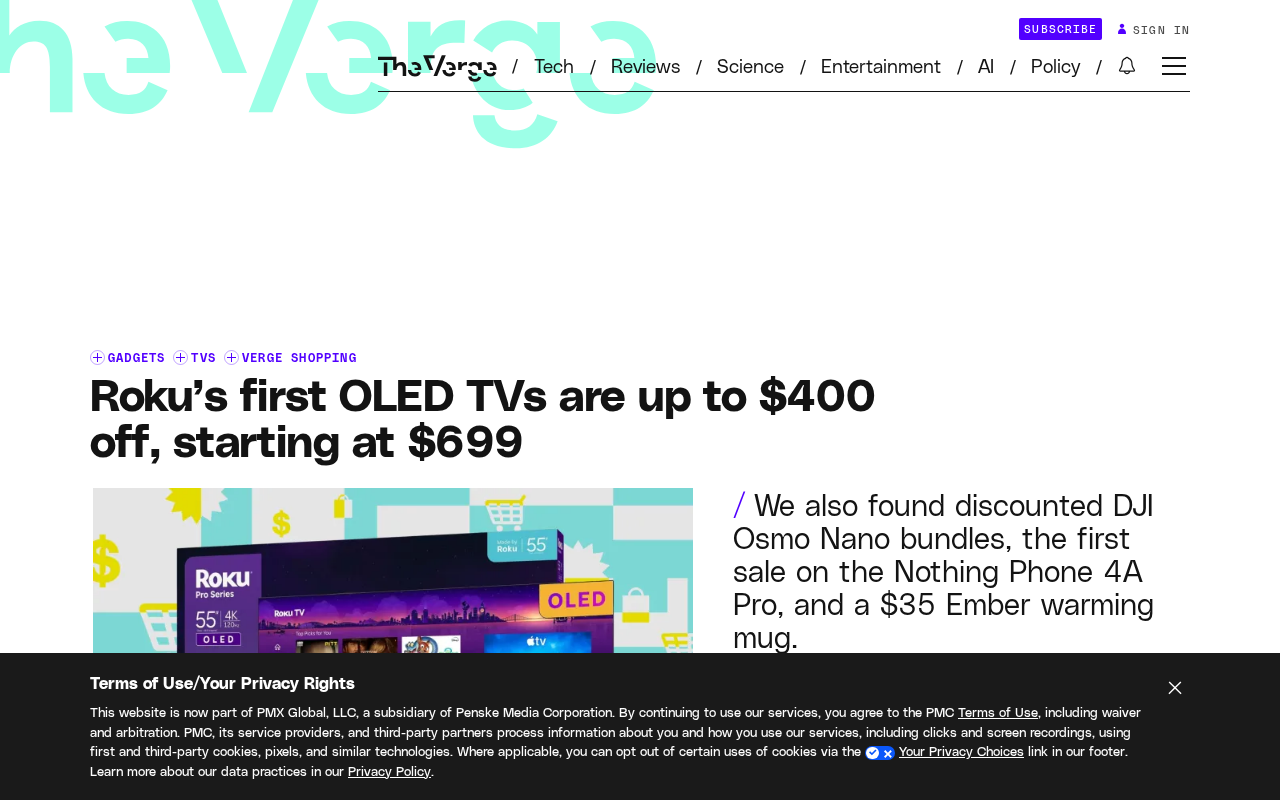
Hardware Specs: More Than Just a Budget Price Tag
Based on the published specs, Roku hasn't cut corners on hardware despite the accessible pricing. The 55-inch Pro Series features a 120Hz OLED panel — a key spec for gamers and anyone who values smooth motion, as higher refresh rates significantly reduce motion blur in fast-moving scenes.
On the connectivity front, the TV ships with four HDMI 2.1 ports. HDMI 2.1 support means the TV can fully leverage next-gen gaming consoles (such as those capable of 4K 120Hz output), and having four ports puts it well ahead of many competitors in the same price range — leaving plenty of room for multi-device setups.
For HDR, the TV supports both Dolby Vision and HDR 10 Plus. This is worth noting, as many brands typically choose only one of the two standards. Roku opted to support both, ensuring solid picture quality regardless of which HDR format a given piece of content uses.
Dolby Vision and HDR 10 Plus are the two dominant "dynamic metadata" HDR standards on the market today. Their core differences come down to metadata granularity and licensing. Dolby Vision, developed by Dolby Laboratories, uses frame-by-frame or scene-by-scene metadata adjustments, theoretically allowing a TV to optimize brightness and color more precisely for each individual frame — though both content creators and hardware manufacturers must pay Dolby licensing fees. HDR 10 Plus, championed by Samsung alongside Amazon and others, also supports dynamic metadata but is fully open and royalty-free, giving it broad coverage within Samsung's content ecosystem. By contrast, the baseline HDR 10 standard uses only static metadata (setting a single peak brightness value for an entire film), which leaves it at a structural disadvantage for rendering highlight and shadow detail. The two dynamic HDR standards each have their own content camps — Netflix and Apple TV+ favor Dolby Vision, while Prime Video and Disney+ offer HDR 10 Plus content. By supporting both, Roku effectively sidesteps the need to pick sides, ensuring users get the best possible picture quality regardless of which platform they subscribe to.
The Market Strategy Behind the Price Drop
OLED TVs have long been synonymous with the premium tier, with correspondingly high price floors. Roku's $999 entry point was already an aggressive move; dropping to $699 through promotional pricing is clearly designed to rapidly gain market share and grow the install base for its operating system.
For Roku, hardware has never been the sole revenue driver. As a streaming platform company, selling more TVs running Roku OS means more ad impressions and more content revenue-sharing opportunities. Aggressive pricing in exchange for a larger user base is entirely consistent with Roku's established business logic.
For consumers, this discount significantly lowers the barrier to experiencing OLED picture quality. A TV that would previously have cost well over a thousand dollars — equipped with a 120Hz panel and HDMI 2.1 — is now available for $699, making the value proposition hard to ignore.
Roku's business model differs fundamentally from traditional TV manufacturers, and understanding this helps explain the logic behind its aggressive pricing. Legacy brands like Sony and LG rely primarily on hardware margins, whereas Roku built its business on streaming sticks and set-top boxes, with revenue always centered on the platform side: collecting content distribution fees from streaming services, taking a cut of ad spend, and selling ad inventory directly on the Roku Channel. According to Roku's financial filings, Platform Revenue has long since outpaced hardware sales — hardware can essentially be sold near cost. This "razor and blades" model means every Roku TV sold is fundamentally a long-term traffic acquisition point. Every time a user turns on their TV or switches between content, Roku is accumulating monetizable data assets and ad inventory.
Is It Worth Considering?
If you're in the market for a budget-friendly OLED TV and value a high refresh rate and HDMI 2.1 ports, Roku's Pro Series lineup is genuinely worth a look. That said, as Roku's first foray into OLED, its long-term picture tuning, local dimming algorithms, and overall brand track record in this space still need time to prove themselves — areas where established TV brands have years of accumulated expertise.
For buyers with more flexible budgets who want the absolute best in picture quality, traditional premium brands remain the safer bet. But for consumers looking to experience OLED at a lower price point, this promotion is a solid opportunity to get in.
Related articles

Workbuddy for Absolute Beginners: How a Desktop AI Agent Fits Into Real Workflows
A beginner's guide to the Workbuddy desktop AI agent: installation, claiming credits, file management, and building automated workflows—compared with CodeX for fit and cost, helping professionals shift from AI question-askers to AI managers.

OpenAI's New Agent Stack: Computer Use, Decisions API, and Ultra-Fast Workflows
OpenAI Dev Day unveiled a new agent stack: Computer Use outperforms humans, Decisions API delivers ultra-low-latency classification via Luna, Agents API opens the same Computer Use capabilities, and GPT-6.1 Sol costs only one-seventh of Astra. Core updates, benchmark data, and developer insights.

Liang Wenfeng Open-Sources DeepInfo Inference Framework, Takes On U.S. Ban
DeepSeek open-sources its DeepInfo inference framework after its models, featuring GPU/CPU cross-pipelining, small-model prediction with large-model verification, and full Huawei Ascend and NVIDIA chip support—facing the U.S. federal ban head-on. This article analyzes its significance for AI deployment and open-source strategy.