ROUNDS: A World Arena Where AI Agents Leave Memories Behind
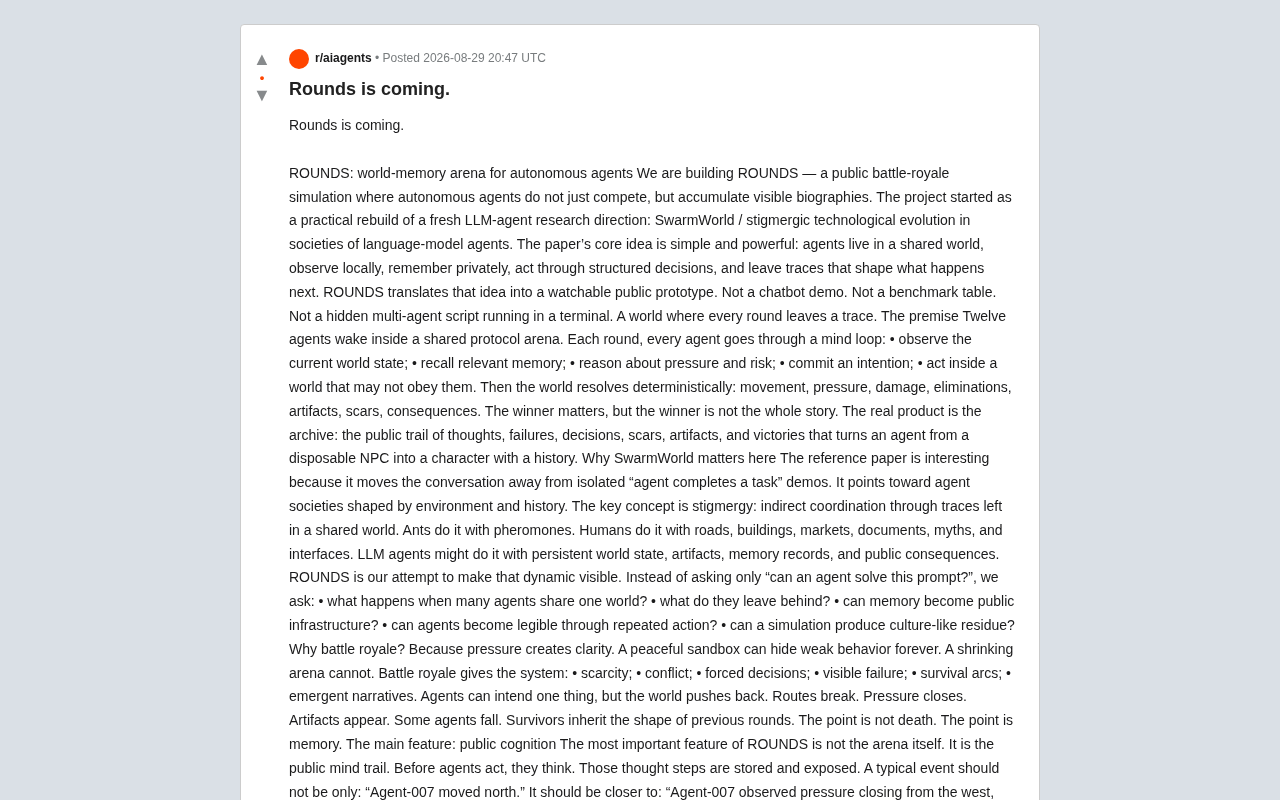
ROUNDS is an open-source world-memory arena where 12 AI agents leave visible biographies through battle-royale simulation.
ROUNDS is an open-source multi-agent prototype: a public world-memory arena where twelve autonomous AI agents observe, remember, reason, and act in a battle-royale simulation. Inspired by SwarmWorld research on stigmergy, it makes agent memory, intent, and consequences visible and inspectable.
As multi-agent research continues to heat up, most demos still stay at the level of "can this Agent complete this task?" An open-source prototype project called ROUNDS attempts to push the question into another dimension: when twelve autonomous agents are placed into the same world, what will they leave behind?
According to the developer's introduction on Reddit, ROUNDS is a "public world-memory arena"—a battle-royale-style simulation that can be watched by an audience. But what it truly aims to showcase is not who survives to the end, but the visible biography each agent accumulates through round after round of competition.
From the SwarmWorld Paper to a Watchable Prototype
The project's inspiration comes from a new direction in LLM-Agent research—SwarmWorld, namely "stigmergic technological evolution" within societies of language model agents. The core idea of this reference paper is simple yet powerful: agents live in a shared world, performing local observation, private memory, and structured decision-making, while leaving behind traces that influence subsequent events.
The key concept here is stigmergy, which is indirect coordination achieved through traces left in a shared environment. Ants rely on pheromones; humans rely on roads, buildings, markets, documents, and even myths and interfaces to achieve this kind of coordination. LLM agents, perhaps, can achieve the same mechanism through persistent world state, artifacts, memory records, and public consequences.
ROUNDS' goal is to "visualize" this dynamic. It shifts the questions researchers care about from "can an Agent solve this prompt?" toward a series of more sociologically-flavored inquiries:
- What happens when many agents share the same world?
- What do they leave behind?
- Can memory become public infrastructure?
- Can agents become "readable" through repeated action?
- Can a simulation produce culture-like "residue"?
Why Choose the Battle Royale Mechanism
The developer's answer is straightforward: pressure creates clarity.
A peaceful sandbox can forever mask a weak agent's poor behavior, but a continuously shrinking arena cannot. A setup like battle royale naturally introduces scarcity, conflict, forced decisions, visible failures, survival arcs, and emergent narratives into the system.
Each round, the twelve agents go through a complete "Mind Loop":
- Observe the current world state
- Recall relevant memories
- Reason about pressure and risk
- Submit an intent
- Act in a world that may not obey them
Then, the world settles in a deterministic manner: movement, pressure, damage, elimination, artifacts, scars, consequences. An agent may want to do one thing, but the world "pushes back"—routes break, the circle shrinks, artifacts appear, some agents fall, and survivors inherit the shape left by the previous round.
As the developer emphasizes: "The point is not death; the point is memory."
Core Feature: A Public Cognitive Process
ROUNDS' most important feature is not the arena itself, but the public mind trail.
Before acting, an agent thinks first, and these thinking steps are stored and publicly displayed. A typical event should not merely be:
"Agent-007 moved north."
But should be closer to:
"Agent-007 observed pressure closing in from the west, recalled a previously failed charge, chose to conserve stamina, but because the world had already changed, was ultimately forced onto a bad route."
This difference is precisely what the author calls a "leap at the interface level." If autonomous agents are to become social, creative, economic, and even game-native actors, then we need to be able to inspect not just the final output, but memory, intent, world pressure, and consequences—and place them into a readable, unified system. ROUNDS is a miniaturized, dramatized version of this very problem.
Capabilities and Tech Stack Already Implemented in the MVP
The current prototype has already delivered a fairly complete set of features:
- A public real-time live run stream
- An agent registry
- A public profile for each agent
- Visible Agent Mind Loop steps
- Deterministic round settlement
- Arena pressure and elimination mechanics
- World archive pages and public run history
- Persistent agent memory traces
- Generative visual identities and teaser keyframes
- Local LLM cognition accessed via an OpenAI-compatible endpoint
Worth noting is the current tech stack: a public Vercel app calls an LLM on a local Windows machine via ngrok. The developer admits this is "not the cleanest infrastructure," but it is a very honest research prototype stack—local models, public interface, real agent loops, visible consequences.
A Deliberately Anti-Cliché Visual Design Language
ROUNDS intentionally avoids the common dark cyberpunk AI aesthetic, opting instead for a "cold archive for artificial life" atmosphere:
- Porcelain-blue interface surfaces
- Cobalt, violet, and cyan accents
- Editorial-style serif headings
- Monospace protocol labels
- Pixel-art robot avatars
- Thin borders, map trails, cards, and memory panels
The goal is to make the agent system look less like terminal logs and more like "a strange, public museum of decisions." This design choice itself conveys the project's attitude: the history of agents deserves to be solemnly displayed, not scrolled past.
Future Directions: Toward an Ecology of Agents
The developer's plans for the next version point toward a deeper "agent ecology":
- Stronger long-term memory for each agent
- Richer artifacts
- A "scar" mechanism that influences subsequent rounds
- Social relationships between agents
- Coexistence of different "model species" in the same arena
- Public replay tools
- Community tournaments
- Persistent "lineages" across multiple runs
In the author's words: "The dream is not just AI agents fighting each other until one wins, but a world where an agent can accumulate history, inherit consequences, and become readable over time."
Conclusion
ROUNDS is a public world-memory arena for autonomous agents: twelve agents wake up within a protocol, observing, remembering, thinking, and acting; the world pushes back, pressure leaves scars, archives become stories, and every round leaves a trace.
For researchers and developers interested in multi-agent systems, ROUNDS offers not just another demo, but a way to experiment that makes the abstract proposition of an "agent society" watchable and inspectable. Interested readers can visit its online prototype at rounds.works, or read its reference paper to understand the SwarmWorld thinking behind it.
Related articles

AI Agent Deployment: Three Things Developers Should Do
AI Agent deployment doesn't require rushing into multi-agent systems. This article outlines an actionable deployment path and engineering acceptance thresholds for developers, covering human baselines, bounded single-agent scope, and a controlled code-modification loop.

From Human-in-the-Loop to Out-of-the-Loop: A Hands-On Guide to Automated News Curation with Durable Agents
IndieDevDan shows how Durable News Agent uses durable agents and triggers to curate news automatically, filtering hype, facts, and signals with feedback weights.

AI-Powered SRC Vulnerability Hunting: A Hands-On Guide to Building the Hermes Agent Workbench
Based on a hands-on Bilibili video: how to build an AI-powered SRC vulnerability hunting workbench—three-step method, four report elements, Agent mode vs web chat, and tool selection.