AI-Powered SRC Vulnerability Hunting: A Hands-On Guide to Building the Hermes Agent Workbench

A Bilibili creator demonstrates building an AI Agent workbench for SRC vulnerability hunting—the framework stays, tools change, humans remain in the loop.
Compiled from a Bilibili creator's hands-on video on AI-automated SRC vulnerability hunting, this article argues that the traditional three-step method (understand the target, discover the vulnerability, produce a report) and the four report elements (URL, reproduction steps, impact description, remediation recommendations) remain unchanged; AI should imitate security professionals' thinking rather than bypass the framework. It compares web Q&A with AI Agent mode, favoring the Agent's full task execution for process-driven hunting, and analyzes tool trade-offs: Claude Code's account ban risks, OpenClaw-type products' lifecycle issues, and Hermes Agent's relative token savings. Security Skills essentially codify expert experience into Agent-executable modules, and testing in a cyber range first is essential—fully hands-off operation is not yet realistic.
Title
AI-Powered SRC Vulnerability Hunting: A Hands-On Guide to Building the Hermes Agent Workbench
Meta Description
Based on a hands-on Bilibili video, this article breaks down the approach to building an AI-powered SRC vulnerability hunting workbench: how the traditional three-step method and four report elements constrain AI Agents, the difference between web interaction and Agent mode, tool selection among Hermes Agent, Claude Code, Codex, and more, plus the design logic behind security Skill modules.
Article Content
A hot topic has been circulating in cybersecurity circles lately: can AI automatically hunt for SRC vulnerabilities? A Bilibili creator did a complete hands-on walkthrough, starting from the underlying logic of traditional vulnerability hunting all the way to building an automated workbench with an AI Agent. This article distills the core ideas and key judgments from the video for security practitioners who want to try AI-assisted vulnerability hunting.
The Underlying Framework of Traditional Vulnerability Hunting—AI Must Follow It Too
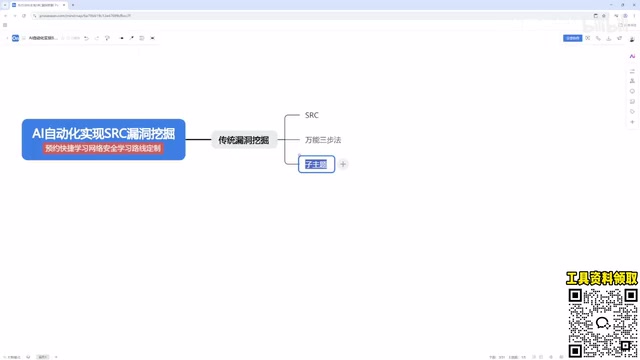
At the start of the video, the creator repeatedly emphasizes one point: whether you use traditional methods or AI, the "universal three-step method" of vulnerability hunting and the "four elements" of a vulnerability report never go away.
The so-called universal three-step method is the basic path of SRC vulnerability hunting—understand the target, discover the vulnerability, produce a report. The four elements of a vulnerability report include the URL, reproduction steps, impact description, and remediation recommendations. These two frameworks are the underlying logic that cybersecurity professionals use for vulnerability hunting; what AI needs to do is imitate this logic, not bypass it.
This judgment deserves attention. When discussing AI automation, many people tend to focus on the tools themselves and overlook the fact that the professional framework of security work is the core. The value of an AI Agent lies in execution efficiency, but it needs to be constrained within the correct hunting methodology and reporting standards. The creator states explicitly that you must understand this point: let AI imitate the thinking of cybersecurity professionals when doing vulnerability hunting.
SRC (Security Response Center) is the security emergency response center established by major internet companies, responsible for receiving vulnerability reports submitted by external security researchers and providing rewards. Vulnerability hunters typically work around the SRC's scope and rating standards, so "understanding the target" is not just technical information gathering—it also means figuring out the target SRC's rules, asset scope, and scoring system. This is similar to how public bug bounty platforms (such as HackerOne) operate, but domestic SRCs are mostly built in-house by enterprises with widely varying rules, and their requirements for report format and reproduction details tend to be stricter—which is exactly why the "four report elements" are especially important in practice.
Web Interaction vs. AI Agent: The Real Gap Between Two Approaches
The video divides how AI is used into two categories and gives a clear judgment on applicability.
The first is direct web interaction. You open a site like DeepSeek, Kimi, or Zhipu Qingyan and have a back-and-forth conversation. This approach was not very convenient for vulnerability hunting in the early days. The creator notes that although it is usable now, it is essentially still a question-and-answer rhythm, which is limited in efficiency for scenarios like vulnerability hunting that require continuous execution of multi-step tasks. However, he also mentions that products like "Qianwen 3.8max" (phonetic) have added some skill capabilities on the web side, which counts as a compromise.
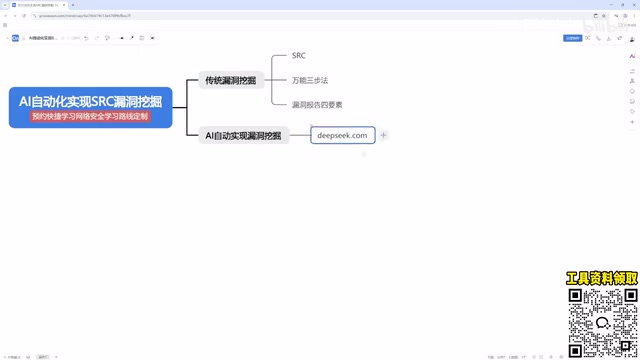
The second is the AI Agent approach. You give it a task, and the Agent runs it from start to finish, with or without intervention in the middle. This mode suits process-oriented tasks like vulnerability hunting, and it is the approach used in this hands-on session.
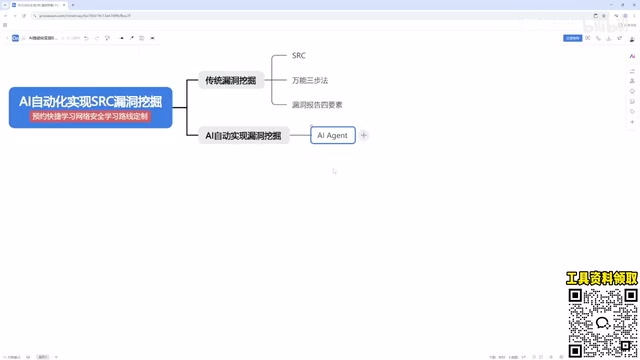
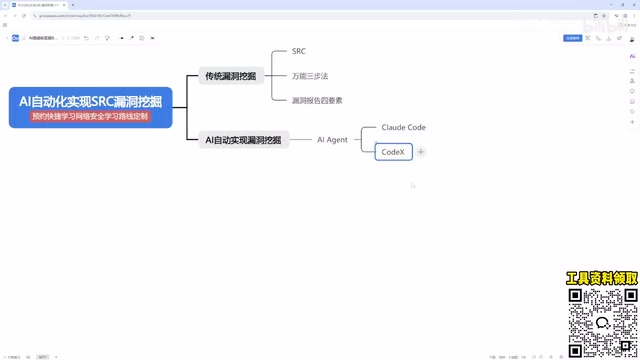
The creator comments on several Agent tools on the market: Claude Code is capable but carries a high risk of account bans—he even mentions a recent case where an American programmer's account was banned while attending a conference in Shenzhen; Codex is the tool commonly used by "Waya Teacher" in courses; personal intelligent assistant products like OpenClawAd (phonetic) saw a wave of free installation enthusiasm from late 2025 to early 2026, with 360 and Tencent both participating, but Tencent's QCloud product was cut after the emergence of WorkBuddyAd and was reportedly discontinued for maintenance in October.
The core difference between an AI Agent and ordinary conversational AI lies in "tool calling" and "task loop" capabilities. An Agent can autonomously plan steps, invoke external tools such as browsers, terminals, and scanners, and decide the next action based on execution results, forming a "think—act—observe" loop. This capability depends on the model's support for the Function Calling protocol, as well as context management and error retry mechanisms. For tasks like vulnerability hunting that require multi-step, cross-tool collaboration, the continuous execution capability of the Agent mode is hard to replace with the web Q&A mode—but it also brings new problems such as high token consumption and execution drifting away from the goal.
Why Hermes Agent Was Chosen
After discussing these tools, the creator mentions Hermes Edge (phonetic) and offers a key comparison: it saves more tokens than OpenClaw and is more convenient to use. But he also candidly says that once you actually use it a lot, you'll find it still consumes tokens—just relatively less.
Choosing Hermes Agent as the core of the workbench has a pragmatic consideration behind it: vulnerability hunting tasks often require multiple rounds of tool calls and long execution chains, so token consumption is a real cost. An Agent that is relatively token-efficient has an advantage in long-term use. This is consistent with the "get twice the result with half the effort" goal mentioned in the video.
That said, it should be noted that the video spends relatively little time on the specific deployment steps of Hermes Agent, focusing more on the workbench's construction approach and tool selection. The actual "hand-holding setup" portion needs to be understood by watching the on-screen operation demos in the video.
Security Skill Modules: Where the Agent's Capability Boundary Lies
The "security Skill modules" mentioned in the title are the key design of this workbench. The Agent itself is a general-purpose executor; to make it do vulnerability hunting, you need to inject security-domain skills into it—which might be an instruction set for vulnerability probing, a template for report generation, or the invocation method for a specific toolchain.
The creator does not elaborate on the specific implementation of Skills in his narration, but from his repeated emphasis that "AI must imitate cybersecurity professionals," the essence of a Skill is to solidify the experience of security experts into modules that the Agent can execute. This is also the mainstream approach for AI Agents landing in vertical domains today: a general-purpose model plus domain skill packages.
For security practitioners who want to make similar attempts, this means the focus of the workbench is not just choosing an Agent tool, but more importantly transforming your own hunting methodology into structured skill descriptions. The three-step method and four elements happen to serve as the skeleton for skill design.
In the Agent system, a Skill usually refers to domain capabilities encapsulated in structured descriptions, commonly in the form of prompt templates, tool-calling scripts, knowledge base retrieval rules, and so on. Unlike fine-tuning a model, a Skill does not require retraining the model; instead, it injects context so that a general-purpose model acquires operational knowledge for a specific domain—low cost and fast iteration. In security scenarios, Skills can solidify common vulnerability probing ideas, Payload construction methods, report templates, and more into reusable modules, enabling the Agent to invoke a unified standard process across different tasks—which is the technical reason why "general-purpose model plus domain skill packages" has become the mainstream path for vertical deployment.
A Few Sober Judgments Before Hands-On Practice
Several less "passionate" conclusions can be drawn from the video content.
AI-automated SRC vulnerability hunting is still at the tool-assisted stage. An Agent can run the full task flow, but task definition, skill authoring, and result review all still require humans. The creator says "you can intervene in the middle"—read in reverse, that means completely hands-off is not realistic at the current stage.
There is no silver bullet in tool selection. Claude Code has account ban risks, OpenClaw-type products have lifecycle issues, and Hermes Agent saves tokens but is not zero-cost. Which one to choose depends on budget, compliance requirements, and task frequency.
Deploying a test range for testing is a necessary step. The title mentions "complete hands-on deployment of a test range," which is a responsible approach—before trial and error on real SRC targets, verify the stability and accuracy of the workbench in a test range to avoid false positives and compliance risks.
The last screenshot's caption is incomplete ("like our early, uh"), so its specific content cannot be confirmed, and no over-interpretation is made here. Overall, the value of this video lies in breaking a hot concept down into discussable engineering problems: the framework stays the same, the tools change, and human judgment is always present.
A cyber range is an isolated testing platform that simulates a real network environment; common open-source options include DVWA, VulnHub machines, and OWASP Juice Shop. Verifying an AI workbench in a cyber range focuses on testing the Agent's vulnerability identification accuracy, false positive rate, and completeness of report generation, while avoiding the legal risks of operating on unauthorized targets. Under the Cybersecurity Law and related judicial interpretations, unauthorized vulnerability probing of real systems may constitute illegal activity, so completing stability verification in a cyber range first and then applying for authorized SRC testing is the compliance bottom line that AI-assisted vulnerability hunting must follow.
One-line Summary
A Bilibili creator demonstrates hands-on how to build an SRC vulnerability hunting workbench with an AI Agent, emphasizing that the framework stays the same, the tools change, and human judgment is always present.
Paragraph Summary
This article is compiled from a Bilibili creator's hands-on video about AI-automated SRC vulnerability hunting. The core viewpoint is that the traditional "universal three-step method" (understand the target, discover the vulnerability, produce a report) and the four report elements (URL, reproduction steps, impact description, remediation recommendations) will not change because of AI; AI should imitate the thinking of security professionals rather than bypass the framework. The article compares the web Q&A approach with the AI Agent approach, arguing that the Agent's complete task execution mode is better suited to process-oriented vulnerability hunting; on tool selection, it analyzes the account ban risks of Claude Code, the lifecycle issues of OpenClaw-type products, and the relative token savings of Hermes Agent. It also points out that the essence of security Skills is to solidify expert experience into Agent-executable modules, and emphasizes that before hands-on practice you should verify in a test range, and that completely hands-off operation is not realistic at the current stage.
Related articles

Free Unlimited Claude Code Solution: Agnes AI + CC Switch Setup Guide
No paid subscription needed — pair the free AI platform Agnes AI with the open-source tool CC Switch to provide a backend for Claude Code, enabling unlimited free calls to text, image, and video models. This guide covers the full setup, test results, and usage boundaries.

A Complete Zero-Cost Guide to Getting Started with Claude Code for Beginners in China
A beginner's guide to Claude Code for users in China: two installation methods (command line and IDE plugin), full configuration steps for replacing the official API with the free domestic LongCat model, and a hands-on demo of building a small tool with natural language, plus tips.

When the NSA Gets Involved: The AI Supply Chain Crisis Behind Open-Source CVEs and API Key Hijacking
Multiple open-source projects disclosed severe CVEs in one day, PHP flaws alarmed the FBI, and Railway and OpenCode were breached with API keys stolen. This article breaks down the vulnerability window, AI-accelerated exploitation, and the AI supply chain crisis behind the API key black market, with a developer defense checklist.