Roveri: A Minimalist Cycling Journal App That Paints Every Ride on a Map

Roveri is a minimalist iPhone cycling journal that paints every ride on your personal map atlas.
Roveri is an iPhone-exclusive cycling journal app that takes a deliberately minimalist approach in a market dominated by feature-heavy competitors. With just one tap, it records route, speed, elevation, and weather data, organizing rides into reopenable "seasons" and building a personal atlas of every road you've ever ridden. Rather than competing on navigation or social features, Roveri focuses purely on recording and reflection, turning cycling data into an emotional, map-based diary.
A Cycling App for "Recording," Not "Navigating"
In a market where cycling apps crowd around navigation, social rankings, and racing metrics, an iPhone app called Roveri has chosen a distinctly different path. Its positioning is crystal clear—this is a "cycling journal," not a navigation tool (A journal, not a navigator).
The current cycling app market is dominated by a few giants: Strava is known for social racing and its "Segment Leaderboard," boasting over 100 million registered users; Komoot focuses on route planning and navigation; Wahoo and Garmin Connect are deeply integrated with hardware ecosystems. The common trend among these apps is relentless feature bloat—from training plans and power analysis to community challenges, they try to cover every stage of a user's athletic lifecycle. In this competitive landscape, Roveri's choice to subtract rather than add, returning to the essence of recording, is a counter-trend product strategy.
The product recently appeared on Product Hunt, earning 79 upvotes and 5 comments, ranking 15th for the day under the iOS, Travel, and Maps tags. While these numbers don't exactly scream viral hit, the product philosophy it represents is worth savoring: in an era of feature excess, restraint itself becomes a differentiator.
One Tap to Record an Entire Ride
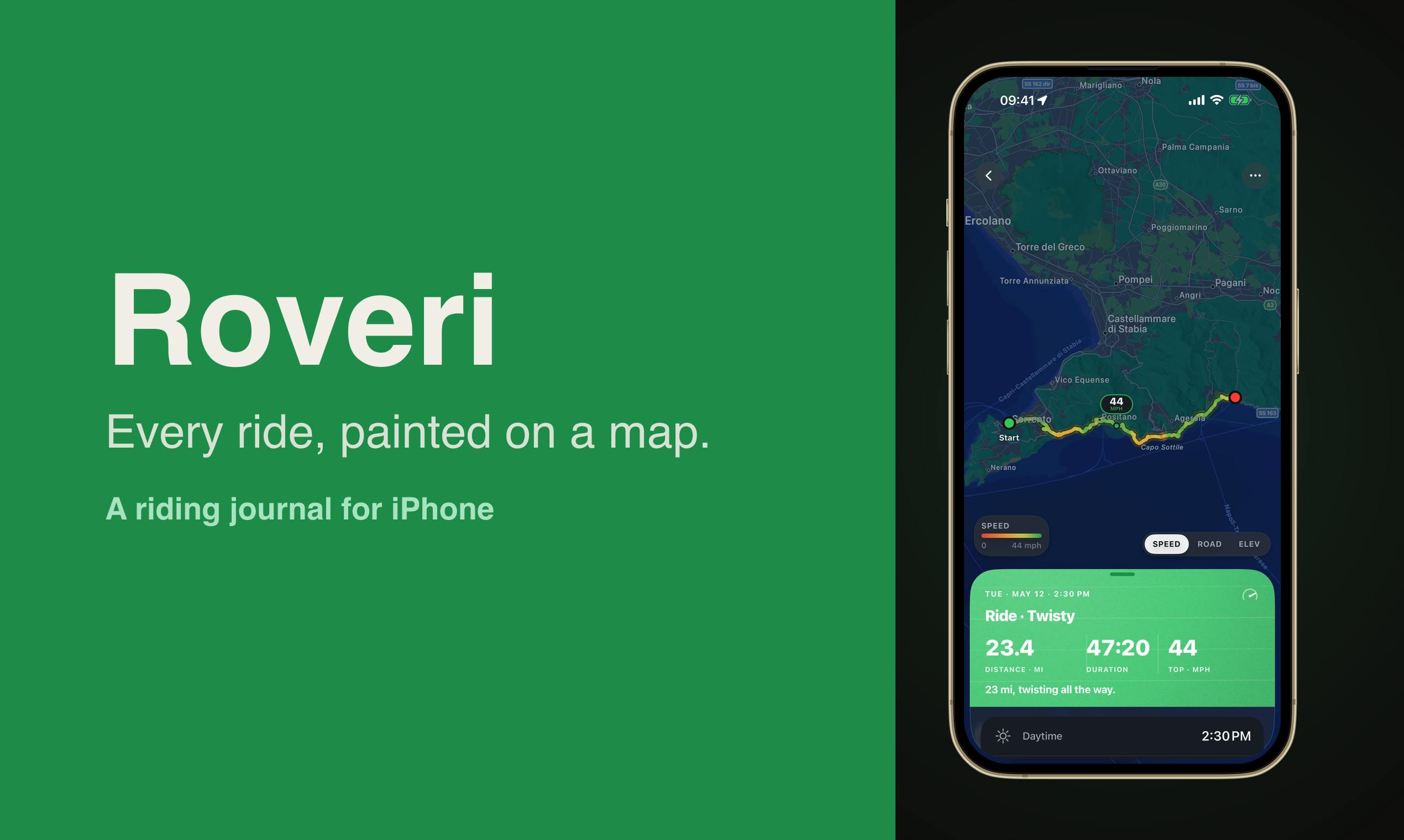
Roveri's core interaction has been compressed to the absolute minimum—one tap. After that single tap, the app automatically begins recording four types of data: route, speed, elevation, and weather—ultimately "painting" this information onto a map.
From a technical standpoint, this recording capability relies on the GNSS (Global Navigation Satellite System) chip built into smartphones. Modern iPhones simultaneously receive signals from GPS, GLONASS, Galileo, and BeiDou multi-constellation systems, achieving positioning accuracy of 3-5 meters. Elevation data is calculated through fusion of barometric sensor readings and satellite positioning data, with the barometer achieving sensitivity to relative altitude changes at the 0.1-meter level. Weather data is typically obtained by calling WeatherKit (Apple's weather API available since iOS 16, which integrated the former Dark Sky's hyper-local forecasting capabilities) to retrieve real-time local meteorological information. These underlying technical capabilities are encapsulated beneath the "one tap" minimalist interaction, reflecting the product's balance between technical complexity and user experience.
This "painted on a map" expression reveals the product's visual ambition. It's not simply drawing GPS tracks as cold, lifeless polylines—it aims to transform each ride into a stroke of warm color on the map. For users who love cycling and value recording and reflection, this "map as journal" metaphor carries significant emotional appeal.
A detail worth noting—the choice of four recording dimensions:
- Route and speed: Standard data for any cycling app
- Elevation: Especially important for road cyclists and mountain bikers, directly tied to ride intensity and sense of achievement
- Weather: A detail with "journal" characteristics that gives each ride contextual memory, rather than being purely performance numbers
From Individual Rides to "Seasons" and a "Road Atlas"
Where Roveri truly reveals its product thinking is in how it organizes data along the temporal dimension.
Reopenable "Seasons"
Individual rides accumulate into "seasons," which users can reopen at any time for review. This design weaves cycling from isolated events into a traceable temporal narrative. Similar to photo albums organized by timeline in photography apps, Roveri lets cyclists look back at their movement trajectories and state changes on a seasonal basis.
The "seasons" organizational concept draws from how humans naturally perceive time. In UX design, this falls under "Temporal Narrative Structure"—using meaningful time segments to help users establish memory anchors. Compared to Strava's pure data aggregation approach of weekly/monthly mileage statistics, "seasons" are closer to humanistic time slices—a cycling season might correspond to spring cherry blossom routes, summer lake-loop challenges, or autumn mountain foliage rides. This design transforms data review from "reading a report" into "flipping through a diary."
A Personal Road Atlas That's Uniquely Yours
Even more interesting is the concept of an "atlas of every road you've ever ridden"—a collection encompassing every road you've cycled. Over time, the roads users "illuminate" on the map grow more numerous, gradually sketching out a personal exploration map.
This "road collecting" mechanic essentially introduces gamified exploration mechanisms into everyday cycling. In Gamification theory, this leverages two core motivational drivers: "collection mechanics" and "exploration rewards." Similar successful examples include: Fog of World (clearing "fog of war" from a map through movement), Wandrer (specifically tracking unique roads covered by cycling/running), and Strava's Local Legend feature. Psychological research shows that "completion visualization" effectively activates the brain's dopamine reward circuit. Roveri combines this mechanism with map aesthetics, letting users' cycling history gradually "grow" into a unique personal geographic portrait. The satisfaction from this long-term accumulation far exceeds the instant feedback of a single workout.
It both motivates users to try new routes and provides a unique source of achievement: you're not competing with others over who's faster, but with yourself over how many places you've explored.
Roveri's Product Positioning and Differentiation Strategy
Roveri explicitly separates itself from navigation apps—a critical product decision.
Mainstream fitness recording apps tend to grow heavier over time—adding social features, training plans, navigation, and complex feature matrices behind paid subscriptions. Roveri does the opposite, focusing solely on "recording and reviewing," keeping complexity in the backend while delivering simplicity to the user. This restraint, in a sports app market plagued by feature homogeneity, actually creates distinctiveness.
Roveri represents an increasingly popular product philosophy within the indie developer community in recent years: "Small and Intentional." Unlike VC-driven growth logic, these products don't pursue maximum user scale but serve a clearly defined niche need. In terms of business model, "Free to start" typically implies a Freemium strategy—basic recording features are free, while advanced features (such as historical data export, custom map styles, full atlas viewing, etc.) are unlocked through one-time purchases or subscriptions. For indie developers, even just a few thousand paying users can sustain ongoing development of a quality app.
Of course, this positioning also means clear boundaries: hardcore users who need real-time navigation, competitive rankings, or deep training analysis probably aren't Roveri's target audience. It's better suited for those who treat cycling as a lifestyle and value experience and memory.
Getting Started: Accessibility and Usability Analysis
Based on the release information, Roveri's basic requirements are:
- Pricing model: Free to start, with potential advanced paid features
- Platform: iPhone exclusive
- System requirements: iOS 18.6 and above
This system version requirement is relatively high, meaning it primarily targets users with newer devices. From a technical perspective, requiring iOS 18.6 likely means Roveri utilizes Apple's latest framework capabilities. iOS 18 introduced several new APIs related to location and maps: MapKit's enhanced custom rendering allows developers to apply more artistic visual treatments to maps (highly aligned with Roveri's philosophy of "painting rides on a map"); Core Location improvements provide more energy-efficient continuous background location modes—crucial for long-distance ride recording that requires hours of continuous GPS data collection without excessive battery drain; additionally, SwiftUI's new animation system provides smoother visual feedback for the "one tap" minimalist interaction. However, this requirement limits compatible devices to iPhone XS and newer models, somewhat constraining its early user base.
The developer is credited as Serg, and based on the product's form, it appears to be a relatively independent, focused creation.
Conclusion: The Value of Small, Beautiful Cycling Products
Roveri isn't a product that's technically groundbreaking, but it provides a noteworthy case study: beyond the feature arms race, winning over specific users through clear positioning and elegant presentation.
"Paint every ride on a map"—this phrase precisely conveys the product's emotional value. For content creators and indie developers, Roveri demonstrates a possibility—rather than pursuing breadth, doing one thing with enough quality and warmth can still carve out a place in the market. It's worth a try for anyone who loves cycling and loves documenting life.
Related articles

Workbuddy for Absolute Beginners: How a Desktop AI Agent Fits Into Real Workflows
A beginner's guide to the Workbuddy desktop AI agent: installation, claiming credits, file management, and building automated workflows—compared with CodeX for fit and cost, helping professionals shift from AI question-askers to AI managers.

OpenAI's New Agent Stack: Computer Use, Decisions API, and Ultra-Fast Workflows
OpenAI Dev Day unveiled a new agent stack: Computer Use outperforms humans, Decisions API delivers ultra-low-latency classification via Luna, Agents API opens the same Computer Use capabilities, and GPT-6.1 Sol costs only one-seventh of Astra. Core updates, benchmark data, and developer insights.

Liang Wenfeng Open-Sources DeepInfo Inference Framework, Takes On U.S. Ban
DeepSeek open-sources its DeepInfo inference framework after its models, featuring GPU/CPU cross-pipelining, small-model prediction with large-model verification, and full Huawei Ascend and NVIDIA chip support—facing the U.S. federal ban head-on. This article analyzes its significance for AI deployment and open-source strategy.