RSA-896: The Cryptographic Challenge Behind a Viral Hacker News Post

RSA-896 is a 896-bit semiprime factoring challenge that went viral on Hacker News, reigniting debate over RSA key security boundaries.
This article examines a blog post titled "RSA-896" that earned 178 upvotes and 72 comments on Hacker News. It covers the basics of RSA's reliance on integer factorization, RSA-896's transitional status between the already-broken RSA-768 and harder numbers, and the three reasons it resonated with the tech community: engineering and academic value, anxiety over key security margins, and curiosity about cracking challenges. The article concludes with practical guidance to use at least 2048-bit RSA keys or migrate to ECC, and transparently notes that the original post's body was unavailable, so context is based on general cryptographic knowledge.
A Cryptography Topic That Sparked Widespread Discussion
Recently, a post titled "RSA-896" on Hacker News captured the community's attention, earning 178 upvotes and 72 comments. The original article was published on the personal tech blog saweis.net, with discussion centered on a specific challenge number within the RSA encryption system.
It's worth noting upfront that the available source material for this article is limited to the title, link, and engagement metrics — the body of the original post was not accessible. The following context is therefore drawn from general cryptographic knowledge to explain what RSA-896 means and why it generated such lively discussion in the tech community.
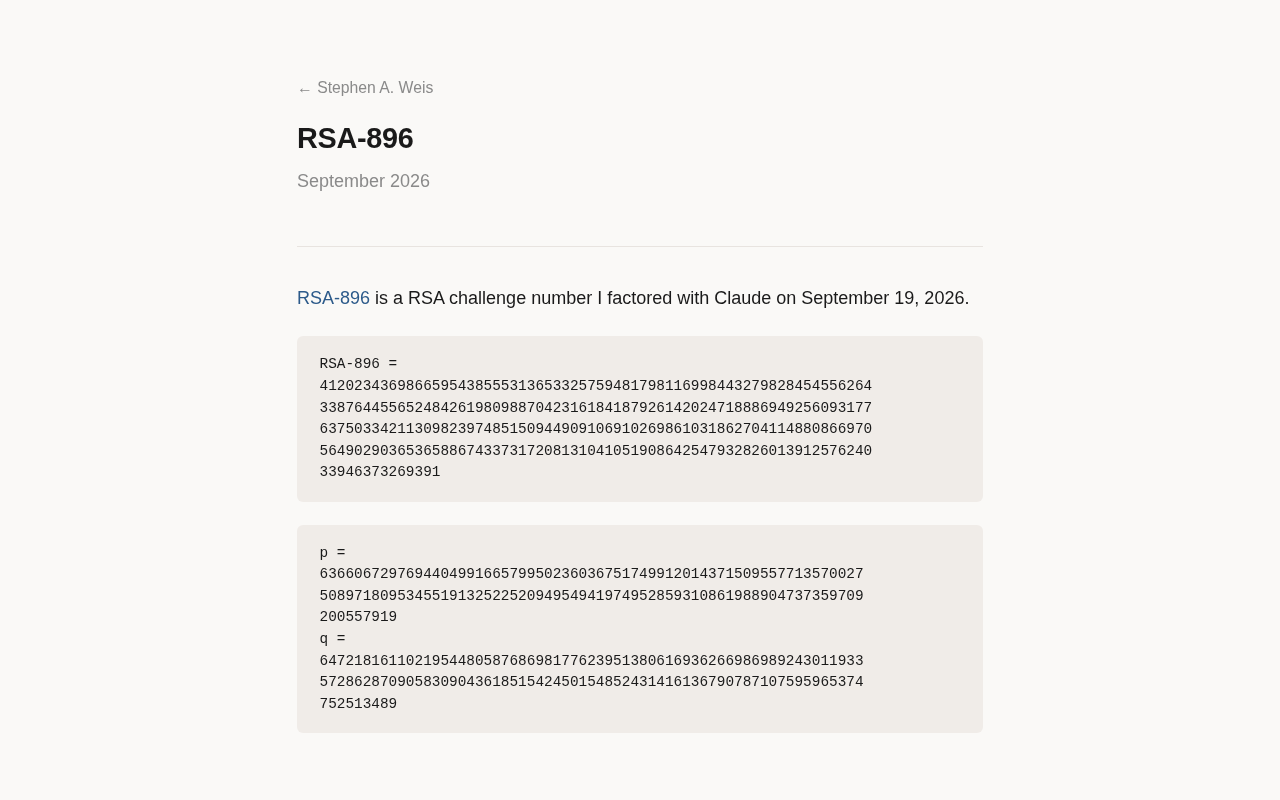
What Is RSA-896
RSA-896 is a number from the well-known "RSA Factoring Challenge" series, a set of challenges launched by RSA Laboratories to assess the difficulty of factoring large semiprimes (products of two large primes) given available computational resources.
The suffix "896" refers to the number's length in binary bits — 896 bits, or roughly 270 decimal digits. The security of RSA encryption is built on the "large integer factorization problem": even though the modulus N in a public key is publicly known, factoring it back into its two original primes p and q is computationally infeasible within a reasonable timeframe.
Within the RSA challenge sequence, RSA-768 (768 bits) was successfully factored years ago, signaling that keys of that size are no longer secure. At 896 bits, RSA-896 sits in a transitional zone between what has already been broken and what still poses significant difficulty — which is why any attempt or claimed progress at this scale draws immediate attention from the cryptography community.
The RSA Factoring Challenge was formally launched by RSA Laboratories in 1991, comprising a series of challenge numbers ranging from RSA-100 (in decimal digits) to RSA-2048, with cash prizes offered for successful factorizations (up to $200,000). The challenge was officially retired in 2007 with no further prizes awarded, but academics and enthusiasts continue to use it as a benchmark for progress in integer factorization algorithms. To date, the largest challenge number successfully factored is RSA-250 (829 binary bits), completed by a research team in 2020 at a cost equivalent to roughly 2,700 core-years of computation. RSA-896 sits between the already-broken RSA-768 and higher, still-unbroken numbers in the sequence. Its factorization difficulty far exceeds that of RSA-768 — factoring time grows sub-exponentially with bit length, not linearly. This is precisely why RSA-896 remains a meaningful topic of discussion even after RSA-768 has fallen.
Why It Made the Hacker News Front Page
178 points and 72 comments represent a solid mid-to-high performance on Hacker News. Content like this tends to generate discussion for a few key reasons.
First, factoring large RSA numbers requires massive computational resources and clever algorithmic implementation (such as the General Number Field Sieve, or GNFS). Any practical attempt carries inherent value both as an engineering feat and an academic contribution.
Second, it touches on one of the most pressing anxieties in modern cryptography: as computing power grows and quantum computing looms closer, just how long does a key need to be to remain "secure enough"? Discussions around RSA-896 are essentially another public stress test of RSA's security boundaries.
Third, the tech community has a natural curiosity about concrete, verifiable achievements like "cracking a challenge" — especially when an author documents the entire process in a blog post.
The General Number Field Sieve (GNFS) is currently the most efficient classical algorithm known for factoring large integers, with a sub-exponential time complexity of exp((64/9)^(1/3) · (ln n)^(1/3) · (ln ln n)^(2/3)). It consists of four main stages: polynomial selection, sieving, linear algebra, and square root extraction. The sieving stage is highly parallelizable and accounts for the majority of computational cost in real-world attacks on large RSA numbers. By contrast, Shor's algorithm on a quantum computer could theoretically factor integers in polynomial time, completely undermining RSA's security assumptions — but practical quantum computers capable of doing this do not yet exist. It is precisely this combination of steady progress in classical algorithms (GNFS) and the long-term threat of quantum algorithms (Shor) that fuels the tech community's ongoing anxiety about RSA key length security margins.
Implications for Modern Cryptographic Practice
From an engineering standpoint, the RSA-896 discussion serves as a reminder that RSA keys shorter than 1024 bits should no longer be used under any circumstances. The current industry consensus recommends a minimum of 2048 bits, with 3072 or 4096 bits for higher-security use cases — and increasingly, a migration toward Elliptic Curve Cryptography (ECC), which achieves equivalent security strength with significantly shorter keys.
The ongoing factorization of these challenge numbers provides important empirical evidence that drives the evolution of key length standards across the industry. Each successful factorization sends a clear signal to the field: parameters once considered secure are becoming obsolete.
ECC can deliver equivalent security with much shorter keys because its security is grounded in the "elliptic curve discrete logarithm problem," for which the best known attack algorithms have fully exponential complexity — making it substantially harder than integer factorization. To put concrete numbers to this: a 256-bit ECC key offers roughly the same security as a 3072-bit RSA key, while a 384-bit ECC key corresponds to approximately 7680-bit RSA. Shorter keys mean not just lower storage and transmission overhead, but also significant gains in computational performance — particularly important in resource-constrained environments like IoT devices. Widely used ECC standard curves include NIST P-256, P-384, and the academically recommended Curve25519. The latter has seen broad adoption in modern protocols (such as TLS 1.3 and the Signal Protocol) due to its transparent design, implementation simplicity, and strong resistance to side-channel attacks.
Summary and a Note on Sources
The viral spread of RSA-896 reflects the tech community's sustained interest in foundational cryptographic questions. It represents both a concrete factorization challenge and an open public discussion about RSA's security boundaries.
In the interest of transparency: because the available source material was extremely limited (title, link, and engagement metrics only — no body text), the content above regarding factorization methods, specific progress, or the original author's conclusions is drawn from general cryptographic knowledge rather than a direct account of the blog post itself. Readers interested in the specific technical details are encouraged to visit the original post at saweis.net for first-hand information.
Related articles

Chain of Thought Isn't Just for AI: How Humans Can Use CoT to Improve Thinking Quality
Chain of Thought isn't just a prompt trick for large models. Starting from a Hacker News discussion, this article analyzes why CoT works for human thinking too, breaks down actionable ways to transfer it, and highlights the key differences between human CoT and machine CoT.
Cloudflare Teams Up with OpenAI: Closi…
Cloudflare Teams Up with OpenAI: Closing the Loop from Vulnerability Discovery to Defense with AI
Cloudflare uses OpenAI Daybreak to investigate security vulnerabilities and generate reviewable remediation plans, while developers use Codex to boost coding efficiency and quality.

Orca Multi-Agent Orchestration in Practice: A Guide to Parallel Collaboration with Claude and Codex
Orca is Stable AI's free open-source agent workbench supporting 34 agents like Claude Code and Codex in parallel. Learn its Git worktree isolation, multi-model orchestration, and mobile management.