Ruflo: Turning Claude Code into a Multi-Agent Collaborative Development Team

Ruflo solves single AI assistant bottlenecks by adding a multi-Agent collaboration layer to Claude Code
This article analyzes the structural bottleneck of attention dilution caused by context window limitations when a single AI assistant handles long tasks. It introduces the open-source project Ruflo, which adds multi-Agent collaboration capabilities to Claude Code through Swarm collaboration, Memory persistence, and a Plugin Marketplace, transforming complex development tasks into organized Agent workflows.
The Bottleneck of a Single AI Assistant
If you've been using Claude Code for writing code, refactoring, or adding tests, you've probably encountered this frustrating scenario: when handling complex tasks, a single AI assistant writes blazingly fast in the first half, only to forget earlier constraints in the second half. When you remind it to add tests, it might break the previous design. When you ask it to perform a security check, it needs to re-understand the entire context from scratch.
This phenomenon has deep technical roots. The fundamental reason a single AI assistant "forgets constraints" during long tasks is the Context Window limitation of the Transformer architecture. Even models like Claude that support 100K or even 200K token contexts experience "attention dilution" in extremely long conversations—critical constraint information from earlier stages gets diluted among massive subsequent content, and the model's attention weight on it decreases. This isn't because the AI isn't smart enough; it's a structural bottleneck of a single instance handling complex tasks.
The real problem isn't that AI can't write code—it's that complex software development inherently requires multiple roles working in their respective capacities: planning, coding, testing, and reviewing. When these responsibilities are crammed into a single conversation window, state becomes scattered and quality is hard to guarantee.
The open-source project Ruflo (also written as Roflo) was created precisely to solve this problem. Think of it as a multi-agent collaboration layer added on top of Claude Code—you still work within Claude Code, but behind the scenes, there's a team of Agents that can divide labor, remember context, and collaborate.
Ruflo's Core Architecture: Swarm, Memory, and Plugin Marketplace
Looking at Ruflo's design philosophy, its core revolves around three key concepts.
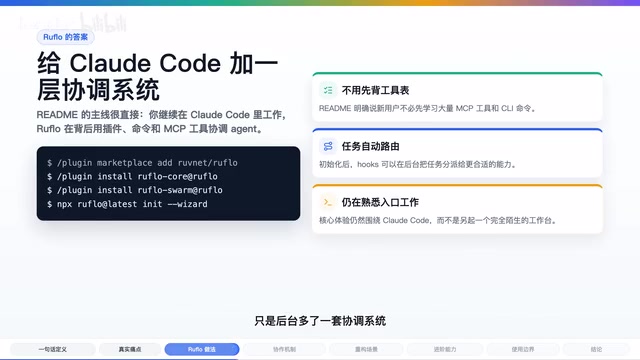
Swarm Collaboration: Organizing Multi-Agent Division of Labor
Swarm is Ruflo's multi-agent organizational method. The name comes from Swarm Intelligence theory, inspired by the natural phenomenon where colony organisms like ants and bees exhibit complex collective behavior through simple individual interactions. In the software engineering context, Swarm architecture emphasizes lightweight coordination between Agents rather than central control—each Agent remains relatively independent, collaborating through shared state and message passing rather than relying on a "super-dispatcher" to orchestrate everything. This is highly similar to the design philosophy of microservices architecture: loose coupling, high cohesion, and single responsibility.
Specifically, Swarm can organize multiple Agents into squads using hierarchical, mesh, or adaptive patterns. Unlike simple sequential calls, Swarm enables genuine collaborative relationships between Agents—after the Coder Agent finishes writing code, the Tester Agent automatically takes over to add tests, the Reviewer Agent reviews risks, and all roles advance in parallel around the same objective. The multi-Agent architecture fundamentally avoids the attention dilution problem of a single instance by splitting tasks so that each Agent only handles context within its own responsibility scope.
Memory: Letting the AI Team Accumulate Experience
This is a key feature that distinguishes Ruflo from ordinary multi-Agent solutions. From a technical implementation perspective, Ruflo's Memory mechanism corresponds to the External Memory design pattern in AI systems. Unlike "parametric memory" solidified in model weights, external memory explicitly saves experiences through vector databases or structured storage, injecting them into context when needed via Retrieval-Augmented Generation (RAG).
Experiences, context, and successful patterns from task execution can be accumulated persistently, so the next time a similar task is handled, it doesn't have to start completely from scratch. This allows the AI team's "experience" to persist across sessions, similar to a human team's knowledge base or Wiki—new conversations can quickly inherit historical accumulations without re-exploring. For large projects requiring repeated iterations, the value is especially obvious—the team's "experience" doesn't disappear when the conversation window closes.
Plugin Marketplace: Assembling AI Development Capabilities On Demand
Ruflo splits core capabilities—testing, documentation, security checks, browser automation, workflows, and more—into independent plugins that can be installed on demand per scenario. This design reflects the "platformization" transformation that AI toolchains are undergoing—similar to VS Code's extension marketplace or Kubernetes' Operator ecosystem, a plugin-based architecture keeps the core framework lean while allowing the community to contribute specialized capabilities for specific scenarios. In the AI Agent space, this pattern is called an ecological extension of "Tool Use": not just letting AI call individual tools, but building a composable, extensible capability marketplace.
This modular design means you don't need to face all features at once—you can gradually introduce them based on actual needs.
Practical Scenario: Refactoring an Auth Module with Ruflo Multi-Agent
Let's look at a concrete use case. Suppose you need to refactor an authentication module. The traditional approach would be to repeatedly prompt and correct within a single Claude Code conversation. With Ruflo's multi-agent collaboration, the workflow becomes:
- Ruflo first helps you break down objectives and constraints, clarifying the refactoring scope and immutable interfaces
- Coder Agent handles writing the implementation code
- Tester Agent automatically adds unit tests and integration tests
- Reviewer Agent reviews security risks and code quality
- Docs/PR Agent organizes change descriptions and documentation
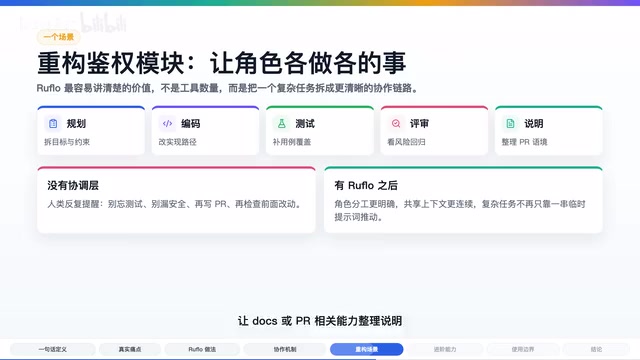
The key isn't that each Agent is individually magical—it's that they have clear division of labor and shared context. Complex tasks no longer degrade into a string of scattered ad-hoc prompts; instead, they become an organized Agent workflow. This approach is highly consistent with a classic research direction in artificial intelligence—Multi-Agent Systems (MAS): decomposing complex tasks among multiple autonomous intelligent agents with different expertise to collaboratively complete them, with theoretical foundations rooted in "distributed cognition" from cognitive science.
Related articles
 Product Reviews
The Programmer's Desk Setup Guide: Building a Workspace That Feels Like Home
Discover how programmers build productive, comfortable workspaces. From multi-monitor setups to ergonomic design, explore the desk philosophy that drives focus and flow.
 Product Reviews
Qoder vs Cursor Real-World Comparison: Which $20/Month AI IDE Is Better?
Hands-on comparison of Qoder vs Cursor AI IDEs: Agent autonomy, human interaction count, and architecture decisions. Qoder needed only 2 interactions vs Cursor's 8.
 Product Reviews
Cursor Cloud Agent Demo: Eliminating Bottlenecks Across the Entire Software Development Lifecycle
Deep analysis of Cursor's Cloud Agent demo showing how cloud VMs, automated test artifacts, and a full-chain control plane systematically eliminate human bottlenecks across the software development lifecycle.