Rumored Pixel-Wide Price Hike: Watch 5 Starting Price May Rise to $399

Google Pixel lineup may see across-the-board price hikes, with the Watch 5 starting at $399 and the LTE version at $499.
Per French leak site Dealabs, Google's Pixel lineup could see across-the-board price increases. The Pixel Watch 5 41mm may start at $399 and the LTE version at $499—nearly 15% higher than the Watch 4. The hike is driven by rising chip costs, supply chain restructuring, and tariffs, with the entire Pixel ecosystem potentially affected. Official pricing awaits confirmation.
Google Pixel Series Faces Across-the-Board Price Increases
According to tech outlet 9to5Google, citing a report from French leak site Dealabs, prices for Google's upcoming Pixel lineup could rise across the board, with increases exceeding last year's levels. This trend isn't limited to flagship phones—it extends to smartwatches and other peripheral devices, meaning consumers will face higher overall costs when buying into Google's hardware ecosystem.
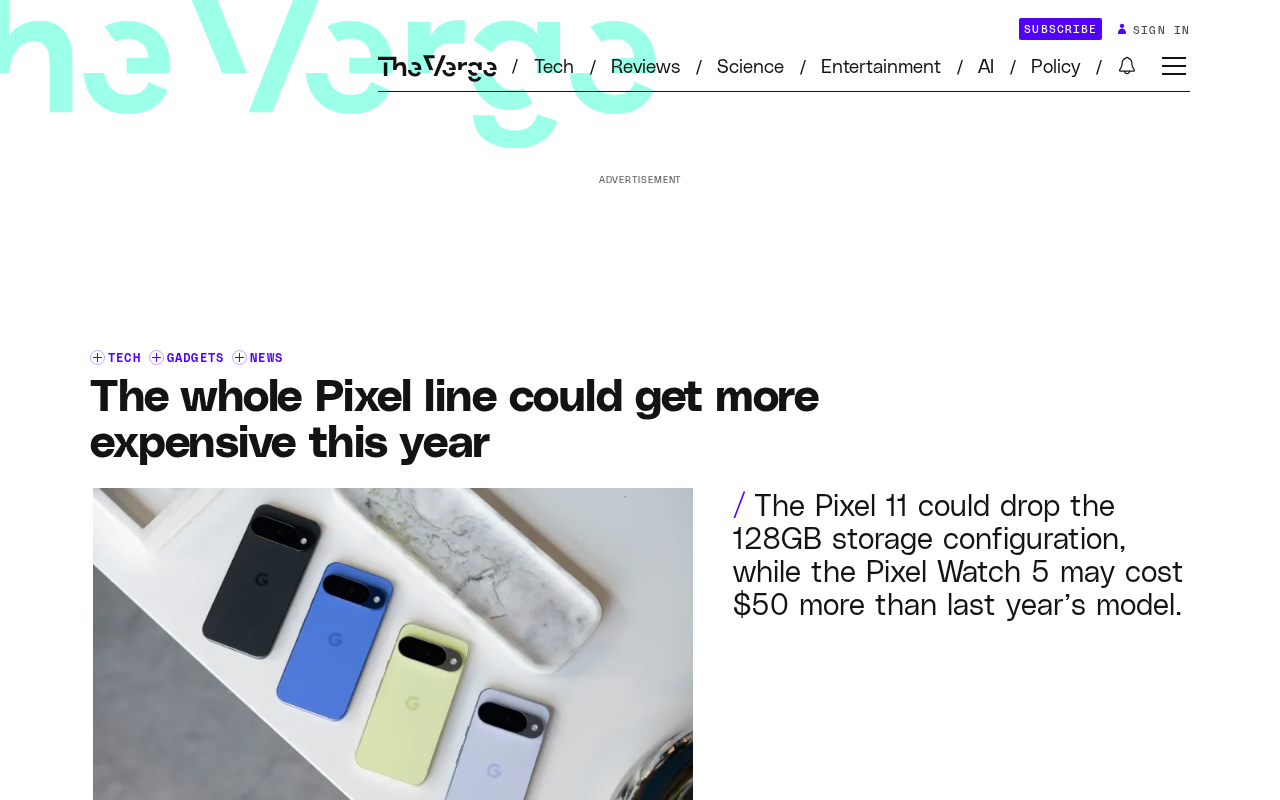
For users who have long followed Google's hardware product lines, this news isn't entirely surprising. In recent years, rising global electronic component costs, supply chain pressures, and exchange rate volatility have continued to push up consumer electronics pricing. Notably, this round of price pressure has a profound macroeconomic backdrop: the restructuring of semiconductor supply chains has driven a continuous rise in the cost of advanced-process chips—foundries like TSMC and Samsung routinely invest over $20 billion in building fabs and ramping up yields for advanced processes like 3nm and 4nm, and these costs are ultimately passed on through chip pricing to end-device pricing tier by tier. A strong US dollar has increased the cost of imported components sold in the US. In addition, the Trump administration's revived tariff policies toward China in 2025 have delivered a fresh blow to consumer electronics supply chains. Although some product categories received exemption windows, the supply chain restructuring costs from major manufacturers accelerating their "China Plus One" capacity relocation strategies are also driving up overall production costs.
The Hidden Cost of the "China Plus One" Strategy: The so-called "China Plus One" strategy refers to a supply chain diversification approach in which tech companies maintain their Chinese production capacity while dispersing part of their production lines to alternative markets such as Vietnam, India, Thailand, and Mexico. This trend began accelerating during the 2018-2019 US-China trade war and picked up further momentum after the COVID-19 pandemic exposed supply chain fragility in 2020. However, capacity relocation is not a cost-neutral operation: infrastructure investment for new factories, worker skills training, building local supplier networks from scratch, and losses from initially low yields in key production stages all constitute significant "migration costs." Take Apple's push to produce iPhones in India as an example—according to supply chain analysts, the initial cost of manufacturing in India was roughly 10% higher than in China. Google's hardware supply chain is likewise heavily dependent on Asian manufacturing systems, and the additional costs from capacity relocation will inevitably be partially passed on to final retail prices.
The Cost Transmission Mechanism of Foundries and Advanced Processes: To understand how chip costs affect end-product pricing, one needs to grasp the basic economics of the semiconductor industry. Foundries like TSMC charge chip design companies per "wafer." The processing cost of a single 12-inch advanced-process wafer has climbed from about $3,000 in the 28nm era to over $20,000 in the 3nm era. The key variable determining a chip's final cost is "yield rate"—the proportion of functional chips on each wafer. Advanced-process yields are often only 50-70% initially, meaning nearly half of the wafer capacity is consumed by defective units, which directly pushes up the average cost per qualified chip. While Google's Tensor chip doesn't chase cutting-edge process leadership, its foundry costs still climb generation over generation as AI computing demands drive ever-higher transistor integration density. This cost pressure is transmitted tier by tier along the chain from "foundry → chip designer → device manufacturer → consumer," and is a key perspective for understanding the deeper logic behind Pixel's price increases.
Major manufacturers like Apple and Samsung have all hedged against these pressures to varying degrees by adjusting product pricing. Google's move to follow suit aligns with the broader industry trend. As a tech giant gradually ramping up its hardware business, Google's pricing strategy adjustment also reflects the general direction of the entire industry.
Pixel Watch 5: Starting Price May Climb to $399
According to information disclosed by Dealabs, Google may raise the starting price of the 41mm Pixel Watch 5 to $399. If consumers opt to add LTE cellular network functionality, the price could climb further to $499.
The price gap between LTE and Bluetooth versions typically ranges from $50 to $100, reflecting the additional hardware cost of integrating a cellular baseband chip, eSIM module, and corresponding antenna design. eSIM (embedded SIM) technology allows smartwatches to independently connect to mobile networks without a physical SIM card. Unlike traditional removable SIM cards, an eSIM is a tiny chip soldered directly onto the motherboard, which is especially critical in space-constrained devices like watches.
The eSIM Industry Ecosystem and Carrier Dynamics: Since the GSMA released its standard specification in 2016, eSIM technology has undergone nearly a decade of industry adoption. Users can remotely "write" carrier profiles via software, enabling number switching and multiple numbers to coexist without visiting a store to swap physical cards. However, eSIM adoption hasn't been entirely smooth—some traditional carriers, concerned about reduced user lock-in, long took a passive attitude toward eSIM. Currently, eSIM support in the US market is relatively mature (Verizon, T-Mobile, and AT&T all fully support it), but in some emerging markets, carrier compatibility remains a limiting factor. For the LTE version of the Pixel Watch, the practical availability of eSIM sharing with a phone number (which relies on carriers' "watch pairing" plans) is also a key variable affecting consumer purchasing decisions.
The Baseband Chip Complexity of Smartwatch LTE: Integrating LTE capability within the extremely constrained physical space of a watch is a severely underestimated engineering challenge. A cellular baseband chip must not only handle complex radio signal modulation and demodulation, but also operate under extremely low power constraints to preserve battery life—a completely different set of design trade-offs from phone basebands. Smartwatches typically use low-power baseband solutions optimized specifically for wearables (such as Qualcomm's MDM series or MediaTek's MT series) and support global carrier frequency bands through multi-band antenna designs. Antenna design is particularly tricky in watch bodies dominated by metal and glass: metal cases shield radio signals, and engineers must ensure signal strength through precise slotting designs and antenna layouts—a process that itself requires substantial R&D investment. The $50-100 premium for LTE versions covers not only hardware material costs, but also partially spreads out these invisible R&D costs.
The LTE version also requires additional integration of an RF front-end module and antenna array, whose combined material cost typically falls in the $30-60 range. Users can make and receive calls and send messages without carrying their phone, which is especially practical for fitness and outdoor scenarios—this is the core value proposition behind the LTE version's premium.
This pricing represents a marked increase over the previous generation. For reference, the base Pixel Watch 4 started at $349—meaning the entry threshold for the Pixel Watch 5 would rise by about $50, an increase of nearly 15%.
Feature Upgrade Expectations Behind the Price Hike
Price increases are usually accompanied by improvements in hardware or features. Although Google hasn't officially announced the specific specs of the Pixel Watch 5, based on precedent, the new smartwatch may see improvements in processor performance, battery life, and health monitoring sensors.
The Technological Evolution of Smartwatch Health Monitoring: Modern smartwatch health monitoring capabilities have expanded from the early days' heart rate sensors to complex systems integrating more than a dozen sensors. Take current flagship wearables as an example—they typically include: optical PPG (photoplethysmography) sensors for heart rate and blood oxygen monitoring, electrode-based ECG (electrocardiogram) sensors for atrial fibrillation screening, skin conductance sensors for stress monitoring, and temperature sensors for women's health tracking. The deep integration of the Pixel Watch series with the Fitbit health platform (Google completed its acquisition of Fitbit in 2021) is its core differentiating selling point—Fitbit has accumulated over 10 years of user health data and algorithm models, providing a unique data advantage for the Pixel Watch's health insight features. Each new generation of sensors not only brings additional material costs, but must also pass medical-grade clinical validation before the corresponding features can be claimed on the product page—a compliance cost that likewise cannot be ignored.
The Technical Principles and Limitations of PPG and ECG: PPG (photoplethysmography) is the most widely adopted heart rate monitoring technology in smartwatches. It works by using LED lights (typically green or infrared) to illuminate the skin, then detecting changes in light reflection caused by variations in blood volume in the capillaries as it pulses with the heartbeat, thereby calculating heart rate and blood oxygen saturation. This technology is inexpensive and moderate in power consumption, but its accuracy drops significantly during high-intensity exercise or wrist movement—an inherent physical limitation of wrist-based optical sensors. ECG (electrocardiogram) sensors work on an entirely different principle: they collect the faint bioelectrical signals produced by the heart (on the order of millivolts) through electrodes on the skin surface, allowing detection of arrhythmias such as atrial fibrillation (AFib). However, the single-lead design of watch ECGs (typically only two electrodes—one on the back of the watch face touching the wrist, another on the side of the crown touched by a finger) has a fundamental gap in diagnostic capability compared to a hospital's 12-lead ECG, serving only as a preliminary screening tool. Understanding the technical boundaries of these sensors helps consumers set rational expectations between marketing claims and actual medical value.
For Google, how to keep the price-hiked products attractive to users will be the core question it must directly address at its launch event.
The LTE version's price of up to $499 pushes it directly into the premium smartwatch market. According to IDC data, the Apple Watch has long held about 30% of global smartwatch shipments, making it the undisputed market leader. In the $400-500 price segment, the Pixel Watch 5 will compete head-to-head with mid-to-high-end Apple Watch Series versions and Samsung's Galaxy Watch LTE editions.
The Market Structure and User Migration Costs of Premium Smartwatches: The smartwatch market exhibits significant "ecosystem lock-in" characteristics, which differ importantly from the competitive logic of the smartphone market. The Apple Watch only supports pairing with the iPhone. While this mandatory binding strategy limits the pool of potential users, it also builds a very deep moat within the iOS user base—switching to an Android phone means the watch is essentially scrapped. Within the Android camp, Samsung's Galaxy Watch has migrated from its early Tizen operating system to the Wear OS-based One UI Watch platform, putting it in the same Wear OS ecosystem as Google's Pixel Watch. This means the software migration cost for users switching between the two is relatively low, making competition more direct. The Galaxy Watch enjoys a natural channel advantage thanks to Samsung phones' massive installed base, while the Pixel Watch's core differentiation must come from software and AI capabilities—especially deep integration with the Gemini assistant and the Google Workspace ecosystem, along with the unique insights from Fitbit's health algorithms. In actual consumer purchasing decisions, "whether it can be used independently of a phone" (i.e., the value of LTE functionality), "compatibility with existing phones," and "the long-term accumulation and portability of health data" are the three core considerations.
Smartwatch users tend to have strong brand loyalty. For the Pixel Watch to break through in the Android camp, it needs sufficiently differentiated features—such as deep integration of the Gemini AI assistant or unique health monitoring capabilities—to justify this premium positioning.
Price Hike Wave Spreads Across the Entire Pixel Ecosystem
Notably, this report isn't targeting a single product but suggests the entire Pixel product line may see across-the-board price adjustments. From Pixel phones to the Pixel Watch, and even accessories like the Pixel Buds, consumers may need to pay more for the next generation of products.
Google's formal entry into self-developed hardware dates back to the launch of the first-generation Pixel phone in 2016. According to data from IDC, Counterpoint, and other firms, the Pixel series has long maintained a global smartphone market share of around 1%, with its main markets concentrated in the US, UK, and Japan. The core strategic logic behind Google's development of its hardware business stems from emulating Apple's "vertical integration" model: achieving optimal user experience by controlling the full software-hardware stack, while providing a "first-party" showcase platform for Android and Google AI services (such as the Gemini assistant and Google Photos' AI features).
Tensor Chips: The Core Engine of Google's Self-Developed Hardware: Starting with the Pixel 6 in 2021, Google introduced its self-developed Tensor chip, marking its shift from dependence on the Qualcomm Snapdragon platform toward a vertical integration path. The Tensor chip is co-designed by Google and Samsung, using Samsung's foundry process (the current generation has advanced to a 4nm process). Its design focus isn't on chasing peak CPU/GPU benchmark performance, but on deep optimization for machine learning inference tasks—the built-in TPU (Tensor Processing Unit) module can efficiently run AI tasks like speech recognition, real-time translation, and computational photography locally, without uploading data to the cloud. This strategy gives the Pixel a differentiated advantage in "on-device AI" experiences, but it also brings continuous R&D investment. As large models like Gemini Nano begin to descend to the mobile end, the AI compute demands on Tensor chips increase further, and the R&D and tape-out costs of new-generation chips are climbing in tandem—one of the deep technical factors driving Pixel hardware pricing upward.
The Strategic Value and Technical Challenges of On-Device AI: The most core design philosophy of the Tensor chip is "on-device AI"—shifting AI computation that would otherwise require calling cloud servers over the network to be completed locally on the device's chip. This design brings three strategic values: first, privacy protection, as sensitive voice, image, and health data never need to leave the device; second, response speed, as local inference eliminates network round-trip latency, enabling millisecond-level real-time response; and third, offline availability, as AI features continue to function normally in offline environments. However, on-device AI faces stringent power and thermal constraints—a phone's thermal design power (TDP) is typically 5-10 watts, while data center GPUs can reach hundreds of watts. To run complex AI models within such a limited power budget, engineers must "quantize" models (compressing floating-point operations into low-precision integer operations) and "prune" them (removing neuron weights with the least impact on output). This compression process inevitably brings precision loss. The Tensor chip partially compensates for this efficiency loss through dedicated hardware acceleration units (the TPU), but finding the optimal balance between "model capability" and "power/heat" remains a core engineering challenge in every generation of Tensor chip development. As larger-parameter models like Gemini Nano 2 migrate to the device edge, the difficulty of this challenge continues to rise.
Notably, Google's advertising business accounts for over 75% of its total revenue, and the Pixel's core value lies more in deeply binding users to the Google ecosystem and strengthening advertising and cloud service monetization, rather than relying purely on hardware sales for profit—this also explains the Pixel series' previously aggressive value-for-money strategy. However, as the costs of Tensor chip R&D and AI feature iteration continue to climb, the pressure to improve hardware profit margins is forcing a systematic adjustment of pricing strategy.
Google's "Hardware Loss for Ecosystem" Model Is Shifting: For a long time, the industry has generally believed that Google hardware (including Nest smart home devices and Pixel phones) was sold at near-cost or even a loss. The core logic was to reach users through hardware and bring them into the monetization systems of services like Google Search, YouTube, Google Assistant, and Google One cloud storage. According to analysts' estimates, each deeply engaged Google service user contributes hundreds of dollars in advertising and subscription revenue annually, far exceeding the profit loss from a single hardware sale. However, this logic faced a fundamental challenge around 2024-2025: on one hand, the generative AI arms race (pressure from competitors like OpenAI, Anthropic, and Meta) has forced Google to invest unprecedented capital expenditure in AI R&D and computing infrastructure; on the other hand, the US Department of Justice's antitrust lawsuit over Google's search monopoly has resulted in a ruling against Google, casting uncertainty over the long-term stability of the search advertising business model. Against this backdrop, Google is being forced to reassess the independent profitability of its hardware business, rather than positioning it purely as an ecosystem traffic driver—this is the deepest institutional backdrop for understanding this across-the-board Pixel price hike.
For Google, this is a double-edged sword. Raising hardware prices helps improve hardware business profit margins; but the Pixel series' share of the global smartphone market is already relatively limited, and price increases could further weaken its value-for-money advantage, putting pressure on sales growth.
The Pricing Game with Competitors
In the high-end Android camp, manufacturers like Samsung and Google have long sought a balance between price and specifications. If Pixel prices rise across the board while competitors like Samsung maintain relatively stable pricing, Google could lose some appeal among price-sensitive user groups. Conversely, if the entire industry is raising prices, the negative impact of a price hike would be relatively limited. Judging by current industry trends, driven by the dual pressures of tariff policies and supply chain costs, the likelihood of the latter scenario is rising.
The "Price Leader" Effect in Consumer Electronics Pricing: In the oligopolistic consumer electronics market, Apple holds a special position as the "price leader" for high-end pricing—its pricing decisions often provide an anchor for the entire industry. Historically, when Apple raised the starting price of the iPhone (such as when the iPhone X pushed the starting price to $999), Android manufacturers tended to follow suit, raising the pricing center of their flagships without bearing the public opinion risk of "raising prices first." In the current cycle, Apple has signaled that it is considering raising US iPhone prices due to tariff pressures. If Apple moves first, it will provide "cover" for competitors like Google and Samsung to collectively raise prices, reducing the market backlash risk each faces. This "coordination effect" is not price collusion (which violates antitrust law) but rather market participants' rational response to signals of shared cost pressures—understanding this mechanism helps explain why price increases in the consumer electronics industry often exhibit collective, synchronized characteristics.
How Consumers Should Respond
For consumers planning to buy new Pixel products, this report provides an important reference signal. It should be noted that Dealabs' leak comes from unofficial channels, and the final retail prices still need to be confirmed by Google's official announcement—pricing data may change before official release.
If your budget is limited, consider the following strategies: first, watch for price cuts and promotions on previous-generation products like the Pixel Watch 4 after the new model launches; second, assess whether the new product's feature upgrades are truly worth the extra investment; and third, wait for third-party hands-on reviews after the launch event before making your final purchasing decision. Additionally, if you don't have a strong need for LTE functionality, choosing the Bluetooth version can save about $100—a pragmatic choice that balances experience and budget.
A Framework for Evaluating a Smartwatch's "Real Usage Scenarios": Before deciding whether to pay the premium for an LTE version, consumers can self-assess with the following questions: ① Do you have a regular "phone-free exercise" habit (such as swimming, cycling, or gym training), and do you want to remain reachable during exercise? ② Does your local carrier offer a "watch pairing" plan (typically about $10-15 per month), and is that fee within your acceptable range? ③ In your daily phone usage habits, how frequently are your phone and watch physically separated? Only if the answers to all three questions are "yes" does the LTE version's premium have sufficient practical value. For most users who primarily use their watch for health monitoring, notifications, and payments, the Bluetooth version is functionally complete in 99% of usage scenarios, and the $100 saved can go toward extended warranty or additional band accessories.
Conclusion
Google Pixel series' potential across-the-board price hike reflects the cost pressures and pricing challenges currently facing the consumer electronics industry as a whole—from rising advanced-process chip costs (foundry prices climbing generation over generation, cost spreading from yield ramps), to supply chain restructuring (including the migration costs of the "China Plus One" strategy), to tariff policy impacts, to the continuous R&D investment in the self-developed Tensor chip. The convergence of these multiple factors is systematically pushing up the hardware pricing center. The rumor of the Pixel Watch 5 starting at $399 and the LTE version reaching $499 means Google is attempting to gain a firmer foothold in the premium wearables market, while supporting its increasingly massive AI R&D system by improving hardware profit margins—a shift also inseparable from Google's deeper strategic transformation of reassessing its business model under the dual pressures of antitrust and the AI arms race.
Whether the price hike will be accepted by the market ultimately depends on whether Google can support a higher price tag with sufficiently solid feature upgrades—especially the differentiation of on-device AI capabilities driven by the Tensor chip (running large models like Gemini Nano under stringent power constraints), and the unique health insights brought by the Fitbit health platform (the continuous iteration of multi-modal sensor fusion algorithms like PPG and ECG). Until the official launch, everything remains to be revealed.
Key Takeaways
- Across-the-board price hike trend: The base Pixel Watch 5 may reach $399, the LTE version may hit $499, an increase of about 15%
- Multiple cost pressures: Advanced-process foundry costs (yield ramps combined with fab investment), tariff policies, and supply chain "China Plus One" restructuring costs together push up the pricing center
- Tensor chips are the core variable: Self-developed chip R&D and tape-out costs continue to rise, but the AI inference capability accelerated by on-device TPUs is the irreplaceable technical foundation of Pixel's differentiation
- eSIM ecosystem maturity: The LTE version's value proposition depends on the availability of carrier-supporting plans; consumers should confirm in advance their local carrier's watch pairing options and monthly costs
- Continuous health monitoring upgrades: PPG+ECG multi-modal sensor fusion and the algorithmic advantage from Fitbit's decade of accumulated data are the core moat distinguishing the Pixel Watch from competitors, but consumers should rationally assess the technical limitations of each sensor
- Business model transformation backdrop: Google is transitioning from "hardware loss for ecosystem traffic" to "independent hardware profitability," with antitrust pressure and AI R&D spending both driving systematic upward shifts in pricing strategy
- Consumer strategy: Use the "three-question framework" to assess LTE necessity, watch for price-drop windows on older models, and wait for third-party hands-on reviews before deciding
Related articles

Felix Rieseberg Personal Homepage
Felix Rieseberg's personal homepage sparks attention on Hacker News. This article covers the Slack engineer's technical background, the rise and fall of nativefier, and the value of a developer homepage as a tech calling card.

@ai-sdk/vue 3.0.306 Patch Release Syncs with [email protected] Update
@ai-sdk/vue 3.0.306 released, synced with [email protected]. A routine patch release for the Vercel AI SDK ecosystem with no public API changes; the Vue adapter layer stays version-aligned with the core package.

Gemini 4 Argon API Launches: The Era of Million-Token Output Begins
Google launches Gemini 4 Argon with sparse MoE architecture, up to 1M output tokens, and a 68.90% Vals Index score, available across API, AI Studio, and the Gemini app.