Rumors of a Touchscreen MacBook Resurface, and Lenovo's Yoga 9n Offers a Good Blueprint

Foreign media sees Lenovo's Yoga 9n as an ideal reference for a touchscreen MacBook; Apple needs systematic design in form, ecosystem, and positioning.
The article revolves around rumors of a touchscreen MacBook, using the Lenovo Yoga 9n mentioned in a foreign media commentary as a reference to analyze the form a touchscreen laptop should have. The Yoga 9n's 360-degree flip hinge enables seamless switching between laptop and tablet modes, while its NVIDIA RTX Spark platform provides local AI compute—both seen as directions worth borrowing for a touchscreen MacBook. The article further proposes three things Apple needs to learn: touch requires system-level form design rather than simply adding a touch layer, ecosystem adaptation must keep up, and pricing and positioning must be clear to avoid internal competition. It concludes that the touchscreen MacBook rumor reflects the PC industry's touch trend, but if Apple enters, it's more likely to bring a complete interaction logic rather than copying the Windows camp's approach.
The Touchscreen MacBook Rumor and a Real-World Reference
Rumors that Apple is planning a touchscreen MacBook have been circulating for a long time, and recent reports make it look closer to reality—there are signs that an official announcement may come soon. Amid the anticipation, a question naturally arises: if Apple really does make a touchscreen MacBook, what should it look like?
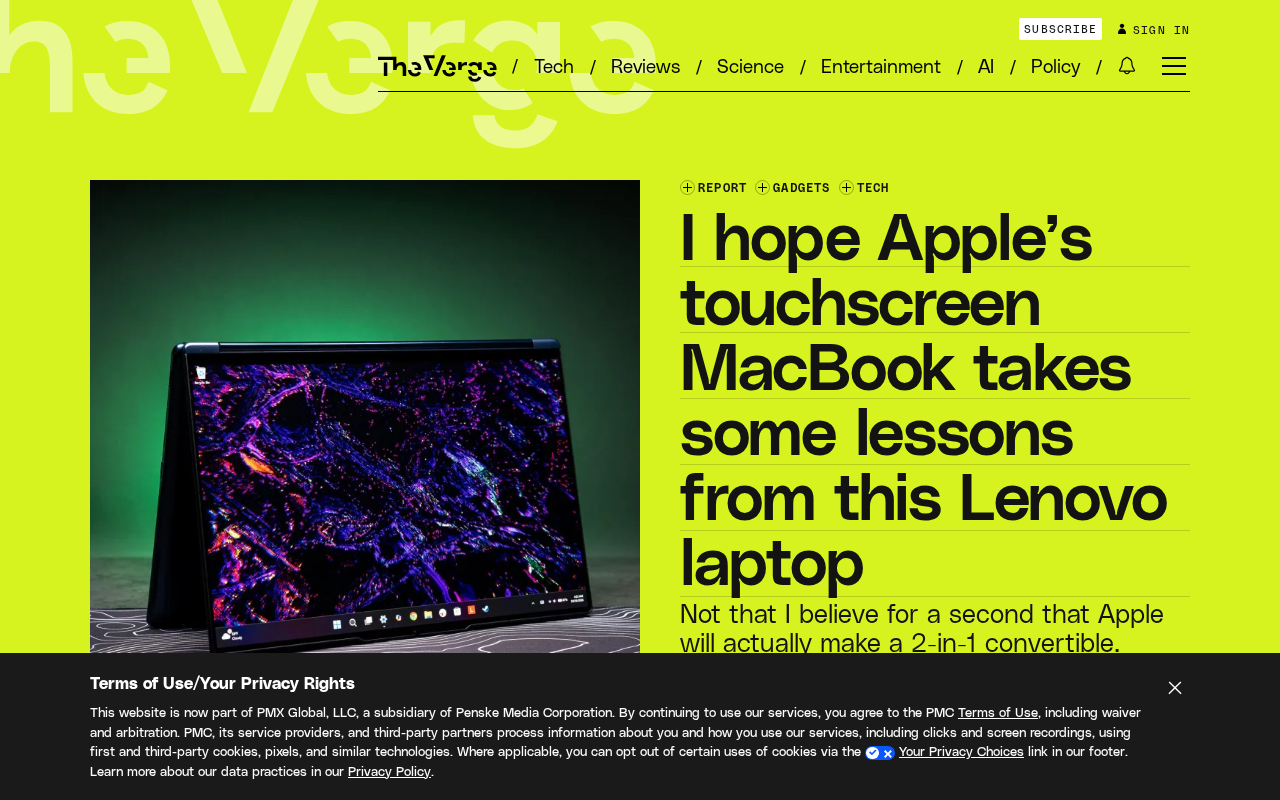
A foreign media commentary offers an interesting reference point: the Lenovo Yoga 9n. The author used this laptop while testing NVIDIA's RTX Spark platform and said outright that "this is most of what I want a touchscreen MacBook to be." That assessment is worth unpacking—it highlights the form a touchscreen laptop should have, while also implicitly warning about pitfalls Apple could fall into.
What the Lenovo Yoga 9n Gets Right
Form Freedom: Seamless Switching from Laptop to Tablet
The Yoga series' core selling point is its 360-degree flip hinge, and the 9n continues that design. The screen can rotate to any angle and fold completely flat into tablet mode. For a touchscreen laptop, this form-factor flexibility is almost essential—if it could only open and close like a traditional laptop, the touchscreen would be far less useful.
According to the original author's experience, the Yoga 9n is highly polished across multiple modes, which is one reason it's seen as a reference for a touchscreen MacBook. If Apple makes a touchscreen MacBook, whether it's willing to break the clamshell structure that the MacBook Air/Pro has retained for years is a key decision point.
The 360-degree flip hinge is a typical design for 2-in-1 laptops, first popularized by Lenovo's Yoga series in 2012. Its structure allows the screen to rotate 360 degrees around the hinge, letting the device switch among four modes: laptop, tent, stand, and tablet. The key to this design is hinge damping: it must keep the screen stable at any angle, control the feel of opening and closing, and provide enough rigidity to support touch and stylus input. Compared with detachable 2-in-1s (like the Surface Pro), the advantage of a convertible is that switching modes requires no separating of parts, but the trade-off is usually slightly higher overall weight and thickness.
Performance Foundation: Local AI Capabilities Brought by RTX Spark
Another highlighted point of the Yoga 9n is that it's equipped with NVIDIA's RTX Spark platform. The original article draws an analogy to Apple's custom chips: just as modern MacBook Pros rely on Apple silicon for energy efficiency and AI compute, RTX Spark likewise emphasizes local AI processing. This means that beyond touch interaction, the device also needs enough compute to support scenarios like stylus input, gesture recognition, and local AI features.
From Apple's perspective, the AI compute of the M-series chips is already in place, so the hardware foundation isn't the hard part. The real question lies in software and the interaction layer—whether macOS will be redesigned for touch, or whether Apple will start from scratch.
Local AI processing means the device completes inference tasks on-device rather than uploading data to the cloud. Its advantages include low latency, privacy protection, and offline availability, but it is limited by the device's compute and power consumption. On laptops, local AI is typically used for background blur, voice noise reduction, image generation, handwriting recognition, and similar scenarios. Apple's Apple silicon provides a hardware foundation for local AI through its unified memory architecture and Neural Engine, while the Core ML framework in macOS lets developers tap into that compute. NVIDIA's RTX Spark platform likewise emphasizes on-device AI, and its GPU architecture has advantages in parallel computing. The two take different approaches but share the same goal: enabling touch, gestures, and intelligent features to respond in real time locally.
Three Things Apple Needs to Learn from Lenovo
First, a touchscreen isn't as simple as adding a touch layer. The value of the Yoga 9n lies in the fact that its entire form design (hinge, screen ratio, weight distribution) serves touch and multi-posture use. If Apple merely swaps in a touchscreen for the MacBook, the experience is likely to be awkward and ill-conceived.
Second, ecosystem adaptation must keep up. Lenovo benefits from the Windows ecosystem, where touch apps and stylus support already have a foundation. macOS has long centered on keyboard and mouse, so touch optimization will require investment from both developers and Apple.
Third, pricing and positioning must be clear. If a touchscreen MacBook has vague positioning, it could easily create internal competition between the MacBook Air and iPad Pro. The Lenovo Yoga series differentiates its product lines by size and configuration, and Apple likewise needs to think through the unique value of this device.
The Industry Signal Behind the Rumor
The reason rumors of a touchscreen MacBook keep heating up is tied to the overall trend in the PC industry. Touchscreen laptops in the Windows camp have been iterated for years, with constant form-factor innovation from 2-in-1s to convertibles. If Apple enters the fray, it means it recognizes the value of touch in productivity scenarios—which is itself a signal.
But Apple has never been a follower. If a touchscreen MacBook does arrive, it's more likely to come with a complete interaction logic rather than simply copying what the Windows camp has done. The reference provided by the Lenovo Yoga 9n is more of a reminder to Apple: form, performance, and ecosystem are all indispensable.
Conclusion
For now, everything about a touchscreen MacBook remains in the rumor stage; the product form, launch timing, and software approach are all undetermined. But the existence of the Lenovo Yoga 9n shows one thing: doing a touchscreen laptop well requires system-level design, not just stacking up screen specs. If Apple makes its move, it's worth anticipating—and worth examining against a higher standard.
Background
The maturity of a touch ecosystem depends on three levels: whether the operating system provides native touch gestures and controls, whether common apps have redesigned their interactions for touch, and the latency and pressure sensitivity support of the stylus. After years of iteration, the Windows camp has developed a set of touch interaction conventions, but third-party app adaptation remains uneven. macOS has long used keyboard and mouse as the primary input method, and the size and spacing of its interface controls (such as the menu bar and toolbars) are not designed for finger operation. If Apple launches a touchscreen MacBook, it may need to introduce a touch mode in macOS or push developers to optimize existing apps for touch—a massive ecosystem coordination effort.
Related articles

WorkBuddy Full Feature Deep Dive: Three Modes and WeCom Integration in Practice
A deep dive into WorkBuddy's three task modes, WeCom integration, and high-value scenarios like foreign trade inquiries, payroll, and scheduled tasks, with a sober assessment of credit strategy and ecosystem lock-in.

Can Foldable Phones Disrupt the Vertical Short-Drama Ecosystem?
The large unfolded screen of foldables doesn't suit vertical short videos—huge black bars appear on both sides. Meanwhile, China-origin micro-dramas are generating over $1 billion in US revenue in vertical format. With foldables under 2% of global sales, can they disrupt the vertical content ecosystem?

Programming Laws Tier List: Which Are Truths and Which Should Be Retired?
From Conway's Law to Brooks's Law, senior developers Tier List classic programming laws: which still hold in the AI era, and which are overrated folk wisdom?