Run Claude Code for Free: DeepSeek V3 & Gemini API Integration Guide
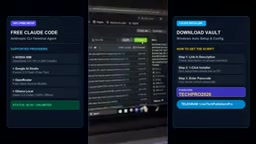
Use a one-click installer to switch Claude Code's backend to low-cost APIs like DeepSeek and Gemini for nearly free terminal AI coding.
The article presents a Hindi tech YouTuber's low-cost method: a one-click Windows installer redirects Claude Code's API endpoint to third-party Anthropic-compatible services, switching the backend to DeepSeek V3, Gemini, or OpenRouter-aggregated models without changing the terminal interface. It notes limitations in instruction-following and tool-call stability versus native Claude models, and dependence on compatibility-layer maintenance.
Claude Code's capabilities have caught many developers' attention, but the subscription cost isn't cheap for individual users. A Hindi-language tech YouTuber offers an alternative approach: use open-source tools to switch Claude Code's backend to free or low-cost API providers like DeepSeek V3 and Gemini, paired with a one-click Windows installer, to get a similar terminal-based AI coding experience at nearly zero cost.
Why Switch Claude Code's Backend
Claude Code is essentially an AI coding assistant that runs in the terminal, handling file reads and writes, command execution, and project structure understanding. By default it calls Anthropic's own models, billed by token. For people who write code frequently, these costs add up considerably.
The video opens with a self-deprecating line that nails the motivation—"No money for Claude? No problem, I'm broke too." The approach the creator offers is to redirect Claude Code's API endpoint to third-party compatible services, so the terminal interface stays the same, but the model called behind the scenes switches to DeepSeekAd, Gemini, or various models aggregated through OpenRouter, dramatically cutting costs or even eliminating them entirely.
Claude Code's API endpoint can be swapped because it follows the Anthropic Messages API request format, and many third-party providers offer interfaces compatible with that format. The so-called "API compatibility layer" means these providers translate incoming requests originally meant for Anthropic into a format their own models understand, then return results in Anthropic's response structure. This means any client that supports the Anthropic interface spec (including Claude Code) can call other models with the interface completely unchanged, simply by switching the base URL and key to a third-party platform's. This is the underlying premise that makes the whole approach work.
Hands-On with the One-Click Windows Installer
The creator's demo revolves around a one-click Windows installer package. After running it, there's no need to manually configure a Node environment or install dependencies one by one—the installer automatically handles Claude Code's runtime environment and guides the user into the provider configuration step.
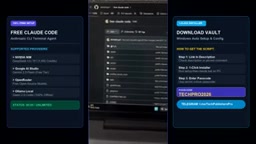
This step is the core of the whole approach. The installer comes with presets for multiple API providers, and users only need to enter the key for the corresponding platform to make Claude Code use that platform's services. For those who aren't familiar with environment variables and config files, the graphical configuration entry point saves a lot of troubleshooting time.
Provider Configuration: DeepSeek, Gemini, and OpenRouter
After entering settings, you'll see a fairly long provider list. The creator highlights several: Claude official, Cloudflare, Gemini, and a whole bunch of models accessed through OpenRouter.
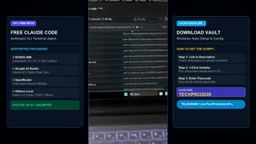
OpenRouter deserves special mention. It's a model aggregation gateway that unifies DeepSeek, the NVIDIA series, and various open-source models under a single API interface. In the video, the creator deliberately scrolls to OpenRouter's model list: the DeepSeek series is prominently featured, along with a batch of models callable through OpenRouter's free quota.
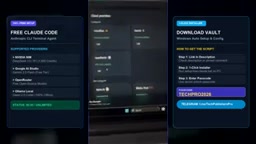
DeepSeek V3's appeal in this scenario comes down to two things: sufficiently strong coding ability, and API pricing far below mainstream closed-source models; some channels even offer free quotas. Gemini, meanwhile, becomes another low-cost option thanks to the free call quota Google provides. The creator mentions "millions of tokens" of free quota in the demo—plenty for everyday scripting and bug fixing.
OpenRouter's operating model can be understood as "one API key to access hundreds of models." Developers only need to register with OpenRouter and get a single key, then switch between different vendors' models through a unified interface and model identifiers (such as deepseek/deepseek-chat), with billing settled uniformly within the OpenRouter account. Its value lies in eliminating the hassle of registering with each platform separately and managing keys and bills individually, while some models with a :free suffix can be called directly using the free quota. Note that free models usually have rate limits and may queue or fail during peak hours, making them better suited for experimentation than stable production.
Limitations and Use Cases for This Approach
Connecting Claude Code to third-party APIs isn't without cost. Some of Claude Code's features are tuned for Anthropic model characteristics, and after switching models, the stability of tool calls and long-context performance may differ. DeepSeek and Gemini perform well in code generation, but in complex multi-step tasks their instruction-following ability still lags behind Claude's native models.
Additionally, this kind of third-party integration depends on ongoing maintenance of the API compatibility layer. Once a provider adjusts its interface or tightens free quotas, the configuration may stop working. Treating it as a low-cost option for learning and small projects is reasonable, but using it for critical production workflows requires careful evaluation.
At the end of the video, the creator reminds viewers to like and subscribe—overall it's a practical tutorial aimed at budget-conscious developers. For those who want to try terminal-based AI coding but don't want to pay right away, this path is worth a shot.
Tool use (Function Calling) is the most easily overlooked difference in this kind of alternative approach. Claude Code's heavy file I/O and command execution depend on the model reliably outputting tool-call instructions that conform to a JSON Schema; even a slight deviation can lead to malformed command concatenation or getting stuck in a loop. Different vendors vary widely in how much they've trained for tool use, and a multi-step workflow that runs smoothly on Claude might require repeated correction on a less-compatible model with the same prompt. So when evaluating alternative models, beyond looking at code completion quality, you should also actually test their stability in multi-turn tool calls and their performance with long contexts (e.g., project files with hundreds of thousands of tokens).
One-line Summary
Use a one-click installer to switch Claude Code's backend to low-cost APIs like DeepSeek and Gemini, achieving nearly free terminal-based AI coding.
Paragraph Summary
The article introduces a low-cost approach from a Hindi-language tech YouTuber: through a one-click Windows installer, redirect Claude Code's API endpoint to third-party services compatible with the Anthropic interface, so that without changing the terminal interface, the backend model switches to DeepSeek V3, Gemini, or various models aggregated by OpenRouter. The installer includes presets for multiple providers, and users only need to enter a key to complete configuration, saving the hassle of manually setting up a Node environment and variables. OpenRouter acts as an aggregation gateway unifying access to DeepSeek, the NVIDIA series, and some free models. The article also points out that this approach falls short of Claude's native models in instruction-following and tool-call stability on complex multi-step tasks, and depends on compatibility-layer maintenance with free quotas that may change, making it better suited for learning and small projects rather than critical production workflows.
Related articles
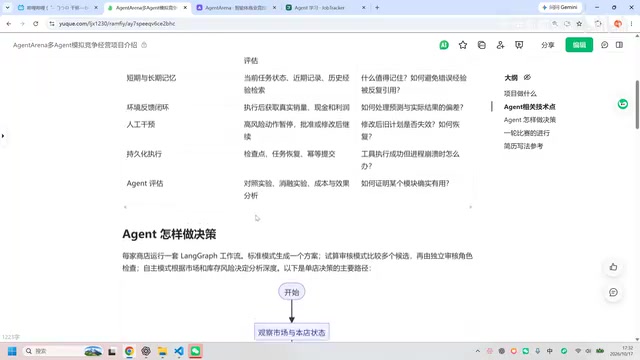
Hands-On Review of an Open-Source Multi-Agent Business Simulation Project
Hands-on review of a Bilibili creator's open-source multi-agent sandbox business project: architecture, memory, HITL, evaluation, and LLM vs rule-engine results.
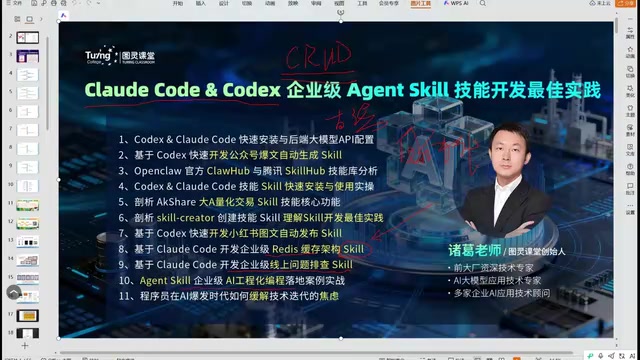
AI Engineering in Practice: The Complete Workflow of Claude Code and Agent Skill Development
A Bilibili hands-on course analyzes AI engineering: using Claude Code, Codex, and WorkBuddy to develop enterprise-grade Agent Skills, covering WeChat article drafts, quantitative analysis, and automated Xiaohongshu posting, while explaining the paradigm shift of Skill-driven development and tool selection.
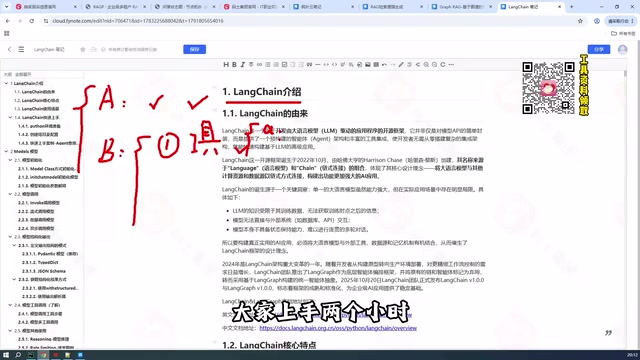
LangChain for Beginners: A Practical Guide to Structured Output and Agents
Starting from zero with LangChain: clarify the difference between low-code platforms and large model application development, covering structured output, tool calling, Agent practice, and multi-tenant RAG enterprise deployment—ideal for engineers with development experience looking to transition into AI application development.