Runaway Multi-Step AI Agent Costs and Loop Protection: A Production Architecture Deep Dive

A proxy gateway cuts multi-step agent costs by about 54% through loop circuit-breaking, semantic routing, and LLM-judge evaluation.
The article tackles two major cost risks in production multi-step AI agents—retry loops causing runaway token spend and flagship models being misused for simple intermediate steps—by proposing a proxy gateway between the agent framework and the LLM provider. The gateway handles automatic loop detection and circuit-breaking via request signatures and user IDs, routes simple steps to lightweight models based on prompt complexity, and uses LLM-as-a-Judge with asynchronous sampling to auto-roll back all traffic to the flagship model when a 95% equivalence threshold is breached. Real logs of 3,571 requests show lightweight models handled about 65% of request volume yet only 2.4% of cost, with total spend dropping from $156.78 to $72.28—about a 54% reduction. The author cautions that routing benefits depend heavily on request composition, so teams should benchmark against their own logs first.
When multi-step AI agents run in production, there are two risks nearly every team runs into: first, the agent gets stuck in a retry loop and burns hundreds of dollars in tokens within minutes; second, flagship models are used for intermediate steps like formatting, classification, and tool-call validation, which severely damages unit economics. GuardrailX's co-founder (the original author) shares the architecture and real data behind using a proxy gateway to solve both problems.
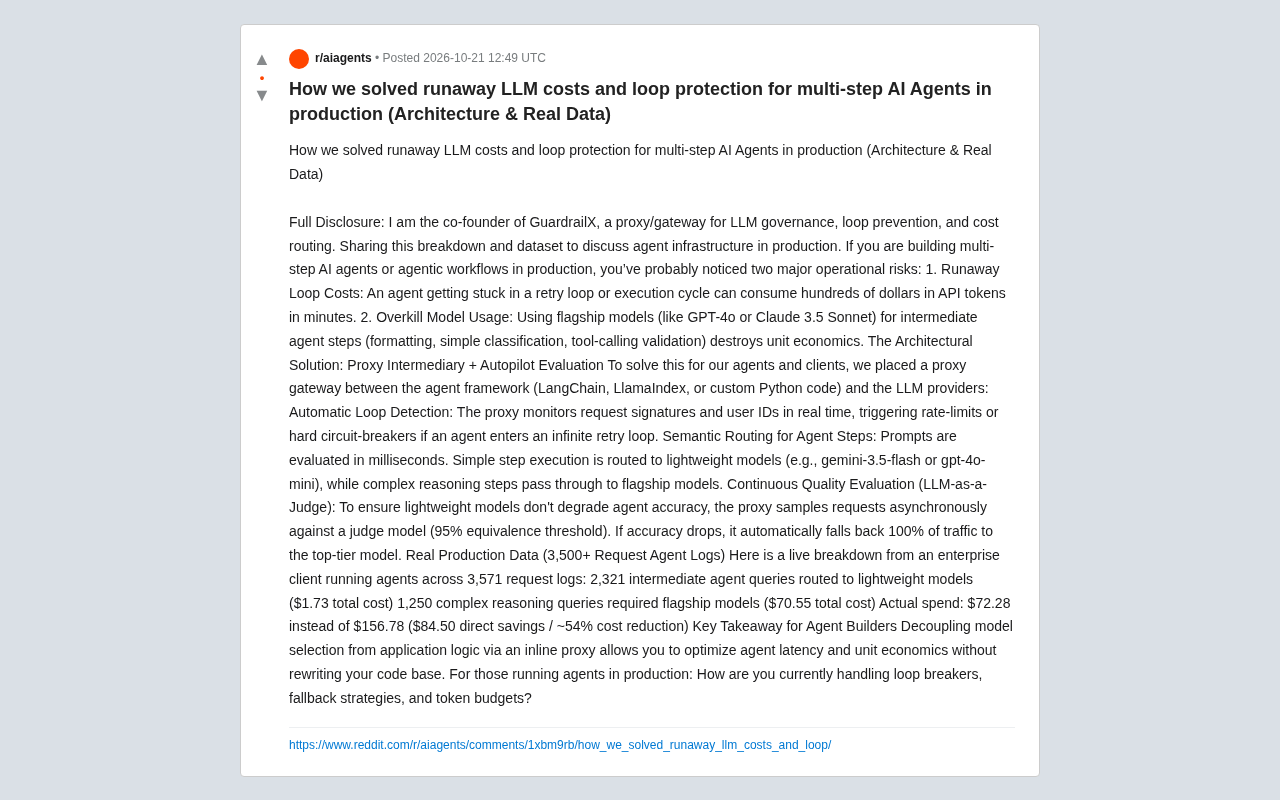
Breaking Down the Problem: Two Kinds of Cost Runaway
The original post distills the operational risks of production agents into two points. The first is Runaway Loop Costs: when an agent gets stuck in a retry loop or execution cycle, API token consumption can reach hundreds of dollars within minutes. This isn't a theoretical risk—each step of a multi-step agent can trigger tool calls, validation, and retries, and the loop amplification effect is very pronounced.
The second is Overkill Model Usage: using GPT-4o or Claude 3.5 Sonnet for an agent's intermediate steps (formatting, simple classification, tool-call validation) directly destroys unit economics. What these two problems share is that they both occur outside the application logic, yet are hardest to govern within it.
The Architecture: A Proxy Intermediary + Automated Evaluation
The author's solution is to insert a Proxy Intermediary between the agent framework (LangChain, LlamaIndex, or custom Python code) and the LLM provider. This gateway takes on three responsibilities.
Automatic Loop Detection
The proxy monitors request signatures and user IDs in real time. Once an agent enters an infinite retry loop, it triggers rate limiting or a hard circuit-breaker. The key is to extract loop protection from the application code—writing loop-detection logic at the application layer is error-prone and hard to maintain, whereas placing it at the gateway layer applies it uniformly to all agents.
Request signatures are fingerprints the gateway generates for each LLM call, typically composed of a hash of the prompt text, model parameters, tool-call context, and other elements. The proxy gateway continuously aggregates the frequency and intervals of identical signatures; when a given signature repeats beyond a threshold within a short time window, it can be judged a potential loop. Compared with maintaining retry counters in application code, signature detection does not depend on the agent framework's internal state and treats LangChain, LlamaIndex, or hand-written Python code alike. Combined with the user ID dimension, it can also distinguish an abnormal retry in a single session from a batch task shared by multiple users, thereby avoiding false positives on normal high-frequency calls.
Step-by-Step Semantic Routing
The gateway evaluates each prompt in milliseconds: simple steps are routed to lightweight models (such as gemini-3.5-flash or gpt-4o-mini), and only complex reasoning steps are allowed through to flagship models. This decouples model selection from application logic—the agent code doesn't need to know which model the current step should use.
Semantic routing means the gateway, without changing the agent's business logic, performs lightweight classification on each incoming prompt to determine whether it belongs to a low-complexity task such as formatting, extraction, or classification, or a high-complexity task requiring multi-step reasoning and long-context understanding. There are usually two implementation approaches: one is to score prompt features (length, instruction type, whether a tool schema is included) based on rules or a small classifier; the other is to use a very small model for intent discrimination. Routing decisions complete in milliseconds and are transparent to the agent—the agent still calls the same endpoint as before, and the gateway decides which model actually receives the request. This decoupling allows model selection to iterate independently of business code and makes it easy to run canary experiments by traffic proportion.
Continuous Quality Evaluation with LLM-as-a-Judge
Lightweight models may lower agent accuracy, so the proxy asynchronously samples requests and hands them to a judge model for evaluation, setting a 95% equivalence threshold. If accuracy drops, it automatically rolls 100% of traffic back to the top-tier model. This design turns the trade-off between "saving money" and "quality" into an automatically adjustable closed loop, rather than setting routing rules by gut feeling.
LLM-as-a-Judge is an evaluation paradigm in which a strong model automatically scores or compares the outputs of weaker models. In the proxy gateway scenario, the judge model receives the outputs of the lightweight model and the flagship model for the same prompt and determines whether the two are semantically equivalent, thereby measuring the lightweight model's accuracy on real traffic. The 95% equivalence threshold means: when sampled evaluation shows that the proportion of cases where the lightweight model's output is equivalent to the flagship model's falls below 95%, the gateway judges quality to be unacceptable and automatically switches all traffic back to the flagship model. The key to this mechanism is asynchronous sampling—evaluation does not block user requests, and the sampling ratio is adjustable, balancing cost against monitoring sensitivity. The threshold itself must be set according to business fault tolerance; scenarios with extremely high accuracy requirements should raise it above 98%.
Proxy Intermediary in this article refers to a reverse proxy layer deployed between the agent application and the LLM API, through which all model calls are forwarded. What distinguishes it from a traditional API gateway is its LLM semantic awareness: it can parse prompt content, identify model endpoints, tally token usage, and execute routing, rate limiting, and circuit-breaking accordingly. Since agent frameworks usually only need the base_url changed to connect, the gateway approach is minimally invasive to existing code—which is why the author emphasizes "without rewriting the codebase." The cost is an extra hop of network latency and the gateway itself becoming a single point of failure; production deployments need to consider high availability and timeout fallback strategies.
Real Production Data: 3,571 Request Logs
The original post provides real-time data from an enterprise customer (3,571 request logs):
- 2,321 intermediate agent queries routed to lightweight models, total cost $1.73
- 1,250 complex reasoning queries routed to flagship models, total cost $70.55
- Actual total spend $72.28, versus $156.78 if everything went through the flagship model
That's a saving of $84.50, a cost reduction of about 54%. What's notable about this data isn't the 54% figure itself but the cost structure: lightweight models handled about 65% of request volume but contributed only about 2.4% of the cost. This shows that intermediate steps may account for a low share of token consumption but a high share of request count—the value of routing shows up mainly in the request-volume dimension, not the token-volume dimension.
Implications for Agent Builders
The author's core conclusion is that decoupling model selection from application logic via an inline proxy can optimize agent latency and unit economics without rewriting the codebase. The universality of this idea lies in the fact that it turns "cost governance" into an infrastructure-layer problem rather than a business problem each agent developer has to solve on their own.
The original post closes by asking production agent practitioners three questions: how do you currently handle loop circuit-breaking, fallback strategies, and token budgets? These three questions happen to correspond to the three weak spots in agent operations.
It should be noted that the data in this article comes from a single vendor's customer case, and the 54% reduction will vary greatly with different request compositions—if an agent has a low share of intermediate steps and a high share of reasoning steps, the routing benefit shrinks significantly. The architectural approach is worth learning from, but the specific benefit needs to be measured against your own request distribution.
Conclusion
The core of cost governance for multi-step agents is not choosing cheaper models, but extracting model selection, loop detection, and quality fallback from application logic into the proxy layer. Real data shows that routing along the request-volume dimension can deliver considerable cost optimization, but the benefit depends heavily on request composition—before adopting it, benchmark against your own logs.
One-line Summary
A proxy gateway cuts multi-step agent costs by about 54% through loop circuit-breaking, semantic routing, and LLM-judge evaluation.
Paragraph Summary
The article addresses two major cost risks in production multi-step AI agents—retry loops causing runaway token spend, and flagship models being misused for simple intermediate steps—by proposing a proxy gateway inserted between the agent framework and the LLM provider. The gateway handles three responsibilities: automatic loop detection and circuit-breaking based on request signatures and user IDs, routing simple steps to lightweight models by prompt complexity, and asynchronous sampling evaluation with LLM-as-a-Judge that triggers automatic full rollback to the flagship model when a 95% equivalence threshold is breached. Real logs of 3,571 requests show that lightweight models handled about 65% of request volume yet accounted for only 2.4% of cost, with total spend dropping from $156.78 to $72.28—a reduction of about 54%. The author also cautions that routing benefits depend heavily on request composition and that teams should benchmark against their own logs before adopting it.
Related articles

JobRunner MCP Server: AI Agents Can Now Fix Failed Java Jobs
JobRunner launches an open-source MCP server enabling AI agents to view cluster status, diagnose failures, and recover Java jobs—incident response from any cloud coding environment or existing agent.

MLAI Digital Launches 9 Security Agents: MCP Server Safeguards the Full Lifecycle of Agentic AI
MLAI Digital launches Security MCP Server with nine built-in specialized security agents covering vulnerability discovery, attack simulation, prompt injection detection, API and infrastructure assessment, and accelerated remediation—embedding security validation across the full Agentic AI lifecycle from development to production.

Running Isaac Lab on H100 GPUs: Exploring Better Approaches
Exploring optimization methods for running Isaac Lab on NVIDIA H100 GPUs, including MIG configuration, mixed precision, TensorRT acceleration, and community experience to improve robotics simulation and reinforcement learning efficiency.