Running a 125B LLM on a Single RX 7900XTX: Avalon vs. Strata Benchmark Showdown
A single 24GB RX 7900XTX runs a 125B model as Strata and Avalon AMD-optimized engines go head-to-head.
A real-hardware test on a Ryzen 3700X with 96GB DDR4 and a single 24GB RX 7900XTX runs a 125B model, comparing Avalon and Strata RDNA3, two AMD-optimized inference engines. Strata leads sustained generation at 92.5 vs. 80.3 token/s (~15.2%) and hits 3,190 token/s prefill at ~250K tokens—1.92x Avalon—cutting time-to-first-token from 156s to 81s. But real-world tasks reverse: Strata wins long-doc extraction and 64K needle-in-a-haystack, while Avalon wins coding at 20.79s. The root cause is different VRAM scheduling—Avalon uses expert caching, Strata uses HostDMA KVCache swapping plus rebuilt AMD matrix operators.
Can a Single Consumer GPU Handle a 100B+ Parameter Model?
Many people used to believe that running a 125B-class model on a single consumer GPU with 24GB of VRAM would either blow out memory entirely or run like a slideshow. But a recent real-hardware benchmark shattered that stereotype: on an identical hardware platform, two inference engines specifically optimized for AMD—Avalon and Strata—went head-to-head in a performance showdown. Generation speed not only hit 92.5 tokens per second, but when handling ultra-long text, the gap in time-to-first-token and prefill throughput between the two nearly reached a full 2x.
This isn't empty talk under identical quantization conditions—it's a direct collision between two complete engineering optimization approaches. For users looking to squeeze every drop of potential out of their AMD GPUs locally, this test provides highly valuable real-world data.
Test Platform and Competitors
A Budget-Friendly Test Bench
The test platform is quite down-to-earth: an older Ryzen 3700X CPU (which doesn't even support AVX512), paired with about 96GB of DDR4 memory, with all computation relying on a single 24GB RX 7900XTX. The system runs Windows, with drivers locked to the official ROCm version. There's no server-grade hardware here—just a combination any ordinary enthusiast could put together.
Core Differences Between the Two Optimized Engines
On the left is Avalon, using a specially optimized IQ3KS mixed quantization model with two-step MTP speculative decoding. On the right is Strata RDNA3, equipped with Swift IQ3S quantization, four-step speculative decoding, and matrix operators deeply rearchitected for AMD architecture.
It's important to emphasize that both engines ran their own officially validated maximum-performance configurations, all single-GPU, single-concurrency, with MTP maxed out by default. This means the comparison isn't about some isolated parameter—it's about the peak performance of two complete engineering philosophies.
IQ3KS / IQ3S quantization: These names belong to the k-quant series in the GGUF ecosystem. The number 3 means weights average about 3 bits, the suffix i typically stands for "important" (keeping higher precision for certain important tensors), and S/K indicate different-scale hybrid schemes. A 125B model at 3-bit storage requires roughly 45–48GB, far exceeding 24GB of VRAM, so expert offloading or KVCache swapping must be used to run it.
MTP speculative decoding: Multi-Token Prediction is the general term for multi-step speculative decoding, where a small draft head or extra prediction layer proposes multiple candidate tokens at once, and the main model verifies them in parallel—accepting them all at once on a hit. Two-step and four-step refer to the number of candidates proposed per round; more steps theoretically yield higher acceleration, but the rollback cost of verification failures also increases.
Round 1: Sustained Generation Speed
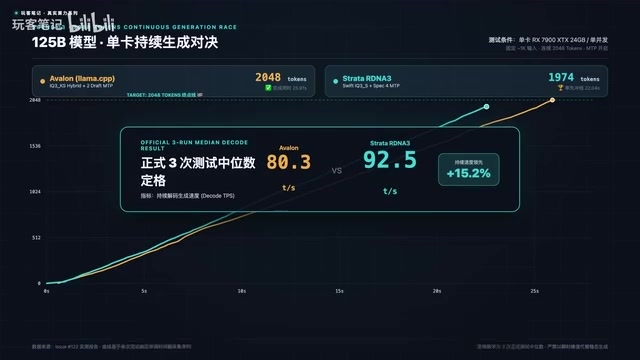
Both engines were fed identical prompts and asked to generate 2048 tokens continuously in one go. Each configuration was officially tested three times, with the median taken to eliminate chance.
From the start, the two were neck and neck. Avalon achieved a solid 80.3 tokens per second—running a 125B model on a single GPU at this speed is already quite smooth for daily use. But Strata's performance was even more impressive, with sustained generation speed reaching 92.5 tokens per second—a full 15.2% lead.
Note that this isn't a fake peak—it's a stable result from 2048 tokens of continuous output. For casual chat you might not notice much difference, but when you need a local model to write lengthy code or generate large technical documents, that 15% sustained speedup translates directly into real productivity time saved.
Round 2: Ultra-Long Context Stress Test
The difficulty ramps up sharply. The test pushed input length from 32K to 64K to 128K, all the way to the extreme of nearly 256K—about 250,000 tokens.
Generation Speed: The Gap Starts to Widen
Under ultra-long context, Avalon's decoding speed gradually dropped from 71 tokens per second to 59.5 tokens per second, while Strata, thanks to superior memory scheduling, held steady at 83.1 tokens per second even under the massive load of about 250,000 tokens.
Prefill Throughput: Where the Real Generation Gap Lies
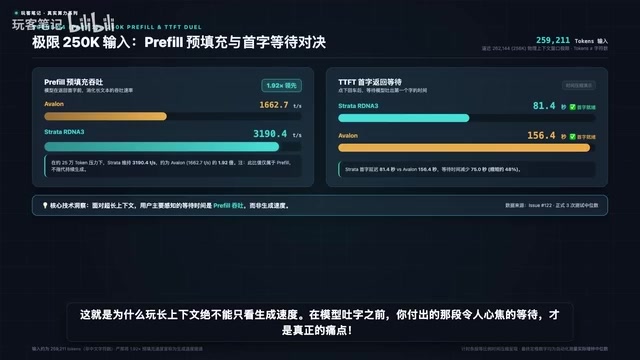
But what truly creates a generational gap between the two engines isn't generation speed—it's Pre-Fill, the speed at which the model digests massive input before emitting its first token. Under the pressure of about 250,000 tokens, Avalon processed 1,663 tokens per second, while Strata hit a blazing 3,190—a staggering 1.92x difference.
Numbers alone aren't intuitive, so look directly at time-to-first-token: facing the same ~250,000-token ultra-long text, Avalon required a painful two-and-a-half-minute wait (a full 156 seconds) before the first token appeared, while Strata took only 81 seconds—cutting the wait time by more than half. This is why you should never look only at generation speed for long-context work—the agonizing wait before the model starts producing tokens is the real pain point.
After the first two rounds, Strata seemed to have victory well in hand. But high benchmark scores don't equal usability—what matters is whether it can actually get real work done.
Pre-Fill and time-to-first-token (TTFT): Autoregressive inference has two phases—the prefill phase performs a single forward pass over the entire input to build the KVCache, which is compute-intensive and highly parallel; the decoding phase generates tokens one by one and is memory-bandwidth-intensive. Time-to-first-token is almost entirely determined by prefill time, whose throughput is often measured in tokens/s. The longer the context, the more prefill computation grows approximately quadratically with length (the attention part), so at 250,000 tokens, prefill capability determines usability more than decoding speed.
Round 3: Real-World Business Scenario Evaluation
The test pulled out three real business scenarios, and the results produced a fascinating reversal.
Long-document key fact extraction: Both engines extracted the internal codename and budget with perfect accuracy. Strata took 7.37 seconds versus Avalon's 10.94 seconds—a slight edge for Strata.
64K needle-in-a-haystack: Three pieces of top-secret information buried at the beginning, middle, and end of a long text were all hit with 100% accuracy by both. Strata took 25.86 seconds versus Avalon's 38.11 seconds—Strata still faster.
Actual programming task: The reversal appeared. Both engines' thread-safe cache code passed all three automated unit tests in a strictly controlled environment on the first try. But this time Avalon finished in just 20.79 seconds, while Strata took 25.04 seconds.
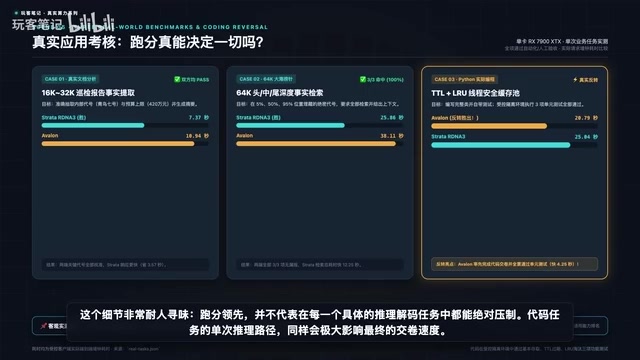
This detail is quite intriguing: a benchmark lead doesn't mean absolute dominance in every specific reasoning and decoding task—the single-inference path of a coding task can also greatly affect final completion speed.
Why Does the Same GPU Perform So Differently?
The core issue is the massive size of the 125B model—no single 24GB GPU can hold it no matter what. The two engines chose different workarounds.
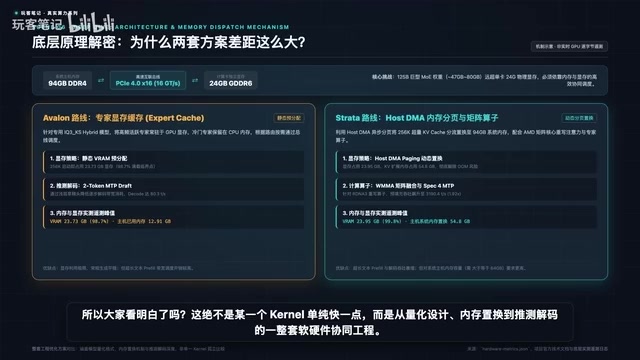
Avalon takes the expert caching route: keeping the most frequently used expert subsets resident in GPU memory, leaving the rest of the many cold experts in 96GB of system memory for on-demand scheduling, and using two-step speculative decoding to compensate for memory bandwidth.
Strata RDNA3 goes deeper and more aggressively: using HostDMA technology to swap excessive KVCache into system memory, completely breaking the 256K context VRAM curse; meanwhile, it rearchitects fused operators for AMD matrix cores and pairs them with four-step speculative decoding to squeeze maximum hardware compute during the prefill phase.
So this isn't about one kernel being slightly faster—it's a complete software-hardware co-engineering effort spanning quantization design, memory swapping, and speculative decoding. Each approach has its trade-offs, which also explains why they trade wins on certain tasks.
MoE expert caching vs. KVCache swapping: 125B-class models are mostly Mixture-of-Experts (MoE) architectures, where only a subset of experts is activated per forward pass—this creates room for "keeping hot experts resident in VRAM and swapping in cold experts from memory on demand," at the cost of latency jitter from swap-in/swap-out. KVCache swapping is another path: under long contexts, the KVCache itself can reach tens of GB, and by spilling it to DDR4 via HostDMA (a zero-copy channel for GPUs to directly read/write system memory), the VRAM capacity limit can be exceeded—but it's constrained by PCIe bandwidth. The two approaches are limited by expert scheduling hit rates and host memory bandwidth respectively, which is exactly why they trade wins across different tasks.
Conclusion and Selection Recommendations
In this showdown of running a 125B model on a single RX 7900XTX with each side at its best optimization, Strata RDNA3 took the overall performance crown with a terrifying near-2x advantage in long-text prefill and a 15% lead in sustained generation. Avalon also performed solidly, even striking back beautifully in the coding task.
If you have a 7900XTX and regularly need ultra-long document analysis, local large models, and long-document processing, Strata is undoubtedly the performance choice for now; but if your workload leans more toward code generation and other tasks sensitive to single-inference paths, Avalon's expert caching approach still has its place.
The real value of this showdown: it proves that running 100B+ parameter models on a single consumer GPU has moved from "can it run" to "how to run it better." Software-hardware co-engineering is gradually bringing capabilities that once belonged to server clusters onto ordinary enthusiasts' desktops.
Related articles
 Tech Frontiers
Gemini Omni 1.2 Flash: AI Video Moves Toward Draft-Style Editing
Google's Gemini Omni 1.2 Flash update enables conversational, draft-style editing of the same video—swap scenes while keeping products, adjust lighting while keeping characters. Clips up to 15s, 720p costs 30% less than the previous Flash—ideal for e-commerce ads, previs, and short-asset production.

Codex Tutorial: One-Command Install and Run Your First Task
Codex tutorial: one-command install and run your first task. Covers the four Codex forms, sandbox and approval guardrails, AGENTS.md and MCP configs, cloud network policy, and the iron rule of human review—everything you need to get started with this autonomous coding agent.
 Tech Frontiers
Localix: An Open-Source Agentic Development Environment with Multi-Model and Local AI Integration
Localix is an MIT open-source Agentic Development Environment (ADE) supporting seamless Claude Code plugin loading, multi-model cloud and local execution, Mini Apps extensions, and agent context management—an open AI collaboration workbench for developers.