Running Edge AI with a Few Commands: NVIDIA's New Approach to Edge Model Deployment

NVIDIA simplifies edge AI model deployment with a few commands, lowering development barriers while performance optimization still requires trade-offs.
The article discusses NVIDIA's command-based edge AI deployment approach, noting that its real value lies in compressing the environment setup and hardware adaptation processes that have long plagued developers. Edge inference is driven by three constraints—low latency, limited bandwidth, and data privacy—with cabin monitoring as a typical scenario; hardware fragmentation is the real deployment challenge, and the command-based experience relies on an engineering system for automatic compilation and runtime adaptation. The article emphasizes that simplified deployment lowers trial-and-error costs for small and mid-sized teams, letting developers refocus on application logic, but engineering details such as model quantization, memory footprint, and power control still require device-specific judgment—commands solve the entry problem, not every problem.
The Barrier to Edge AI Development Is Being Redefined
AI is moving out of the data center. Developers are building a new generation of agents that execute tasks directly on the edge—monitoring driver attention and cabin state, performing inference locally rather than sending data back to the cloud. A recent NVIDIA developer blog post introduced an approach: running AI models on edge devices with just a few commands, compressing what was once a cumbersome deployment process into something minimal.
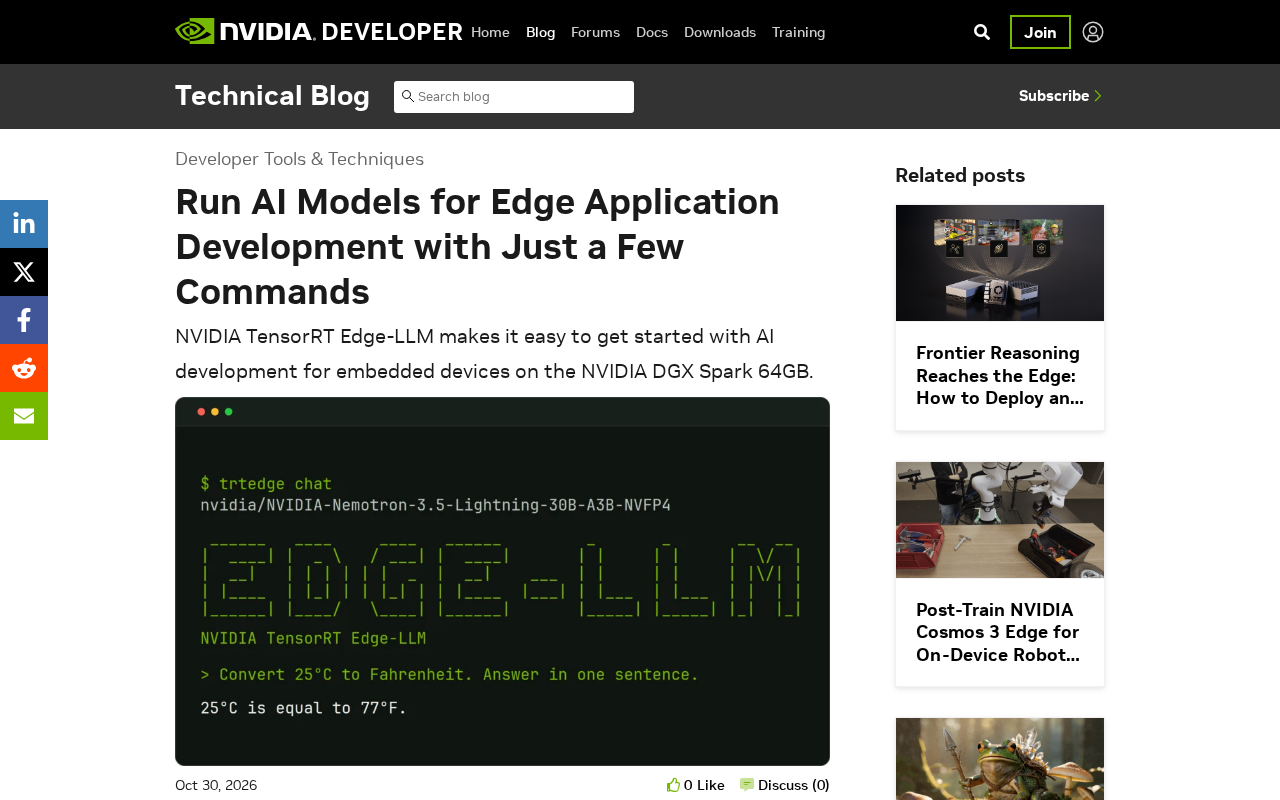
The significance here isn't that "the commands are shorter"—it's about the long-standing complexity of edge deployment. Models must be adapted to target hardware, operator compatibility must be handled, and the inference runtime must be wired up; a failure at any of these steps can leave developers spending enormous time on environment configuration. When deployment is reduced to a few commands, developers can redirect their effort back to the application logic itself.
Why Edge Inference Needs a Lighter Deployment Path
The Triple Constraints of Latency, Bandwidth, and Privacy
The core requirements of edge scenarios are straightforward: responses must be timely, networks aren't always reliable, and data ideally never leaves the device. Applications like cabin monitoring are especially latency-sensitive—inference results need immediate feedback, and the jitter of a round trip to the cloud is unacceptable. Running models on-device sidesteps these uncertainties.
Hardware Fragmentation Is the Real Challenge
Edge devices come in many forms, with varying compute power, memory, and power budgets. Getting the same model to deliver usable performance across different devices often requires hardware-specific compilation and optimization. This is precisely why "a few commands" deserves its own discussion—behind it sits an engineering system capable of handling hardware adaptation automatically.
Running a model on an edge device typically involves a compilation and optimization stage that converts a model exported from a training framework into an instruction sequence executable on the target hardware. This process involves operator mapping, memory layout adjustment, and precision strategy selection, and different chip architectures (such as GPU, NPU, and DSP) vary widely in their operator support. So-called automatic adaptation essentially packages the compilation configuration, operator fallback, and precision calibration that developers once handled manually into the toolchain, letting the system select appropriate kernel implementations based on target device characteristics. Understanding this helps frame the judgment: command-based deployment simplifies configuration work, while the model's own operator compatibility still depends on how thoroughly the toolchain covers the target hardware.
What Happens Behind the Commands
Judging from the approach disclosed in the original material, the goal of this pipeline is to let developers complete the conversion from model to a runnable on-device program with minimal operations. For developers, the experiential changes can be summarized as follows:
- Less friction in environment setup: no need to manually assemble the inference runtime and dependencies; the command-based entry point lowers the cost of getting started.
- Shorter validation cycles: whether a model runs correctly on the target device can be answered quickly, without a long trial-and-error process.
- Freedom retained at the application layer: with deployment simplified, business logic and interaction design remain in the developer's hands.
It should be noted that the original material did not disclose specific command syntax, the list of supported models, or performance benchmark data, so this article does not speculate on those details. Teams intending to implement this should consult the official documentation to confirm actual support.
The inference runtime is the software layer that actually executes the model on the device, responsible for loading the model, scheduling operators, managing memory, and handling input/output tensors. In traditional workflows, developers must install the runtime themselves, match versions to the model format, and configure the execution backend—version mismatches often cause load failures. The essence of a command-based entry point is to collapse runtime selection, dependency resolution, and backend binding into a single instruction, with the tool automatically determining the combination based on model format and target device. This also explains why simplified deployment can significantly shorten validation cycles—error-prone steps shift from scattered manual configuration into the toolchain, narrowing the scope of troubleshooting.
The Practical Impact on Developers
The competitive focus in edge AI is shifting from "can it run" to "how effortlessly can it run." As deployment processes become standardized and command-driven, small and mid-sized teams can also validate edge solutions at lower cost, rather than being shut out by environment engineering. For projects that need to deploy agents on-device, the value of such tools lies in driving down trial-and-error costs—get it running first, then optimize.
At the same time, simplified edge deployment doesn't mean performance issues vanish on their own. Engineering details such as model quantization, memory footprint, and power control still require developers to make judgments based on the specific device. Commands solve the entry problem, not every problem.
Model quantization is a common compression technique in edge deployment, converting floating-point weights and activations into low-bit integer representations to reduce memory footprint and compute requirements. Quantization introduces numerical error that can affect output quality on precision-sensitive tasks, so a trade-off must be made among model size, inference speed, and accuracy. Related to this are memory footprint and power control: edge devices have limited available memory and thermal budget, and sustained high-load inference may trigger throttling. These parameters usually need to be tuned through real-world testing on the specific device; command-based deployment only guarantees the model runs—it cannot replace performance calibration for the target hardware.
Conclusion
Deploying AI models to the edge is transforming from a specialized skill of a few teams into a more general development capability. Command-based deployment is one facet of this trend: it lowers the barrier without replacing an understanding of scenarios and hardware. For developers planning edge agent projects, it's worth spending time first getting this simplest path running, then deciding where to optimize further.
Related articles

Anthropic's IPO Crisis: Why $16.8B in Revenue Can't Buy a High Valuation
Anthropic posted $16.8B in Q3 revenue with 85% gross margin yet faces a cut to its IPO valuation. A deep dive into halved growth, the token price war, circular financing, and the clash between safety ideals and capital reality.

Anthropic Races Toward the Largest IPO in History: Can a $100 Billion Raise Ignite the AI Investment Boom?
Anthropic may file its prospectus as early as October 23, aiming to raise up to $100 billion at a valuation of up to $2 trillion, potentially the largest IPO ever. Q3 revenue hit $16.8 billion, up nearly 50% quarter over quarter, with adjusted profitability, but slowing growth has led some investors to cut valuation to $1.5 trillion. The IPO is a key test of whether the AI investment boom can continue.

Bessemer Partner on Anthropic IPO: The Public's First Direct Investment in AI Software
Bessemer partner Byron Theta on the Anthropic IPO: why it's called the moment everyone's been waiting for, the $650M four-round investment, the LP liquidity bind, and expectations of a 2027 IPO wave—plus open-source model pricing pressure, existential risk disclosures, and what the founders' 50.1% voting structure means for ordinary investors.