Running Gemma on a Printer: The Edge AI Reality Behind a Reddit Brainstorm

A Reddit brainstorm about running Gemma on a printer reflects the capability spread and safety tensions of edge AI.
The article revolves around a Reddit post titled "Gemma on a printer," analyzing three layers of narrative in the comments: functional jokes about language models over-explaining and wasting resources; safety vigilance citing Anthropic's self-replicating AI research and mentioning Dario Amodei; and anticipation interpreting the surge of Gemma posts as a signal of Gemma 5 iteration. The author notes that devices like printers rely on deterministic control logic, while language models output probabilistic results—the core contradiction of embedded deployment. What is truly valuable is validating the feasibility of shifting edge device interaction from fixed instruction sets to natural language interfaces through quantization, pruning, and inference framework adaptation. The discussion is not dense with information but distills the two tensions of capability spread and safety boundaries.
When Gemma Meets a Printer: The Technical Imagination of a Reddit Post
A Reddit post titled "Gemma on a printer" recently appeared, with an image showing someone attempting to deploy Google's Gemma model on an extreme edge device like a printer. The post itself was brief, but the comment section quickly split into several typical attitudes: some joked, "If Dario (referring to Anthropic CEO Dario Amodei) saw this, he'd say this kind of thing is going to destroy the world again," while others dug up links to Anthropic's prior research on self-replicating AI as a response, and still others simply punned on the name of the band Rage Against the Machine—"They didn't say which machine, I guess it's probably the printer."
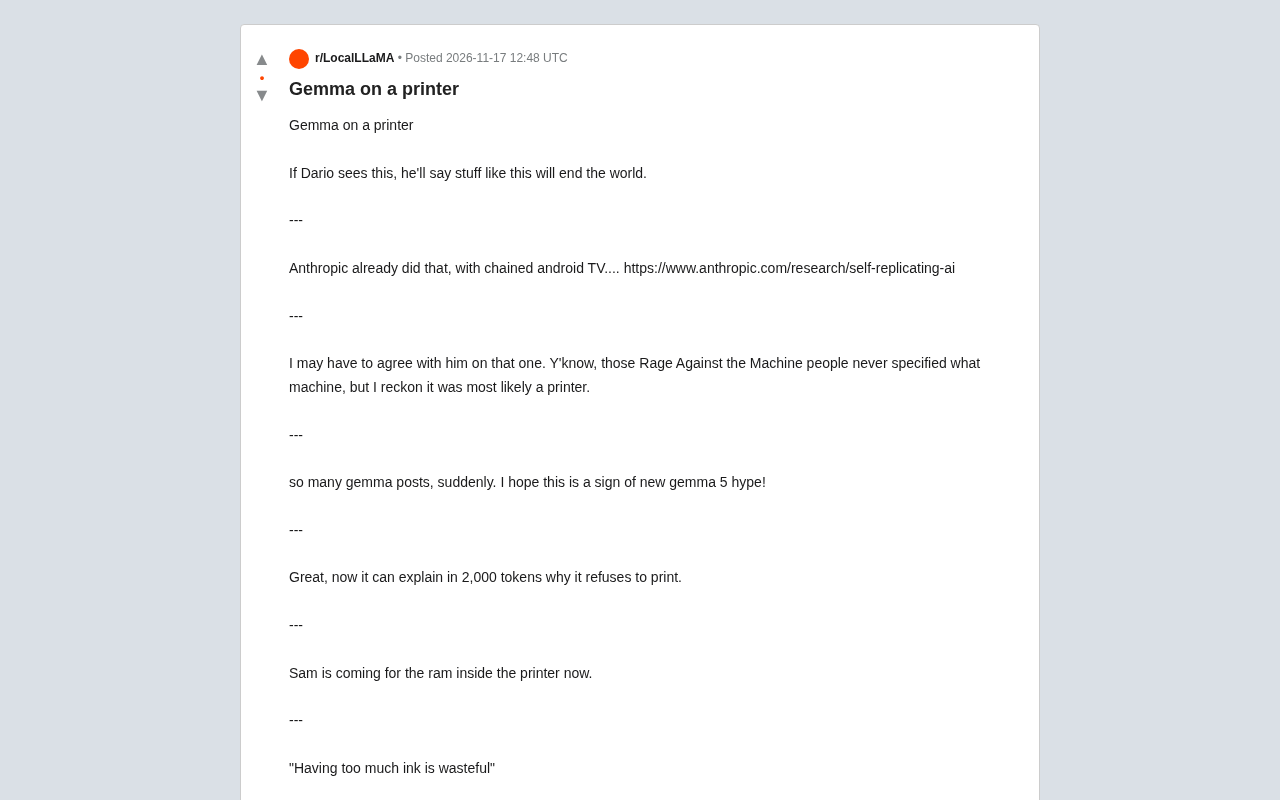
What makes this post worth discussing isn't how practical "running a large model on a printer" is in itself, but that it distills several real tensions in edge AI today: the speed of model miniaturization, the extent to which hardware compute is being pushed downmarket, and the community's instinctive mix of jest and vigilance toward the spread of AI capabilities.
Three Layers of Narrative in the Community Response
The Joking Layer: 2,000 Tokens Explaining Why It Refuses to Print
The most direct reaction in the comments was functional mockery. One highly upvoted reply read: "Great, now it can spend 2,000 tokens explaining why it refuses to print." This clearly alludes to the tendency of large models to over-explain when following instructions—a task that should be a binary decision (print or don't print) gets processed by a language model into a lengthy reasoning process. Another user added, "Too much ink is also a waste," steering the topic toward the model's "value judgments" about resource constraints.
Behind these jokes lies a serious technical reality: cramming a general-purpose language model into a device like a printer raises a primary question not of whether it can run, but of whether, once running, it is more reliable than traditional embedded logic. A printer's control logic requires determinism, whereas a language model outputs probabilistic results.
The Vigilance Layer: From Printers to Self-Replicating AI
Someone in the post directly linked to Anthropic's research page on self-replicating AI and pointed out that "Anthropic has already done something similar with chained Android TVs." This citation elevated the discussion from the toy level to the context of AI safety. Although Gemma on a printer and self-replicating AI are completely incomparable in terms of capability, the community's reaction shows that once a language model appears on non-traditional computing devices, people instinctively associate it with capability boundaries and the risk of losing control.
The repeated mentions of Dario Amodei also reflect that the AI safety narrative has trickled down into the everyday banter of ordinary developers. Such banter does not constitute a technical argument, but it is a signal—every step in the spread of edge deployment triggers a public reassessment of AI's boundaries.
Chained AI typically refers to linking multiple model instances together through scripts, API orchestration, or agent frameworks, enabling them to call one another, pass tasks along, and recursively expand themselves. The core concern of institutions like Anthropic regarding such research is not the capability of a single call, but whether a system can complete replication, propagation, and resource acquisition without human intervention. Posting links to such research under a "Gemma on a printer" thread effectively juxtaposes "single-machine deployment" with "self-perpetuating systems" to highlight the spectrum of risk discussion: the former is strictly constrained by hardware and memory, while the latter concerns the orchestration layer and access permissions.
The Anticipation Layer: Community Sentiment Around Gemma 5
One comment mentioned, "Suddenly so many Gemma posts, I hope this is a signal that a new Gemma 5 is coming." This is the community's sensitive reaction to the cadence of model iterations. The Gemma series, as open-weight models, has maintained steady attention in the local deployment community. The emergence of extreme scenarios like printers is, to some extent, the community testing the limits of model miniaturization by asking "can it run on even more absurd hardware?"
What Running Gemma on a Printer Technically Means
Setting aside the memes in the post, this scenario points to an ongoing trend: open-weight models are being pushed onto devices that traditionally fall outside the scope of AI computing. Printers typically carry low-power MCUs or low-end SoCs, with extremely limited memory and compute. Running a model like Gemma on them—even a minimal-parameter version—requires extensive adaptation work in quantization, pruning, and inference frameworks.
The practical value of such attempts lies not in making printers "talk," but in validating a technical path: when models become small enough to fit into embedded environments, the interaction paradigm of edge devices may shift from fixed instruction sets to natural language interfaces. Of course, this path is still in the geek-experimentation stage, with a considerable distance to productization. Someone in the post half-jokingly said, "We need to get an abliterated version of Gemma ASAP," which also hints that the behavioral constraints of current models in embedded scenarios remain an open question.
Quantization is one of the key means of squeezing large models into embedded hardware, referring to mapping model weights and activations from floating-point numbers (such as FP16/FP32) to lower-bit-width integers (such as INT8, INT4, or even lower), thereby compressing memory usage to 1/4 to 1/16 of the original. A common post-training quantization (PTQ) process uses a small calibration dataset to gather statistics on the numerical distribution of each layer, based on which scaling factors are determined to minimize precision loss.
Pruning, on the other hand, structurally reduces redundancy: it can remove less important weights (unstructured pruning) or entire channels or layers (structured pruning), with the latter being more conducive to achieving actual speedups on resource-constrained inference frameworks. When combined with quantization, the two together determine whether a model can be squeezed into the limited memory of a low-end SoC and whether inference latency falls within an acceptable range.
The "abliterated version" mentioned in the comments originates from a common community model-modification technique, typically translated as "ablated version" or "refusal-removed version." The approach is to locate the direction within the model associated with refusal behavior (the refusal direction) and then orthogonalize the weights or activations along that direction, so that the model no longer tends to output refusal statements. This kind of modification does not retrain the model, so it is low-cost and spreads quickly; it is widely used in the open-weight community to study the editability of alignment behavior. It also illustrates that behavioral constraints in embedded scenarios are difficult to guarantee by the model itself and often require external guardrails or a restricted output space as a fallback.
The Reference Value of a Brainstorm Discussion
This Reddit post is not dense with information, but it presents a typical reaction pattern of the tech community when facing the spread of edge AI: first memes, then safety associations, and finally expectations for model iteration. For those following the deployment of open-weight models, the printer scenario itself does not deserve over-interpretation, but the two tensions that repeatedly appear in the community discussion—"determinism vs. probabilistic output" and "capability spread vs. safety boundaries"—are the real issues edge AI must confront.
Gemma running on a printer most likely won't destroy the world. But it does serve as a reminder: when models become small enough to be everywhere, discussions about AI will no longer take place only in data centers.
Related articles

From 0 to 1: Vibe Coding an AI Knowledge Base — A Practical Retrospective and Tech Stack Breakdown
A retrospective on building the AI knowledge base OilBook from scratch with Vibe Coding: Next.js+Neon stack, Oil Dev Skill workflow, Stripe paywall security, interview-style writing, AI-flavor control, and Vercel deployment.

GLM-5.4 Hands-On: Native Vision Meets a New Vibe Coding Workflow
Hands-on with Zhipu GLM-5.4: native vision tested across a 3D product demo, pure-code video generation, and remote-control Vibe Coding, compared with GPT-6.2 and Gemini Neon.

AI and Humans Claim to Prove the Riemann Hypothesis: Machine-Verified, Yet Nobody Can Understand It
Anthropic mathematician and AI Claude claim to prove the Riemann Hypothesis with 17 million lines of Lean code, machine-verified but unreadable by humans. This article analyzes the event, the zero proportion record from 41.6% to 67.2%, and the gap between machine verification and human understanding.