Running Native DLA Inference in Python on Jetson AGX Orin with cuDLA

cuDLA lets Python developers natively schedule the DLA on Jetson AGX Orin for multi-model, low-power edge inference.
Based on NVIDIA's developer blog, the article explains how to call cuDLA directly from Python for native DLA inference on Jetson AGX Orin. It describes the DLA as a fixed-function accelerator independent of the GPU that frees GPU resources and controls power, then contrasts cuDLA with TensorRT's DLA backend, noting cuDLA's finer control granularity and lower barrier to use. It also covers limited operator support, DLA/GPU partitioning, and memory layout overhead, positioning the DLA as a GPU coprocessor.
Why Use DLA Specifically on Jetson
Edge AI deployment often runs into a real-world conflict: a device needs to run multiple neural networks at once, but compute and power budgets are both limited. NVIDIA's Deep Learning Accelerator (DLA) is a dedicated inference accelerator designed exactly for this. A technical article published on NVIDIA's official developer blog, Run Native DLA Inference in Python on NVIDIA Jetson AGX Orin Using cuDLA, lays out a path for calling cuDLA directly from Python to perform native DLA inference on Jetson AGX Orin.
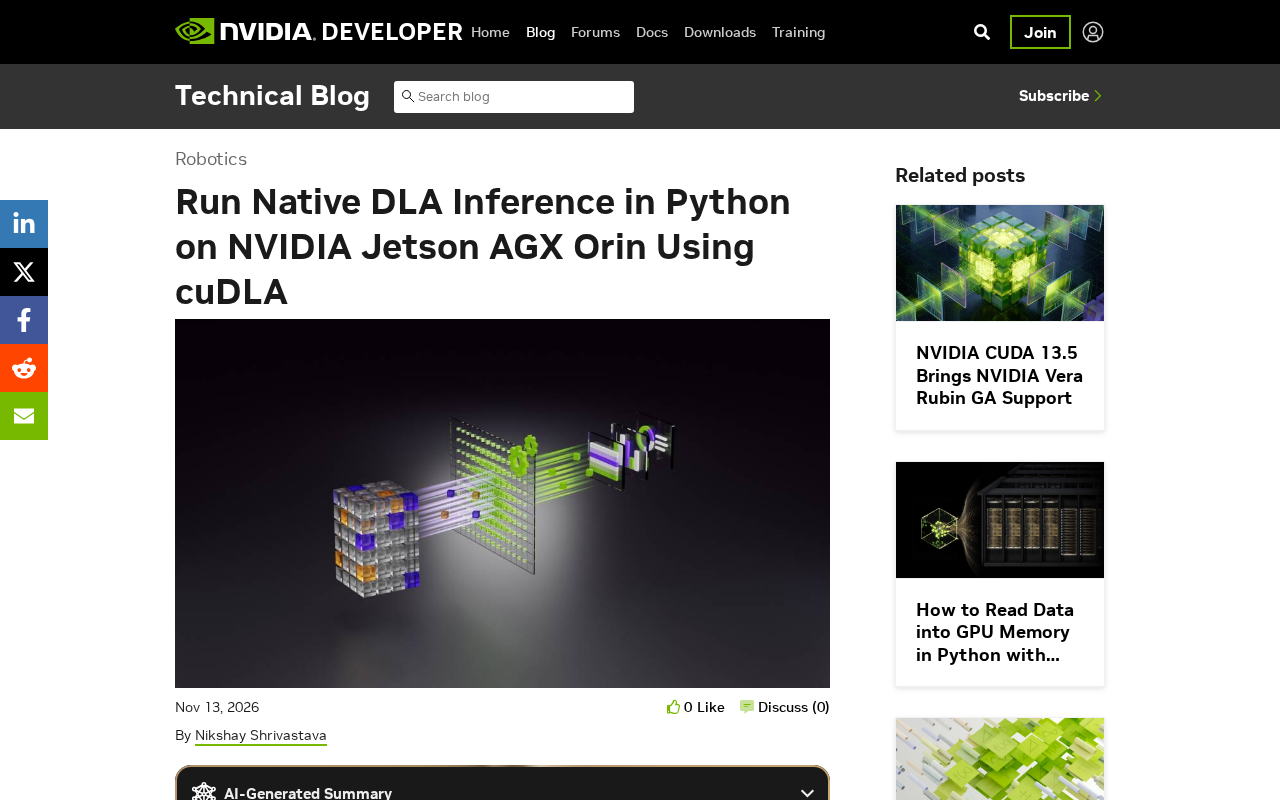
The compute power of Jetson AGX Orin does not come from the GPU alone. The on-chip DLA unit is a fixed-function accelerator independent of the GPU, purpose-built for deep learning operators such as convolution. Offloading part of a network to the DLA delivers two benefits at once: GPU resources are freed up to run other models or preprocessing pipelines, and overall system power consumption becomes more manageable.
For edge scenarios that need to run multiple networks in parallel (multi-camera detection, robot perception stacks, industrial vision), this division of labor is often more practical than piling every model onto the GPU. This is precisely where the original article starts: edge AI applications need to run multiple neural networks within limited compute and power budgets.
The hardware positioning of DLA: DLA (Deep Learning Accelerator) is a fixed-function inference accelerator integrated into NVIDIA's Tegra/Orin series SoCs. Its microarchitecture is built around dedicated data paths and on-chip caches for tensor operators such as convolution, deconvolution, pooling, and activation, and it can execute inference independently without relying on the GPU's SM arrays. Taking Jetson AGX Orin as an example, its DLA provides multiple independently configurable accelerator instances (the DLA units referred to in the original article), each of which can carry one inference pipeline, so when running multiple networks in parallel, different models can be assigned to different DLA instances or form a heterogeneous division of labor with the GPU. Because it is fixed-function hardware, DLA's convolution throughput per unit of power is typically better than that of a general-purpose GPU, but flexibility is low, and operator coverage and data types (such as INT8 and FP16) are constrained by the hardware version. This is the fundamental reason the article later emphasizes the need for DLA/GPU partitioning.
What cuDLA Is, and How It Differs from TensorRT's DLA Backend
The common way to use DLA is to let TensorRT assign some layers to the DLA during engine building, without the developer directly touching DLA's low-level interfaces. cuDLA, by contrast, provides a lower-level programming model that lets developers organize DLA tasks in a near-native manner and then invoke them through Python bindings.
The value of this path lies in control granularity. With TensorRT, layer assignment and format conversion are decided by the framework; with cuDLA, developers have more direct say over the computational graph submitted to the DLA, and it is easier to embed DLA inference into existing Python services or scripts without having to build an engine separately for each model. What the original article calls "Native DLA Inference" points precisely to this execution approach that bypasses high-level wrappers.
The mechanism of TensorRT's DLA backend: When building an engine, TensorRT can specify DLA as the execution backend, and the builder determines whether a layer can execute on the DLA based on its operator type, precision, and tensor shape; layers that cannot execute or offer low benefit fall back to the GPU, a process that is semi-transparent to the developer. The cost is coarse control granularity: layer assignment strategies are determined by TensorRT's internal heuristics, and format conversion and memory planning are also encapsulated by the engine, making it difficult for developers to fine-tune a specific topology. In contrast, cuDLA directly exposes the DLA's task submission interfaces (such as loading an executable graph, setting input/output tensors, triggering inference, and synchronizing), and developers decide for themselves how to partition and submit the computational graph, bypassing the abstraction layer of TensorRT engine building. It is therefore better suited to scenarios that require deep integration with existing pipelines or fine-grained heterogeneous scheduling.
The Engineering Significance of Python Invocation
In the Jetson ecosystem, Python is the primary language for prototyping and rapid iteration. Previously, working directly with the DLA usually meant work at the C/C++ level, which created a gap with the daily toolchains of most algorithm teams. The cuDLA Python interface lowers this barrier: inference scripts can live in the same Python process as data processing and result post-processing, shortening the debugging loop.
From an engineering practice standpoint, this kind of native interface is better suited to two types of teams. One is performance-sensitive projects that need fine-grained load partitioning between DLA and GPU; the other is production applications that have already deployed models in Python services and want to further cut power consumption.
Considerations for Deployment
DLA is a fixed-function accelerator with a relatively limited set of supported operators and data types, so not every network can be offloaded wholesale. In practice, deployment usually requires splitting the network into a DLA-executable portion and a GPU fallback portion, and this partitioning strategy directly affects end-to-end latency. In addition, DLA inference inputs and outputs often involve memory layout and format conversion, and this overhead needs extra attention at the Python layer.
The original article does not provide specific performance comparison data, but from an architectural positioning standpoint, DLA's benefits are mainly reflected in energy efficiency and freeing up GPU resources rather than surpassing the GPU in absolute throughput. Planning task allocation by treating it as a GPU coprocessor is more in line with its design intent than expecting it to carry the main inference on its own.
Memory layout and format conversion overhead: DLA has specific requirements for the memory arrangement of input and output tensors, commonly NHWC or a particular tiled/aligned format, whereas NumPy arrays and PyTorch tensors on the Python side typically use NCHW or a contiguous row-major layout. When the two are inconsistent, reordering (such as transpose or padding alignment) is needed before submission; this is done on the CPU or GPU, and if placed in the inference hot path it can significantly erode the energy-efficiency gains brought by the DLA. In practice, you should try to have pre- and post-processing directly produce the layouts the DLA expects, or fuse format conversion with other operators, and reuse input/output buffers to avoid frequent allocation. In addition, DLA inference is usually submitted asynchronously and requires proper synchronization before results can be read; the Python wrapper should make this timing semantics explicit, otherwise it is easy to run into the problem of reading unfinished results.
Summary
cuDLA opens a lower-level channel to using the DLA on Jetson AGX Orin, enabling Python developers to natively schedule this dedicated accelerator. For multi-model, power-constrained edge deployments, this is an approach worth including among architectural options—provided there is a clear prior assessment of network structure and the boundaries of operator support.
One-line Summary
cuDLA lets Python developers natively schedule the DLA on Jetson AGX Orin, enabling multi-model parallel and low-power edge inference.
Paragraph Summary
Centered on technical content from NVIDIA's developer blog, the article introduces a path for calling the DLA directly from Python via cuDLA to perform native inference on Jetson AGX Orin. It first explains that the DLA, as a fixed-function accelerator independent of the GPU, is valuable for freeing GPU resources and controlling overall system power, making it suitable for multi-network parallel edge scenarios. It then compares cuDLA with TensorRT's DLA backend: the latter lets the framework decide layer assignment, while the former provides a lower-level programming model and finer control granularity. The Python interface lowers the barrier to using the DLA, allowing inference to be embedded in existing Python services. The article also notes that DLA operator and data type support is limited, that deployment requires partitioning the DLA and GPU portions, and that memory layout conversion overhead must be watched; the DLA's role is that of a GPU coprocessor rather than the main throughput engine.
Related articles

RePlan-VLA: Progress-Aware Replanning Breakthrough for Long-Horizon Robotic Manipulation
The RePlan-VLA framework converts VLA models' short-horizon capabilities into reliable long-horizon execution through progress-aware adaptive replanning, improving success rates by 21.9% and 10.4% on RoboCasa365 and CALVIN, and validating real-world deployment on a Franka Research 3 robot.

Geometric Bridge Flow Matching: A New Breakthrough in Blind Rigid Motion Correction
Geometric bridge flow matching enables blind rigid motion correction in head CBCT, achieving 37.1 dB PSNR and 0.27 mm RPE on simulated data in ~9.1 minutes, outperforming existing methods.

Google Releases Gemini 4 Hydrogen: 2.5x Faster Without Sacrificing Intelligence
Google releases the lightweight Gemini 4 Hydrogen: 2.5x faster task completion, AA Intelligence Index of 54 beating its flagship sibling, 7.3s single-step on Agent Arena faster than Claude and GPT rivals, four thinking levels with pay-as-you-need pricing, now available across AI Studio and more.