Running Power Electronics Simulations with Local AI Agents: Measured Power, Token, and Time Costs
Study quantifies power, energy, token, and time costs and capability boundaries of local AI agents driving power electronics simulations.
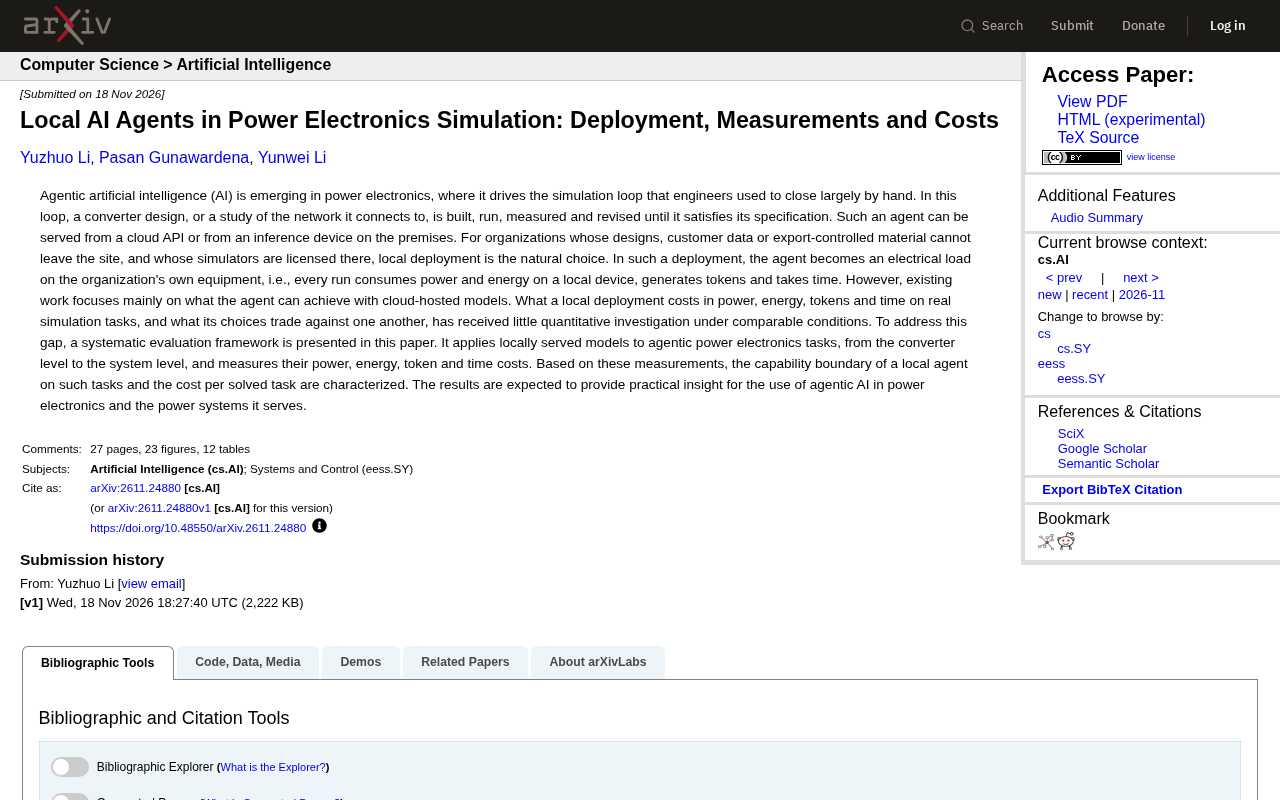
The article introduces a systematic evaluation of the real costs of locally deployed agentic AI in power electronics simulation. Existing work focuses on cloud model capabilities, while local deployment lacks comparable quantification of power, energy, token, and time costs. For organizations whose data or export-controlled materials cannot leave their premises, local deployment is a compliance requirement, making the agent an actual power load on owned equipment. The framework covers converter-level to system-level tasks, measuring four cost categories and characterizing capability boundaries and per-task-solved cost. The article notes multi-dimensional trade-offs among reasoning length, model precision, and parallelism, and recommends that engineering teams incorporate agent resource consumption into infrastructure planning and use cost per task solved rather than per-run cost as the basis for selection.
When AI Agents Take Over the Simulation Loop
Power electronics design has long relied on engineers closing the loop manually: build a converter model, run the simulation, measure waveforms, tweak parameters, and repeat until specs are met. Agentic AI is changing this workflow—agents can autonomously drive the entire simulation loop, freeing engineers from repetitive labor.
But one key question has been overlooked: when agents are deployed locally rather than in the cloud, what is their real cost?
According to a systematic evaluation study focused on this question, existing work mostly examines what cloud models can achieve in terms of capability, while there is a lack of quantitative investigation under comparable conditions of the power, energy, token consumption, and time costs of local deployment on real simulation tasks. This study aims to fill that gap.
Agentic AI refers to AI systems with autonomous planning, tool-calling, and multi-step execution capabilities, distinct from single-turn question-answering models. In engineering scenarios, it typically uses a large language model as the reasoning core, paired with external tools such as simulators, parameter interfaces, and result parsers, forming a "perceive—decide—execute—feedback" loop. The agent autonomously determines the direction of the next parameter adjustment based on simulation output, without requiring step-by-step human instructions, and can therefore drive dozens or even hundreds of simulation iterations continuously. The value of this paradigm for power electronics design lies in the fact that design space exploration is inherently a high-dimensional, multi-constraint trial-and-error process, which matches the iterative nature of agents. But the stronger the autonomy, the longer the reasoning chain per task and the more intensive the tool calls, making resource consumption harder to estimate with traditional single-inference metrics—which is precisely why local deployment cost evaluation requires separate modeling.
Why Local Deployment Is a Hard Requirement
For organizations whose design data, customer information, or export-controlled materials cannot leave their premises, local deployment is not a preference but a compliance baseline. The simulators in such organizations are usually locally licensed as well, so cloud solutions are ruled out outright at the data governance level.
The cost of local deployment is that the agent becomes a power load on the organization's own equipment. Every simulation run consumes power and energy, generates tokens, and takes time. These costs are abstracted away when billed by API in the cloud, but locally they become real data center electricity bills and compute occupancy.
Export-controlled materials in this context refer to technical data and design documentation subject to export control regulations, such as certain power semiconductor process parameters, military or aerospace-grade converter topologies, and controlled EDA model libraries. The storage, processing, and cross-border transfer of such materials usually carry explicit compliance requirements involving access permissions, physical location, and audit of transmission paths. When simulation inputs or intermediate results contain such data, sending them to a cloud API constitutes a potential risk of data export or third-party disclosure. Local deployment keeps data within the organization's controllable physical boundary, making it easier to meet audit and access control requirements. This is also why, for such organizations, cloud solutions are not a matter of being "more expensive" or "slower"—they are simply not an option at the compliance level, and cost evaluation must be built on a local premise.
What the Evaluation Framework Measured
The systematic evaluation framework proposed by the study applies locally served models to agentic power electronics tasks, covering different levels from converter-level to system-level, and measures four categories of cost: power, energy, tokens, and time.
Based on these measurements, the study characterizes two key boundaries: the capability boundary of local agents on such tasks, and the cost corresponding to each task solved. These two conclusions have direct reference value for engineering teams making selections—knowing what the agent can do, and knowing what it costs to get it done.
Tokens are the basic unit by which large language models process text, with one token roughly corresponding to a word fragment or several characters. In agentic tasks, token consumption comes from multiple sources: system prompts and tool descriptions, the input context of each reasoning round, the reasoning steps and tool-calling parameters generated by the model, and the parsing of returned simulation results. Because the agent requires multiple rounds of iteration, context accumulates with each round, and token consumption often grows superlinearly rather than simply linearly. When billed by tokens in the cloud, this item maps directly to cost; in local deployment, token volume indirectly reflects reasoning compute occupancy and is the intermediate variable connecting "task complexity" with "power and time costs." Measuring it alongside power and energy is therefore necessary to explain whether cost differences stem from model efficiency or task structure.
The Trade-offs Among Costs
The core tension of local deployment is that multiple costs constrain one another. Longer reasoning chains may improve task success rates but directly drive up token consumption and time; higher-precision models mean greater power draw per inference; running multiple simulation tasks in parallel can compress total duration but raises instantaneous power demand.
In the cloud, these trade-offs are often reduced to a single cost figure; locally, they manifest as real constraints on equipment selection, cooling design, and power capacity. The study emphasizes that its measurement results are intended to provide practical reference for agentic AI applications in power electronics and the power systems they serve.
Implications for Engineering Teams
For teams considering local deployment, this study suggests several pragmatic directions. First, incorporate the agent's resource consumption into simulation infrastructure planning rather than adding it afterward. Second, focus on "cost per task solved" rather than cost per run—a configuration with a low success rate may be cheaper per run but more expensive overall. Third, capability boundaries vary by task level, and converter-level and system-level tasks should not be shoehorned into the same deployment strategy.
The adoption of agentic AI in power electronics is shifting from "can it be done" to "is it worth doing." Quantifying the cost of local deployment is the first piece of that arithmetic puzzle.
Related articles

Bin's Live Stream Highlights: Hilarious Interactions from "You Came at the Right Time" to "I'll Support You From Now On"
Bin's hilarious live stream highlights: from "You came at the right time" to "I'll support you from now on," featuring Championship skins, wigs, and other game memes that showcase Bilibili's unique streaming culture.

Hunter Rescues Educated Youth: The Mountain-Chasing System Launches a New Warm-Hearted Viral Drama Formula
Bilibili's early-access period short drama *Everyone Thinks I'm a Poor Hunter* opens with a snowy-night rescue of an educated youth. Hunter Chen Shan activates the mountain-chasing system, using realistic hypothermia first-aid details and mutual-probing character dynamics to deliver a warm-hearted period drama without the sleaze.

Riemann Hypothesis Proven by AI? The Truth Has Nothing to Do With Your Reality
34-year-old mathematician Levent Alpöge claims to have proven the Riemann Hypothesis and Generalized Riemann Hypothesis with Claude, releasing 17 million lines of formal verification code. This article sorts out the facts, debunks myths about RSA collapse and new material revolutions, and analyzes the true significance of mathematics-AI collaboration.