Running Q3 Quantized Models on 16GB VRAM: Building a Village Simulation Game with Qwen
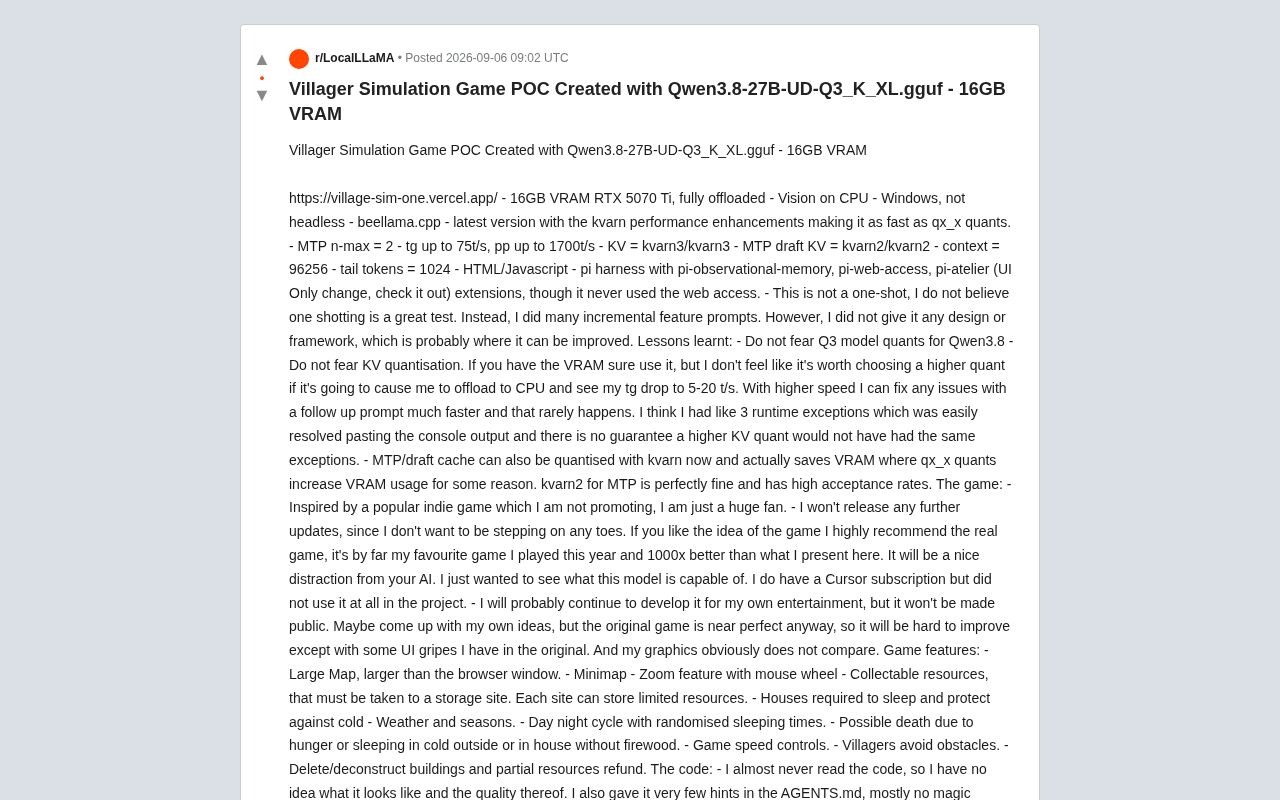
Building a complete village sim game with Q3-quantized Qwen3.8-27B on just 16GB VRAM at 75 tokens/s.
A developer demonstrated that Qwen3.8-27B's Q3_K_XL quantization can power complex game development on an RTX 5070 Ti with 16GB VRAM, achieving 75 tokens/s inference speed. Using kvarn KV cache quantization and llama.cpp, they built a full village simulation with resource management, pathfinding, and survival mechanics. Key findings: model weight precision matters more than KV cache precision, Q3 with full VRAM loading beats Q4 with CPU offloading, and observational-memory extensions solve context management challenges.
Real-World Capability Validation of Q3 Quantized Models
A developer shared their complete experience on Reddit building a village simulation game using the Q3_K_XL quantized version of Qwen3.8-27B. This case shatters the stereotype that "you need high-precision models for complex applications," proving that a properly configured Q3 quantized model running on an RTX 5070 Ti with 16GB VRAM is more than capable of handling real project development.
Q3 quantization refers to compressing model weights from their original FP16 (16-bit floating point) format to an integer representation averaging about 3 bits. Within the GGUF format ecosystem, Q3_K_XL belongs to the K-quant family of variants — the "K" denotes an importance-based mixed-precision quantization strategy where layers with greater impact on output retain higher precision, while less sensitive layers undergo more aggressive compression. The "XL" suffix means that compared to standard Q3_K, more critical layers are preserved at higher precision — an optimized trade-off between accuracy and compression ratio.
The project is deployed at https://village-sim-one.vercel.app/ and runs on the latest version of llama.cpp. llama.cpp is an open-source project initiated by Georgi Gerganov that uses pure C/C++ to enable efficient execution of large language models on consumer hardware, and it defines the GGUF model format that has become the de facto standard for local deployment. The developer employed the kvarn performance enhancement scheme, achieving inference speeds of 75 tokens/s for text generation and 1,700 tokens/s for prompt processing. The developer emphasized this was not a one-shot generation but rather an incremental build through multiple feature prompts — yet no design or framework guidance was ever provided. The model autonomously decided the entire code architecture.
The Critical Choice of Quantization Strategy
The Balancing Act Between VRAM and Precision
Through practice, the developer distilled an important lesson: don't blindly chase higher-precision quantization. Their needle-in-a-haystack test showed that Q3_K_XL paired with kvarn3 KV cache quantization achieved near-100% accuracy, while Q4 quantization — despite its higher precision — drastically reduced context length due to VRAM constraints.
The Needle-in-a-Haystack test is a standard benchmark for evaluating LLM long-context capabilities: a specific piece of information (the "needle") is inserted into a large body of irrelevant text (the "haystack"), and the model is then asked to retrieve it. By repeating the test at different context positions and total lengths, you can generate a heatmap of the model's information retrieval ability across its entire context window. This test directly reveals how quantization affects the model's attention mechanism — if quantization is too aggressive and distorts attention weights, the model will fail to accurately locate key information buried deep in long text.
When the model needs to be offloaded to CPU, text generation speed plummets from 75 t/s to 5–20 t/s. llama.cpp supports offloading some model layers to CPU, but the data transfer bandwidth bottleneck between CPU and GPU causes a dramatic drop in inference speed. In this scenario, using Q3 quantization with faster inference speeds — and quickly iterating on fixes when issues arise — is actually more efficient than a slow, high-precision model. The entire development process encountered only 3 runtime exceptions, all resolved by pasting the console output.
The Performance Advantage of KV Cache Quantization
The KV cache (Key-Value Cache) is the primary source of memory consumption during Transformer model inference. During autoregressive generation, the model must store attention key-value pairs for all processed tokens to avoid redundant computation. For long-context scenarios, KV cache VRAM usage can even exceed the model weights themselves.
The developer specifically noted that the kvarn quantization scheme delivers performance close to qx_x quantization while significantly saving VRAM. kvarn uses a variance-aware adaptive quantization strategy that dynamically adjusts quantization precision based on the numerical distribution characteristics of different attention heads and layers, trading minimal precision loss for enormous VRAM savings and thereby accommodating longer context windows within limited VRAM.
MTP (Multi-Token Prediction) draft caching works perfectly fine with kvarn2 quantization while maintaining a high acceptance rate. MTP is a speculative decoding acceleration technique — traditional autoregressive generation produces only one token at a time, while speculative decoding uses the model's built-in draft heads to predict multiple candidate tokens at once, which are then verified in parallel by the main model. Accepted tokens can be output directly, achieving several times the speed improvement. The "acceptance rate" refers to the proportion of draft predictions approved by the main model — higher acceptance rates mean more pronounced acceleration. Draft caching has lower KV precision requirements than main model inference, so kvarn2 is sufficient.
By contrast, qx_x quantization actually increases VRAM usage. Although kvarn performs slightly worse than qx_x on needle tests, its KLD (Kullback-Leibler Divergence) metric is superior. KLD is a classic information theory measure of the difference between two probability distributions. In quantization evaluation, it measures the divergence between the quantized model's output probability distribution and that of the original FP16 model. Unlike needle tests that only care about whether the final answer is correct, KLD statistically measures the shift in prediction probability for every single token — a more fine-grained quality metric for quantization. A quantization scheme might occasionally lose points on needle tests, but if its KLD is better, its overall output distribution is more faithful to the original model, potentially performing better on tasks like coding that require precise probability sampling.
For a context length configuration of 96,256, kvarn3 is sufficient. The developer mentioned possibly experimenting with a kvarn4/kvarn3 hybrid in the future but was unwilling to sacrifice too much context space for it.
Complete Game System Implementation
This simulation project, inspired by indie games, implements a fairly complete set of game mechanics:
- Map System: A large map that extends beyond the browser window, equipped with a minimap and mouse wheel zoom
- Resource Management: Collectible resources that can be transported to storage points, each with limited capacity
- Survival Mechanics: Villagers need houses for sleeping and warmth; lack of food or sleeping in the cold leads to death
- Environmental System: Weather, seasonal changes, and day-night cycles with randomized villager sleep times
- Pathfinding: Villagers automatically navigate around obstacles
- Building System: Buildings can be demolished with partial resource refunds
- Game Controls: Adjustable game speed
The developer expressed satisfaction with the game's performance, despite never having carefully reviewed the quality of the generated code. The AGENTS.md file contained only basic guidelines like "avoid magic numbers, write modular code, avoid single HTML files."
Iterative Experience with Code Modularization
The initial prompt did generate a single HTML file, but as the project grew, the developer requested a split into modules. The first attempt failed — the model rewrote the entire UI during the modularization process. After rolling back, the developer explicitly requested "modularize without changing any functionality or UI," and the second attempt succeeded.
This detail reveals an important principle for collaborating with LLMs: clear constraints are more effective than broad instructions. LLMs tend to over-deliver when given vague instructions; explicitly defining the scope of output significantly improves collaboration quality.
Practical Context Management Solutions
During early development, the context frequently filled up and couldn't even be compressed, forcing the developer to temporarily expand the context, have the model create a handover document, then shrink the context and feed the handover document back in to start fresh. This is essentially a manual context management strategy — using human-triggered information distillation to compress key decisions and code state from long conversations into structured summaries.
After introducing the pi-observational-memory extension, the problem was completely resolved. The extension's core mechanism automatically extracts key information from conversation content during LLM interactions and stores it persistently as structured notes. When the context window approaches its limit and compression is needed, critical information has already been pre-extracted and saved in a separate memory store, so the compression process doesn't lose important information. This is more reliable than traditional context compression approaches (such as having the model generate conversation summaries) because information extraction happens continuously rather than all at once at the moment of compression. Compression completes almost instantly because key information has already been pre-extracted. The developer also configured pi-atelier (UI changes only) and pi-web-access extensions (though the latter was never used).
Performance Conclusions on Quantization Configuration
The greatest value of this project lies in validating a counterintuitive conclusion: when VRAM is constrained, the model quantization level has a greater impact on performance than the KV cache quantization level.
The developer's needle test data supports this conclusion: the Q3_XXS model scored about 80% even with F16 KV cache, while Q3_K_XL paired with kvarn3 KV cache scored near 100%. This demonstrates that model weight precision is foundational — overly aggressive weight quantization fundamentally damages the model's reasoning capability, while KV cache quantization primarily affects information retention in long contexts. Beyond a certain threshold, the benefit of improving model weight precision significantly outweighs that of improving KV cache precision.
For users with 12GB VRAM, Q3_XXS remains a viable option, with coding capabilities still superior to Qwen3.6. The developer emphasized that needle tests aren't the only criterion — kvarn performs better on KLD metrics, and once needle scores approach 100%, requirements are met. This means evaluating quantization schemes should consider multiple dimensions: needle tests measure information retrieval ability in extreme scenarios, KLD measures overall output distribution fidelity, and actual task performance is the ultimate standard.
Practical Takeaways
- Q3 quantization is fully usable: The Q3_K_XL quantized version of Qwen3.8 performs excellently in real-world applications
- Prioritize speed over precision: It's better to load Q3 entirely in VRAM for high-speed inference than to offload Q4 to CPU
- Targeted testing is essential: Different models have varying sensitivities to KV quantization; you need to test for the optimal configuration for your specific model and task
- Context management tools add significant value: Extensions like observational-memory dramatically improve the experience during extended development sessions
- Incremental development is more controllable: Through multiple small iterative steps, models are better able to maintain code quality and consistency
This case provides invaluable reference for resource-constrained developers: with sensible quantization configuration and the right collaboration approach, 16GB of VRAM can handle complex AI-assisted development projects. In an era where large models are becoming increasingly accessible but consumer hardware resources remain finite, understanding and leveraging quantization techniques is no longer optional — it's an essential skill for local AI development.
Related articles
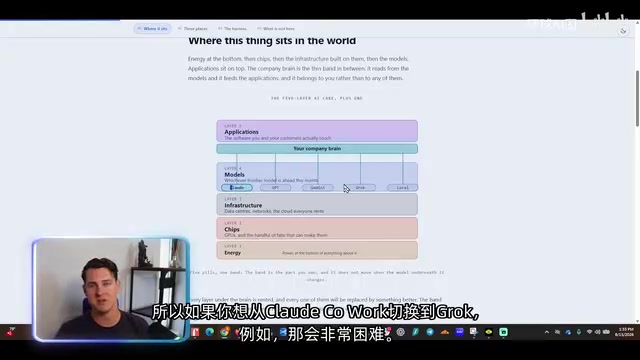
Enterprise AI Operating System Implementation Guide: Complete Analysis of 7 Core Tool Stacks
In-depth analysis of 7 core tool stacks for enterprise AI operating systems, covering VS Code framework layer, n8n automation, Paperclip agent management, Bitchat communication, secure key management, and data warehouses to help enterprises truly implement AI systems.
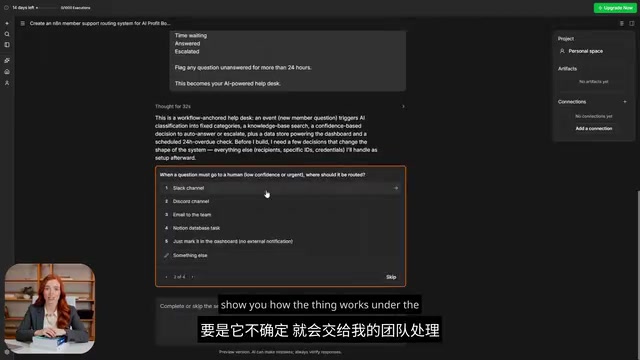
Building an AI Customer Support Assistant with n8n: No-Code Workflow Automation
Learn how to build an AI customer support assistant with n8n using zero code. Automate repetitive questions, integrate 400+ tools, and self-host for data control.
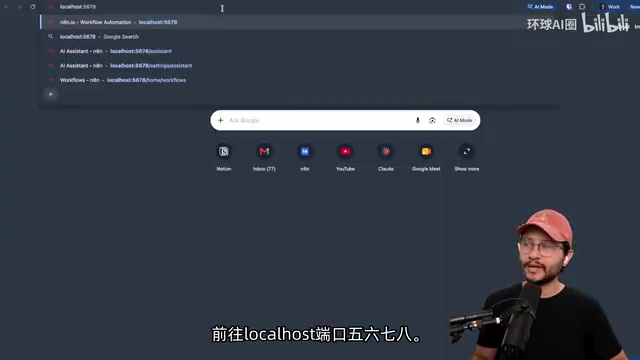
n8n Local Deployment Tutorial: Self-Hosting + AI Assistant with a Single Command
Deploy n8n locally with one Docker command and use its built-in AI assistant to build automation workflows in natural language. Covers OpenRouter, permissions, and debugging.