Running Qwen-3.8-27B Locally to Replace APIs: One Developer's Real-World Experience

Local Qwen-3.8-27B with a minimal toolchain now matches cloud API quality and cost for real coding tasks.
A developer shares how locally deployed Qwen-3.8-27B (Q4_K_S quantized) fully replaced commercial APIs for code refactoring. Key findings: reasoning models work best unsupervised; a minimal toolchain (Bash + 3 tools) outperforms complex setups for local models; stability beats speed — Swift-Qwen's loop issues disqualify it for unattended agents. At ~$0.024/M input and $0.70/M output tokens, costs match the cheapest cloud providers, with added privacy and no rate limits. The 27B open-source model has moved from toy to practical tool.
The capability frontier of open-source LLMs is rapidly closing in on commercial APIs. A Reddit developer shared their experience of completely replacing cloud-based APIs with a locally deployed Qwen-3.8-27B — a case worth examining not just for what it says about model capabilities, but for its hands-on detail around quantization, agent toolchains, and cost accounting.
From "Painful" to "Letting Go": The Adjustment Period
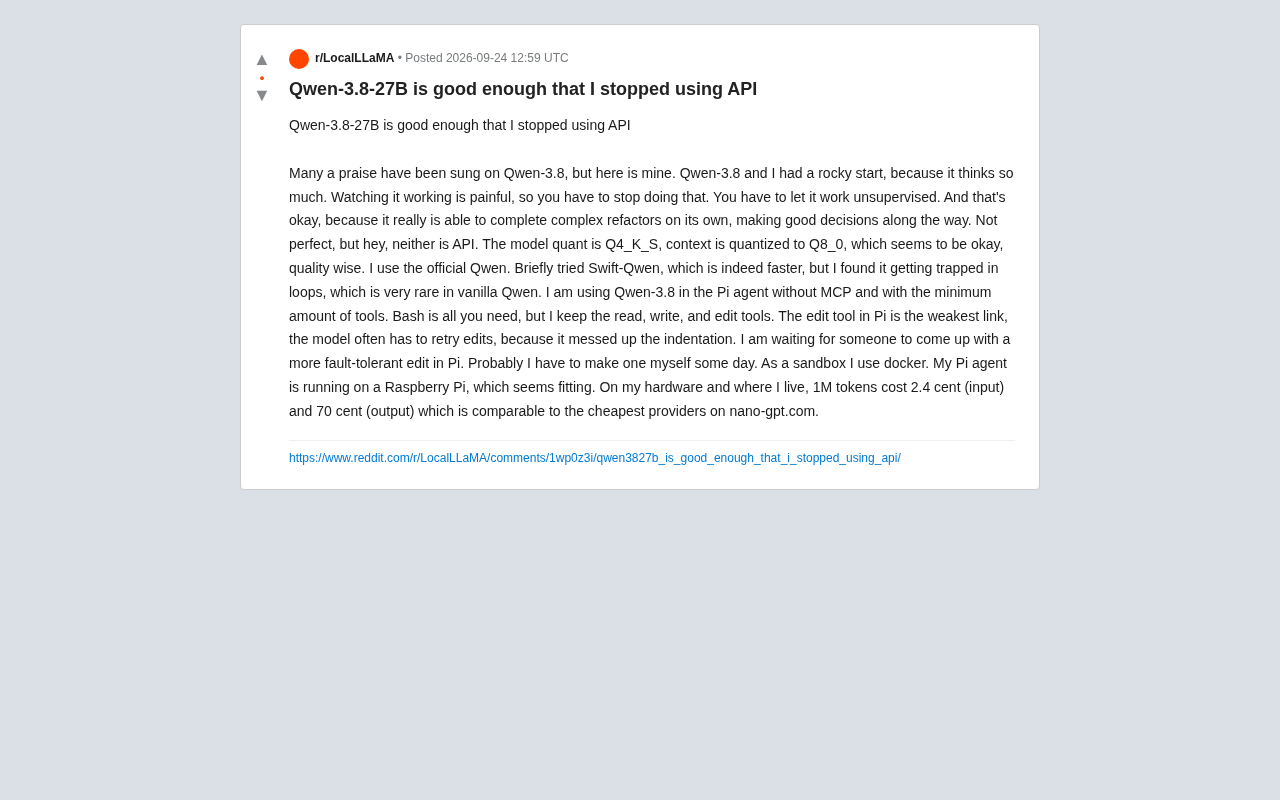
The developer candidly admitted that working with Qwen-3.8 had a "rough start" — because it "thinks too much." Watching the model's reasoning process was described as agonizing; the long chains of thought made it tempting to intervene. Their solution: don't watch at all. Let it work unsupervised.
This reflects a key mindset shift required when working with reasoning models. The value of a reasoning model lies precisely in its willingness to spend more compute on complex tasks. Developers accustomed to the instant responses of traditional models may feel anxious watching lengthy deliberation. But once they let go, Qwen-3.8 proved capable of independently completing complex code refactoring and making sound decisions along the way.
The developer didn't oversell it either: the model is "not perfect, but neither are APIs." This pragmatic comparison is exactly the right benchmark for evaluating local models — not perfection, but whether they reach a level of practical utility comparable to paid alternatives.
Choosing a Quantization Scheme and Model Variant
On the technical side, the chosen quantization configuration was Q4_K_S for weights and Q8_0 for context — and in practice, the quality "looks fine." This is a common sweet spot for running large models on consumer or edge hardware: acceptable precision loss in exchange for dramatically reduced VRAM requirements.
The developer also compared model variants. They briefly tried Swift-Qwen, which was noticeably faster, but found it prone to "getting trapped in loops" — something that rarely happened with the original Qwen. This is a useful reminder: speed-optimized model variants may sacrifice stability. For agent workloads that need to run unattended for extended periods, stability usually matters more than raw speed.
Q4_K_S and Q8_0 are common quantization precision identifiers in the GGUF format, popularized by the llama.cpp ecosystem. The numbers indicate bits per weight: Q4 means 4-bit quantization, Q8 means 8-bit. The "K" denotes the "k-quant" algorithm, which improves quality by assigning different precision levels to different layers. S/M/L stand for Small/Medium/Large — the degree of compression aggressiveness within the same bit width. For a 27B-parameter model, full precision (FP16) requires roughly 54GB of VRAM, while Q4_K_S compresses that to around 15–16GB at the cost of slight precision loss. Choosing Q8_0 for context quantization means keeping higher precision in the KV cache (the intermediate attention state storage), which often has a more significant impact on output quality than weight quantization — a common strategy for prioritizing output quality when VRAM is limited.
Bash Is All You Need: A Minimalist Toolchain Philosophy
On the agent architecture front, this developer took a notably restrained approach. Running Qwen-3.8 inside Pi agent, they skipped MCP (Model Context Protocol) entirely and kept the toolset to a bare minimum. The guiding principle: "Bash is all you need" — a single Bash tool can handle most operational needs, supplemented only by read, write, and edit.
This minimalism isn't laziness. More tools mean a larger decision space for the model, increasing the probability of errors and distraction. For a local model with finite capacity, narrowing the toolset can actually improve task completion rates.
The developer called out Pi's edit tool as "the weakest link" — the model frequently needed to retry edits due to incorrect indentation. They hoped the community would build a more fault-tolerant edit implementation, and even considered building one themselves. This rings true: the bottleneck in local agents is often not the model itself but the robustness of the tools. Small errors in indentation or formatting can meaningfully drag down overall efficiency.
MCP (Model Context Protocol) is an open protocol released by Anthropic in late 2024, designed to give AI models standardized access to tools and data sources — essentially a "USB interface spec" for agents, enabling unified access to file systems, databases, web search, and more. The developer's deliberate choice to skip MCP reflects a clear-eyed understanding of mid-sized local models: MCP's rich tooling ecosystem is better suited for more capable models (like Claude 3.5 or GPT-4 tier), which have the context comprehension and planning capacity to orchestrate complex tool combinations. For a quantized 27B model, the sheer number of available tools becomes a cognitive burden. Trimming down to "the minimum sufficient set" lets the model concentrate its limited reasoning capacity on the core task.
Running an Agent on a Raspberry Pi and the Cost Math
Perhaps the most memorable deployment detail: the Pi agent runs on a Raspberry Pi — which the developer jokingly noted is a fitting match ("Pi agent on a Pi"). The sandbox environment uses Docker for isolation, ensuring safe code execution.
On costs, the developer gave concrete numbers: on their hardware and local electricity rates, the cost comes to roughly $0.024 per million input tokens and $0.70 per million output tokens. They noted this is comparable to the cheapest providers on nano-gpt.com.
This figure is the most compelling part of the whole case. The electricity cost of local deployment can now go toe-to-toe with the cheapest cloud APIs — while also delivering data privacy, no rate limits, and no network dependency as added benefits. Of course, this calculation is highly sensitive to local electricity prices and hardware amortization, and won't generalize to everyone. But it at least proves that local deployment is no longer economically far-fetched.
"Pi agent" here is a double reference: it refers both to a lightweight scheduling process running on a Raspberry Pi single-board computer (which sends requests to the host machine running the LLM) and to the name of the agent framework itself. The Raspberry Pi serves as the task orchestrator and interface layer — not the compute source. The actual inference of the 27B quantized model happens on a separate machine with sufficient VRAM. Docker sandboxing isolates the execution environment for model-generated code, preventing an autonomously running agent from accidentally modifying host system files or executing dangerous commands — standard safety practice for unsupervised local agents. The cost breakdown's "input much cheaper than output" pattern also makes sense: reasoning models generate large volumes of chain-of-thought tokens during inference, meaning output token counts are often several times higher than input counts, making output cost the dominant factor.
What This Case Actually Tells Us
A single developer's experience has its limits — it's subjective, hardware-specific, location-dependent, and lacks rigorous benchmarking. But it reflects a real trend: mid-sized open-source models at the 27B scale, when quantized and paired with a carefully designed agent toolchain, are now capable of handling real-world code refactoring tasks.
For developers who care about cost, data privacy, or simply enjoy tinkering with local deployments, the "good enough" threshold is arriving. APIs still have their advantages — higher peak capability, zero maintenance overhead, larger context windows — but for a substantial portion of everyday tasks, local deployments have graduated from "toy" to "tool."
The real barrier is no longer whether the model can do the job. It's whether you're willing to invest the time to tune quantization settings, streamline your toolchain, and tolerate imperfection along the way.
Related articles

Chain of Thought Isn't Just for AI: How Humans Can Use CoT to Improve Thinking Quality
Chain of Thought isn't just a prompt trick for large models. Starting from a Hacker News discussion, this article analyzes why CoT works for human thinking too, breaks down actionable ways to transfer it, and highlights the key differences between human CoT and machine CoT.
Cloudflare Teams Up with OpenAI: Closi…
Cloudflare Teams Up with OpenAI: Closing the Loop from Vulnerability Discovery to Defense with AI
Cloudflare uses OpenAI Daybreak to investigate security vulnerabilities and generate reviewable remediation plans, while developers use Codex to boost coding efficiency and quality.

Orca Multi-Agent Orchestration in Practice: A Guide to Parallel Collaboration with Claude and Codex
Orca is Stable AI's free open-source agent workbench supporting 34 agents like Claude Code and Codex in parallel. Learn its Git worktree isolation, multi-model orchestration, and mobile management.