Running Qwen3 27B for $6/Month: A Budget Inference Service Built for AI Agents

FEIHOA offers Qwen3 27B inference at $6/month with no token cap, optimized for async AI Agent workloads.
The FEIHOA project delivers Qwen3 27B FP8 inference on 4 RTX PRO 6000 GPUs at just $6/month with no token limits. Using batching to achieve 220 tok/s aggregate throughput and YaRN for 1M-token context, it's designed for background AI Agent tasks that can tolerate queuing. While prefill latency remains a challenge for long prompts, the project demonstrates a viable cost-optimization path: mid-sized open-source models + aggressive batching + async Agent positioning.
A Low-Cost Inference Experiment Built for Agents
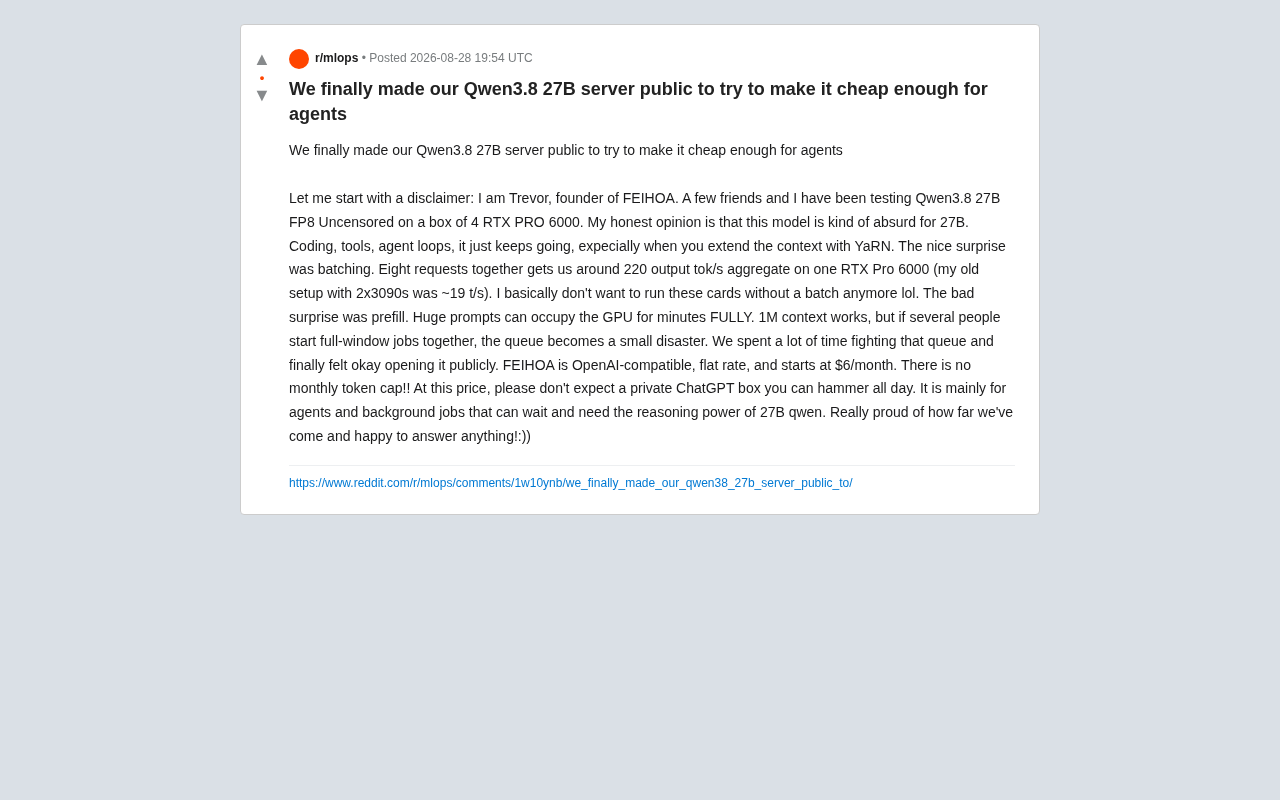
At a time when LLM inference costs remain stubbornly high, an entrepreneur named Trevor has stepped into the spotlight with his FEIHOA project. According to his Reddit post, he and a few friends have been running long-term tests on the Qwen3 27B FP8 model (described as "Qwen3.8 27B FP8 Uncensored") on a server equipped with 4 RTX PRO 6000 GPUs. They've now decided to open the service to the public, with a clear goal: drive the price low enough that AI Agents can afford continuous API calls.
The RTX PRO 6000 (formerly known as the RTX 6000 Ada Generation Pro edition) is a high-end GPU from NVIDIA targeting the professional workstation market, featuring 48GB of GDDR6X VRAM. This memory capacity is critical for large model inference — a 27B-parameter FP8 model requires roughly 27GB of VRAM just to load the weights, and the remaining 48GB headroom comfortably accommodates the KV Cache and additional memory needed for batching. Compared to the consumer-grade RTX 4090 (24GB VRAM), the PRO 6000 offers a twofold advantage in memory capacity, which directly determines whether larger models or longer contexts can run on a single card. Trevor's team chose this GPU over the more expensive data center-grade H100/A100, reflecting a pragmatic cost calculation: the PRO 6000 costs roughly one-third to one-quarter of an H100, and while it falls short in raw compute, it offers superior price-to-performance for small-to-medium-scale inference services.
This isn't another "private ChatGPT" marketing story. Trevor was upfront from the start: "At this price, please don't expect it to be a private ChatGPT box you can hammer all day." That statement actually reveals the project's true positioning — it's inference infrastructure designed for background tasks and Agent workflows that can tolerate waiting.
The 27B Model Punching Above Its Weight
Trevor's assessment of the model was quite direct: "This model is kind of absurd for 27B." In his hands-on testing, whether for code generation, tool calling, or Agent loops, the model ran consistently and reliably — especially after extending the context window using YaRN technology.
YaRN (Yet another RoPE extensioN) is an efficient method for extending a large model's context window without retraining the entire model, stretching originally short context capabilities to extremely long ranges. It's specifically designed for Transformer models that use RoPE (Rotary Position Embedding) — the position encoding scheme widely adopted by mainstream LLMs today (including the Qwen and LLaMA families), which injects positional information into attention computations via rotation matrices. However, models are typically trained on text of limited length (e.g., 32K tokens), and directly running inference on longer sequences causes distribution shifts in attention score calculations, leading to sharp performance degradation. YaRN's core insight is to apply differentiated scaling strategies to different frequency dimensions of RoPE: high-frequency dimensions (encoding local positional relationships) are kept largely unchanged, while low-frequency dimensions (encoding long-range dependencies) are interpolated and stretched, with a temperature scaling factor introduced to correct the attention distribution. Compared to earlier approaches like NTK-aware interpolation, YaRN delivers more stable performance during extreme context extension and requires no full fine-tuning — only minimal calibration.
According to Trevor, this technology enabled their service to support 1M (million-level) token context. For scenarios involving long documents, extensive conversation histories, or complex Agent states, this context length is immensely valuable.
It's worth noting that the FP8 (8-bit floating point) quantization format used here is also a key enabling technology. FP8 compresses model weights from the standard FP16 (16-bit) down to 8-bit representation, halving memory footprint and significantly boosting inference speed while incurring minimal accuracy loss on most tasks. NVIDIA's Ada Lovelace and Hopper architectures provide native hardware support for FP8 operations, with built-in FP8 Tensor Cores that execute floating-point operations at speeds approaching INT8 while retaining the dynamic range advantages of floating-point numbers. For a 27B-parameter model, FP16 format requires approximately 54GB of VRAM just for weight storage, whereas FP8 compresses this to roughly 27GB, allowing a single 48GB RTX PRO 6000 to not only fit the model but retain ample room for KV Cache during inference — the very resource that underpins long context and batching.
A mid-sized model demonstrating capabilities beyond its weight class in coding and Agent tasks also validates the strong competitiveness of the Qwen series in the open-source model landscape in recent years. For cost-sensitive Agent applications, accomplishing tasks with a 27B model instead of a larger one is itself a value-driven choice.
The Batching Surprise and the Prefill Pain Point
The most technically substantive part of Trevor's post is his candid record of performance optimization.
Batching: An Order-of-Magnitude Throughput Boost
The biggest surprise came from batching. According to Trevor, when 8 requests are batched together, a single RTX PRO 6000 achieves approximately 220 output tok/s in aggregate throughput. For comparison, his previous setup with two RTX 3090s managed only about 19 tok/s.
That's more than a tenfold throughput improvement. The root of this leap lies in GPU architecture. Modern GPUs have thousands of compute cores designed to process massive amounts of data in parallel. When serving a single request, the decode phase produces only one token per forward pass, leaving the vast majority of compute units idle — this is the classic "compute-bound vs memory-bound" problem, where single-request inference is severely bottlenecked by memory bandwidth rather than compute. Batching merges multiple requests into a single batch, allowing the GPU to generate tokens for multiple sequences simultaneously in a single matrix operation, dramatically improving compute utilization. More advanced continuous batching techniques, as implemented by vLLM and TensorRT-LLM, allow requests of different lengths to dynamically join and leave batches, eliminating the waste of short requests waiting for long ones in traditional static batching.
Trevor even half-joked: "I basically don't want to run these cards without batching anymore." This also reveals a crucial fact for Agent scenarios: when an inference service handles large numbers of concurrent requests, batching is the core mechanism for driving down per-unit costs. This is precisely the technical foundation that enables his extremely low pricing.
Prefill: The Untamed Queue Problem
However, the bad news is equally real. The prefill stage turned out to be the biggest pain point. Trevor admitted that extremely large prompts can completely occupy a GPU for several minutes. While 1M context works, if multiple users simultaneously submit full-window tasks, the queue becomes "a small disaster."
Prefill refers to the process where the model must encode the entire input prompt before generating the first token. LLM inference actually consists of two distinctly different phases: Prefill and Decode. The prefill phase processes the entire input prompt in one pass, computing Key and Value vectors for every input token at each Transformer layer and caching them (the KV Cache). This phase is compute-intensive — for a 1M-token input, since the computational complexity of self-attention scales quadratically with token count (even though optimizations like FlashAttention reduce memory complexity to O(n), the compute volume remains enormous), the KV Cache alone consumes tens of gigabytes of VRAM, and prefill computation can take several minutes.
What makes it even trickier is that the prefill and decode phases have completely different GPU resource demand profiles — the former requires massive compute and memory bandwidth simultaneously, while the latter is primarily memory bandwidth-bound. This heterogeneity makes scheduling complex: a request undergoing long-prompt prefill monopolizes GPU compute, blocking other requests that are in the decode phase and causing their generation speed to plummet. The industry is exploring architectures like prefill-decode disaggregation to address this conflict, but for small teams, it remains a problem that requires careful engineering.
This also explains why Trevor's team "spent a lot of time fighting with this queue" before finally feeling confident enough to open the service to the public. This detail is invaluable real-world experience for any team considering building their own long-context inference service: the alluring capabilities of long context come at the cost of a heavy scheduling burden during the prefill phase.
Pricing Strategy and True Positioning
FEIHOA's service incorporates several key design decisions:
- OpenAI-compatible API: This means existing applications built on the OpenAI API can migrate at low cost. The OpenAI-compatible API has become the de facto standard protocol for LLM inference services, encompassing REST API endpoints like /v1/chat/completions and /v1/completions, along with standardized request/response JSON structures. Since OpenAI was the first to commercialize LLM APIs at scale, the entire ecosystem — from Agent frameworks like LangChain and LlamaIndex, to AI coding tools like Cursor and Continue, to various automation workflow platforms — almost universally treats the OpenAI API format as first-priority support. By adopting this interface, FEIHOA allows users to seamlessly switch from OpenAI or other providers simply by changing the API base_url and key.
- Flat rate: Starting at $6 per month.
- No monthly token cap: This is quite rare in a market dominated by usage-based billing.
No token cap plus rock-bottom monthly pricing sounds almost "too good to be true," but it makes sense given the technical context above: this service is designed on the premise that Agents and background tasks can wait in a queue. It sacrifices the immediacy of real-time interaction in exchange for maximized overall resource utilization and extreme cost compression.
In other words, it's a deliberate trade-off — not suitable for conversational scenarios requiring sub-second responses, but ideal for batch Agent workloads that can tolerate latency while needing 27B-class inference capabilities.
Implications for the Industry
FEIHOA's practice reflects an important trend in today's AI infrastructure landscape: as open-source model capabilities improve and professional-grade GPUs advance, small and medium teams now have the opportunity to build price-competitive inference services.
More importantly, it reveals a clear cost optimization path: a cost-effective mid-sized model + aggressive batching strategy + explicit positioning for async Agent scenarios. The combination of these three elements turns "making Agent calls cheap enough" from a slogan into a real possibility.
The rise of AI Agents is fundamentally changing the economic model of LLM inference services. Unlike traditional human-machine conversation scenarios, Agent workflows are characterized by high frequency, long chains of calls, and low latency sensitivity — a coding Agent might invoke an LLM dozens or even hundreds of times to complete a single task, involving code generation, error analysis, tool-call result parsing, and other multi-turn interactions. At mainstream cloud providers' usage-based pricing (e.g., GPT-4o at approximately $2.5/M input tokens, $10/M output tokens), a single execution of a complex Agent task can cost several dollars, and costs quickly become unsustainable at scale. This has created enormous demand for cheap inference. The industry has already seen multiple response strategies: vendors like DeepSeekAd have driven API prices to extremely low levels through engineering optimization; the open-source community continues to lower local deployment barriers through quantization and distillation; and the model represented by FEIHOA — self-built small-scale GPU clusters serving async Agent scenarios — is yet another path worth watching, particularly well-suited for backend automation scenarios with high call volumes but relaxed real-time requirements.
Of course, as a report from a single entrepreneur, the performance data and stability still await broader user validation. Whether the prefill queue issue will become a bottleneck as the user base scales remains to be tested over time. But regardless, this project provides a concrete and authentic sample for thinking about "the economics of inference in the Agent era."
Key Takeaways
Related articles

Workbuddy for Absolute Beginners: How a Desktop AI Agent Fits Into Real Workflows
A beginner's guide to the Workbuddy desktop AI agent: installation, claiming credits, file management, and building automated workflows—compared with CodeX for fit and cost, helping professionals shift from AI question-askers to AI managers.

OpenAI's New Agent Stack: Computer Use, Decisions API, and Ultra-Fast Workflows
OpenAI Dev Day unveiled a new agent stack: Computer Use outperforms humans, Decisions API delivers ultra-low-latency classification via Luna, Agents API opens the same Computer Use capabilities, and GPT-6.1 Sol costs only one-seventh of Astra. Core updates, benchmark data, and developer insights.

Liang Wenfeng Open-Sources DeepInfo Inference Framework, Takes On U.S. Ban
DeepSeek open-sources its DeepInfo inference framework after its models, featuring GPU/CPU cross-pipelining, small-model prediction with large-model verification, and full Huawei Ascend and NVIDIA chip support—facing the U.S. federal ban head-on. This article analyzes its significance for AI deployment and open-source strategy.