Runway Integrates with Replit: Generate Image and Video Assets Directly for Web Design

Runway integrates with Replit so developers can generate images, videos, and assets directly inside their projects, reducing tool switching.
Runway announced Runway for web design, deeply integrated with cloud IDE Replit. Developers can generate images, videos, and various assets directly within the Replit project environment. Official messaging says onboarding takes only "Connect in seconds" with no complex configuration. This embeds AI generation into the development workflow, addressing the pain points of fragmented asset sourcing and cross-tool transfers in web design. The article suggests such integrations could shift the starting point of web design from "find assets first, then lay out" to "build while generating," though asset quality, copyright ownership, and cross-project consistency still require real-world validation.
Starting with a Puppy: The Runway and Replit Union
Runway posted a viral-worthy message on Twitter: "You came for the cute puppy. Stay for what you can create." The image featured a puppy, but the real focus was on the second half — Runway for web design is officially live, and it comes with deep integration into Replit.
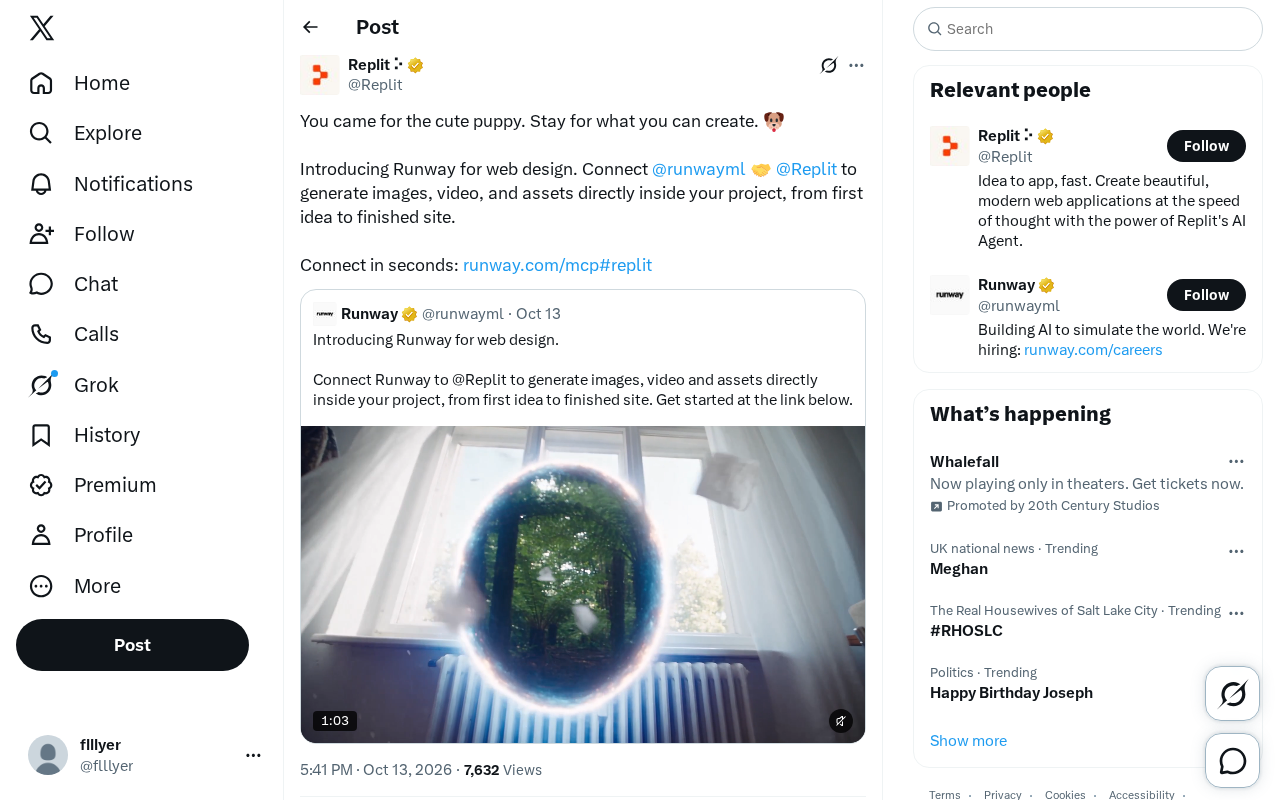
This means developers and designers can now call on Runway's image, video, and asset generation capabilities directly within the Replit project environment — from the first spark of an idea to the final site going live, without ever leaving the editor.
What Problem Does This Integration Actually Solve
In the web design workflow, sourcing assets has always been a fragmented step. Designers typically juggle between Figma, stock libraries, and AI generation tools, then manually import the results into their projects. By connecting Runway with Replit, the "generation" step is now embedded directly in the development environment.
According to the official tweet, users can generate images, videos, and various assets directly inside a Replit project. For scenarios with intensive visual asset needs — rapid prototypes, landing pages, portfolios — this eliminates the hassle of moving assets across tools.
Connect @runwayml 🤝 @Replit to generate images, video, and assets directly inside your project, from first idea to finished site.
The phrase "from first idea to finished site" signals something bigger: Runway is no longer just a standalone creative tool — it's positioning itself as a foundational capability layer within the development workflow.
What is Runway: Runway is an AI creative tool company founded in 2018. It first entered public view with video generation models like Gen-1 and Gen-2, making it one of the pioneers in text-to-video. Its product matrix covers image generation, video editing, motion tracking, green-screen keying, and other visual creation capabilities. Its user base includes film production teams, advertising agencies, and independent creators. Runway positions itself not merely as a model API provider, but as a toolset oriented around creative workflows.
What is Replit: Replit is a browser-based cloud IDE (Integrated Development Environment) that lets developers write, run, and deploy code without local environment setup. It supports Python, JavaScript, Node.js, and many other languages. It natively supports multiplayer collaboration, AI-assisted programming (Replit AI), and one-click deployment, giving it strong adoption in rapid prototyping, educational settings, and small-to-medium projects.
The essence of this integration is plugging Runway's multimodal generation capabilities into Replit's runtime environment as a plugin or built-in module, so that generated results can be used directly as project files.
How to Get Started Quickly
The official onboarding method is remarkably lightweight — "Connect in seconds." The tweet includes a connection link, suggesting the entire binding process requires no complex API key configuration or quota application.
For developers already using Replit, this "seconds-level onboarding" lowers the barrier to trying it out. You don't need to first register a Runway account, then study documentation, then write integration code — you simply authorize within the Replit interface and start generating.
This product design approach is worth noting: AI capability distribution is shifting from "standalone apps" to "embedded in existing workflows." Replit provides the development environment, Runway provides multimodal generation, and their user bases overlap heavily — both serve technically-minded creators with strong needs for efficiency and creative output.
The technical meaning behind "Connect in seconds": This kind of instant onboarding typically relies on OAuth authorization or platform-level partnerships (such as Replit's Integrations marketplace) rather than the traditional manual API key configuration. After developers click connect, account binding and permission grants are completed between the platforms. Generation requests are proxied from Replit to Runway, and billing and quotas may be settled uniformly within the Replit account. The benefit to users is zero configuration; the trade-off is that capabilities are limited by the interface granularity the platform provides — for example, perhaps only image/video generation is exposed, while Runway's advanced editing features may not all be available. The specific permission scope has not yet been disclosed officially.
Potential Impact on Web Design Workflows
If this kind of integration becomes the norm, the starting point of web design may change. In the past, it was "find assets first, then lay out"; in the future, it could be "describe requirements first, let AI generate assets, and build while generating."
Runway has deep accumulations in video generation. With its image and video capabilities integrated into Replit, the barrier to generating dynamic backgrounds, product demo videos, and interactive motion assets will drop significantly. For individual developers and small-to-medium teams, this is equivalent to outsourcing part of visual design to AI.
Of course, the quality of generated assets, copyright ownership, and consistency across different projects all remain questions that can only be judged after hands-on use. Currently, official information is limited, and more details await validation once the product is officially opened up.
Summary
The core value of the Runway and Replit integration isn't "yet another AI generation entry point" — it's putting generation capabilities into the tools developers already use. Reducing tool switching means reducing creative friction. For anyone who frequently needs to quickly produce visual assets for web projects, this is an update worth watching.
Related articles

Chain of Thought Isn't Just for AI: How Humans Can Use CoT to Improve Thinking Quality
Chain of Thought isn't just a prompt trick for large models. Starting from a Hacker News discussion, this article analyzes why CoT works for human thinking too, breaks down actionable ways to transfer it, and highlights the key differences between human CoT and machine CoT.
Cloudflare Teams Up with OpenAI: Closi…
Cloudflare Teams Up with OpenAI: Closing the Loop from Vulnerability Discovery to Defense with AI
Cloudflare uses OpenAI Daybreak to investigate security vulnerabilities and generate reviewable remediation plans, while developers use Codex to boost coding efficiency and quality.

Orca Multi-Agent Orchestration in Practice: A Guide to Parallel Collaboration with Claude and Codex
Orca is Stable AI's free open-source agent workbench supporting 34 agents like Claude Code and Codex in parallel. Learn its Git worktree isolation, multi-model orchestration, and mobile management.