RuoYi-Vue-Pro Deep Dive: A 36k Star Enterprise-Grade Java Development Platform

RuoYi-Vue-Pro is a 36k Star enterprise-grade Java full-stack development platform from China.
RuoYi-Vue-Pro is built on Spring Boot + MyBatis Plus + Vue, offering RBAC permission management, SaaS multi-tenancy, and Flowable workflow engine as core capabilities. It includes built-in business modules for e-commerce, CRM, ERP, and MES, along with cutting-edge integrations like AI large models, IM, and IoT. Having evolved from a backend management framework into an enterprise-grade full-stack development platform covering multiple industry scenarios, it's ideal for SME informatization, SaaS product development, and outsourcing project delivery.
Project Overview: A 36k Star Domestic Open-Source Benchmark
RuoYi-Vue-Pro is a brand-new Pro version based on the classic RuoYi-Vue framework, led by developer YunaiV (芋道源码). It has garnered over 36,900 Stars and nearly 8,000 Forks on GitHub, making it one of the most popular open-source projects in the Java backend management system space in China. The project uses Spring Boot + MyBatis Plus + Vue & Element as its core tech stack, optimizing and refactoring all features from the original RuoYi while significantly expanding enterprise-level application scenarios.
Technical Architecture Analysis
Backend Tech Stack: Spring Boot + MyBatis Plus
The backend is built on Spring Boot + MyBatis Plus, a combination that has become the de facto standard in Java enterprise development today. Spring Boot, created by the Pivotal team (now under VMware/Broadcom), is a rapid development framework that dramatically simplifies the tedious XML configuration and dependency management of traditional Spring applications through its "convention over configuration" philosophy — developers only need to include the corresponding Starter dependencies to automatically configure data sources, web containers, security frameworks, and other components. MyBatis Plus is an enhancement tool developed by the Baomidou team on top of MyBatis. Without altering MyBatis's original architecture, it provides generic Mappers, Lambda query builders, automatic pagination plugins, logical deletion, optimistic locking, and other frequently-used enterprise development features, significantly reducing boilerplate code. Together, developers can set up a fully functional RESTful API service with complete CRUD capabilities in just minutes — which is why this combination has such high adoption in Chinese Java enterprise development. The entire backend architecture follows layered design principles with a high degree of modularity, facilitating team collaboration and feature extension.
Being developed in Java means the project inherently offers excellent cross-platform capabilities and rich ecosystem support. For most domestic enterprise tech teams, Java remains the language with the deepest talent pool and the most accumulated technical expertise.
Frontend Tech Stack: Vue + Element UI + WeChat Mini Programs
The frontend uses the classic Vue + Element UI combination, providing a complete backend management interface. Vue.js is a progressive JavaScript framework created by Evan You in 2014. With its low learning curve, excellent reactive data binding mechanism, and flexible component-based architecture, it quickly became one of the world's three major frontend frameworks (alongside React and Angular). Element UI is a desktop UI component library based on Vue 2.x, open-sourced by the Ele.me frontend team. It provides 60+ components frequently used in enterprise backend development — tables, forms, dialogs, tree controls, date pickers, and more — dominating the domestic backend management system development landscape. Vue's component-based development model paired with Element UI's rich enterprise-grade component library significantly boosts frontend development efficiency.
Notably, with the growing adoption of Vue 3, Element UI has evolved into Element Plus (rewritten with Vue 3 + TypeScript), and the RuoYi-Vue-Pro project is actively adapting to the new version for better performance and TypeScript type safety support.
The project also supports WeChat Mini Programs, covering mobile usage scenarios — particularly practical for enterprises needing C-end (consumer-facing) reach.
Core Feature Modules Explained
RBAC Permissions & Multi-Tenancy System
RuoYi-Vue-Pro provides a comprehensive permission management system built on the RBAC (Role-Based Access Control) model. RBAC is one of the most classic permission management models in information security, formally proposed by the National Institute of Standards and Technology (NIST) in 1992. Its core concept is to assign Permissions to Roles, then assign Roles to Users, thereby decoupling users from permissions. Specifically, it includes:
- Dynamic RBAC Permissions: Role-based access control supporting flexible configuration of menu permissions, button permissions, and data permissions. Menu permissions control which pages users can see, button permissions control which operations users can perform, and data permissions control which scope of data users can access — together forming a complete fine-grained permission control system
- Data Permission Isolation: Supports multi-dimensional data isolation strategies at department and individual levels
- SaaS Multi-Tenant Architecture: Built-in multi-tenancy support, allowing a single system to serve multiple customers — critical for enterprises pursuing SaaS deployment
SaaS (Software as a Service) multi-tenant architecture is the core software delivery model of the cloud computing era, allowing multiple customers (tenants) to share the same application instance while ensuring complete data isolation between tenants. There are three mainstream multi-tenant data isolation approaches in the industry: the "independent database" approach offers the strongest isolation but highest cost; the "shared database, independent schema" approach creates independent table spaces for each tenant within the same database; and the "shared database, shared tables" approach differentiates tenant data by adding a tenant_id field to each table — lowest cost but requiring strict data isolation at the application layer. RuoYi-Vue-Pro's multi-tenancy implementation is primarily based on MyBatis Plus's TenantLineInnerInterceptor plugin, using the shared table approach to automatically append tenant filter conditions at the SQL execution level with nearly zero intrusion on business code.
This permission system covers virtually all common permission management needs in enterprise applications, truly delivering an out-of-the-box experience.
Flowable Workflow Engine Integration
The project integrates the Flowable workflow engine, supporting visual process design and approval flow management. Flowable is a lightweight Business Process Management (BPM) engine whose lineage traces back to jBPM and Activiti. In 2016, Activiti's core developer Tijs Rademakers forked the Flowable project from the Activiti 5.x branch after disagreements with Alfresco over the project's direction. Flowable is fully compatible with the BPMN 2.0 (Business Process Model and Notation) international standard, supporting user tasks, service tasks, gateways (exclusive, parallel, inclusive), subprocesses, events (timer, message, signal), and other rich process elements.
In enterprise informatization, workflow is one of the most critical foundational capabilities — leave approvals, procurement processes, and contract signing all require flexible process orchestration. Compared to Activiti, Flowable offers better performance under high-concurrency scenarios and adds support for CMMN (Case Management) and DMN (Decision Model) engines, capable of handling more complex business decision scenarios.
Built-in Enterprise Business Modules
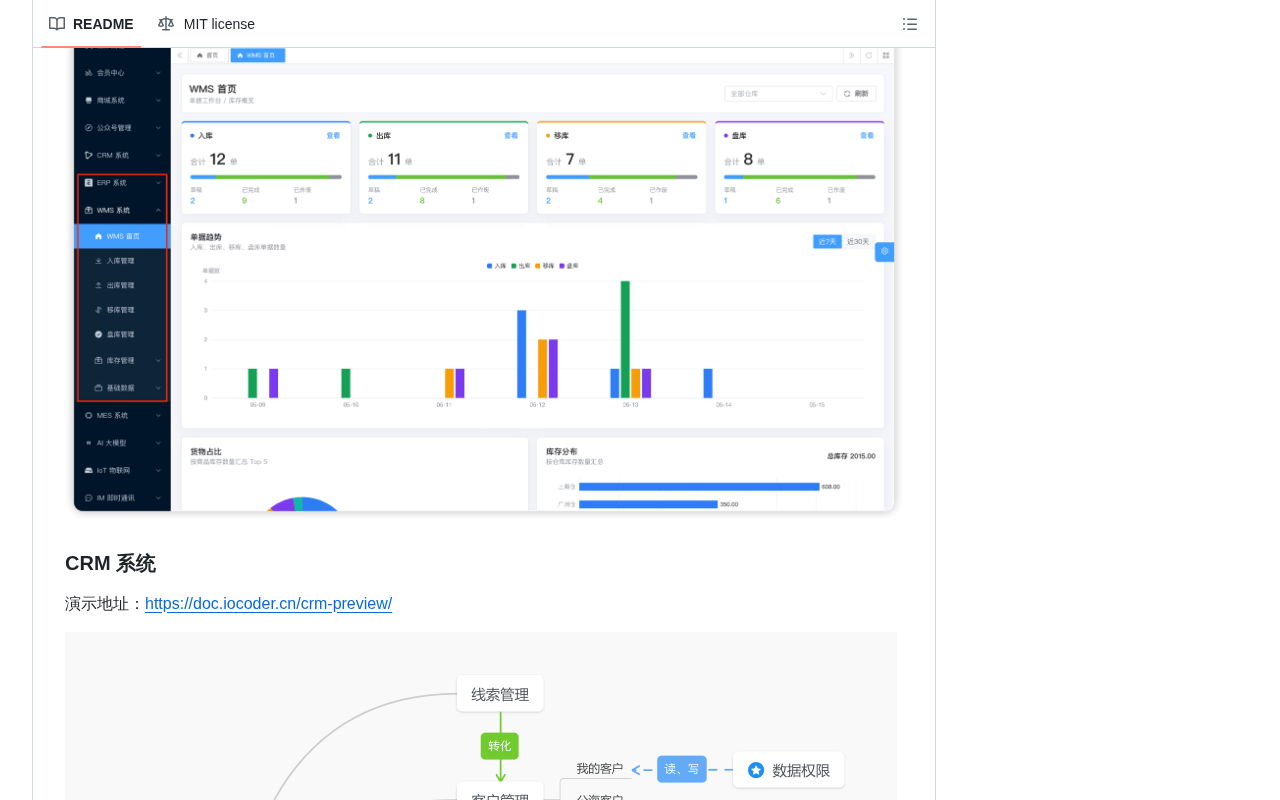
This is the biggest differentiator of RuoYi-Vue-Pro from other backend management frameworks. The project not only provides basic admin panel capabilities but also includes multiple complete business modules:
- E-commerce System: Core transaction capabilities covering e-commerce scenarios
- CRM (Customer Relationship Management): Customer follow-up and management tools for sales teams
- ERP (Enterprise Resource Planning): Inventory management and other enterprise resource management features
- MES (Manufacturing Execution System): Production management modules for manufacturing
- Payment & SMS Services: Out-of-the-box integration of common foundational services
- Third-party Login: Quick integration with WeChat, DingTalk, and other third-party platforms
Cutting-Edge Technology Integration: AI, IM, IoT
The project keeps pace with technology trends by integrating the following cutting-edge capabilities:
- AI Large Models: Integrates large language model capabilities to infuse intelligent scenarios into enterprise applications. Since ChatGPT ignited the Large Language Model (LLM) wave in late 2022, embedding AI capabilities into enterprise applications has become an industry consensus. At the technical implementation level, there are typically three paths for enterprise applications to integrate AI large models: directly calling cloud APIs (such as OpenAI API, Baidu ERNIE Bot API, Alibaba Tongyi Qianwen API) for rapid validation scenarios; using RAG (Retrieval-Augmented Generation) technology to combine enterprise private knowledge bases with large models for intelligent Q&A based on enterprise data; or fine-tuning and privately deploying open-source models (such as LLaMA, ChatGLM, Qwen) for scenarios with extremely high data security requirements. RuoYi-Vue-Pro's AI integration enables developers to quickly build intelligent customer service, document summarization, data analysis assistants, and other scenarios within the admin system, lowering the technical barrier for enterprises to embrace AI
- IM (Instant Messaging): Infrastructure for internal enterprise communication and collaboration
- IoT (Internet of Things): Device connectivity and data collection capabilities. IoT refers to the technology ecosystem that connects physical devices to the internet through sensors, communication modules, and software platforms to enable device status monitoring, remote control, and data collection and analysis. At the protocol level, the most commonly used communication protocols in IoT include MQTT (a lightweight publish/subscribe messaging protocol designed for low-bandwidth, high-latency network environments), CoAP, and HTTP. Enterprise-grade IoT platforms typically need core capabilities including device registration and management, data collection and storage, rule engines, and data visualization dashboards. RuoYi-Vue-Pro's IoT module integration enables developers in manufacturing, smart agriculture, intelligent buildings, and other industries to manage both business systems and IoT devices on a unified technology platform, avoiding the operational complexity caused by multi-system fragmentation
The addition of these modules transforms RuoYi-Vue-Pro from a simple backend management framework into an enterprise-grade full-stack development platform covering multiple industry scenarios.
Use Cases & Project Value
Why 36k Stars Deserve Attention
36,000+ Stars represent not just community recognition, but also an active maintenance team and rich community resources behind the project. For developers, it means solutions are easier to find when encountering issues, and long-term project maintainability is better assured.
Four Typical Use Cases
- SME Informatization: Quickly build internal management systems, avoiding the high costs of developing from scratch
- SaaS Product Development: Multi-tenant architecture naturally supports SaaS models, shortening time-to-market
- Outsourcing Project Delivery: Rich functional modules can significantly reduce project development cycles and improve delivery efficiency
- Spring Boot Full-Stack Learning: A complete enterprise-grade project architecture serving as excellent hands-on material for learning Java full-stack development
Important Considerations Before Use
Rich functionality also means a relatively steep learning curve — it's recommended to start with core modules and gradually familiarize yourself. Some advanced business modules (such as e-commerce, CRM) may require significant customization based on actual business needs. Additionally, under high-concurrency scenarios, targeted performance tuning of the architecture will be necessary.
Conclusion
RuoYi-Vue-Pro represents a high-caliber benchmark for domestic open-source enterprise development frameworks. It's not merely a backend management template but a comprehensive Java development platform integrating permission management, workflow engines, and multiple business modules. For teams using the Spring Boot tech stack, whether deploying directly to production or using it as an architectural reference, it offers extremely high practical value. With the continued integration of cutting-edge modules like AI large models and IoT, this project's application boundaries continue to expand.
Related articles
 Product Reviews
The Programmer's Desk Setup Guide: Building a Workspace That Feels Like Home
Discover how programmers build productive, comfortable workspaces. From multi-monitor setups to ergonomic design, explore the desk philosophy that drives focus and flow.
 Product Reviews
Qoder vs Cursor Real-World Comparison: Which $20/Month AI IDE Is Better?
Hands-on comparison of Qoder vs Cursor AI IDEs: Agent autonomy, human interaction count, and architecture decisions. Qoder needed only 2 interactions vs Cursor's 8.
 Product Reviews
Cursor Cloud Agent Demo: Eliminating Bottlenecks Across the Entire Software Development Lifecycle
Deep analysis of Cursor's Cloud Agent demo showing how cloud VMs, automated test artifacts, and a full-chain control plane systematically eliminate human bottlenecks across the software development lifecycle.