RuoYi-Vue-Pro Deep Dive: A 37K Star Enterprise-Grade Java Development Platform

RuoYi-Vue-Pro is a Spring Boot-based enterprise Java platform covering permissions, workflows, AI, and IoT.
RuoYi-Vue-Pro is an enterprise development platform rebuilt by YunaiV, based on Spring Boot + MyBatis Plus + Vue, with 36,900+ GitHub Stars. It offers dynamic RBAC permissions, data permissions, SaaS multi-tenancy, and Flowable workflows as core capabilities, plus built-in vertical modules including Mall, CRM, ERP, MES, AI LLM, and IoT—suitable for internal enterprise systems, SaaS prototypes, and secondary development foundations.
Project Overview: From Admin Panel to Enterprise Development Platform
RuoYi-Vue-Pro is a completely rebuilt Pro version of the classic RuoYi-Vue framework, led by developer YunaiV (芋道源码). As of now, the project has earned over 36,900 Stars and nearly 8,000 Forks on GitHub, making it one of the most popular open-source projects in the Java backend management system space.
Built on a core tech stack of Spring Boot + MyBatis Plus + Vue & Element, the project covers everything from basic permission management to cutting-edge fields like AI large language models and IoT. For Java developers, this isn't just an out-of-the-box admin system—it's a highly modular enterprise-grade development platform.
Core Technical Architecture
Backend Stack: Spring Boot + MyBatis Plus
The backend is built on Spring Boot with MyBatis Plus as the persistence layer—a battle-tested combination in the Java ecosystem that balances development efficiency with runtime performance. Compared to the original RuoYi-Vue, the Pro version features deeply optimized refactoring across all functionalities, with significant improvements in code quality and architectural design.
Spring Boot is the rapid-development variant of the Spring framework, with its core value rooted in the "convention over configuration" design philosophy. Through its Auto-Configuration mechanism, Spring Boot automatically handles extensive infrastructure setup based on project dependencies—for example, automatically configuring a data source when a database driver is included, or launching an embedded Tomcat server when web dependencies are added. This mechanism reduces the hundreds of lines of XML configuration typical in traditional Spring projects to virtually zero, allowing developers to focus on business logic. Spring Boot also includes production-ready features like health checks, metrics monitoring, and externalized configuration, making it the de facto standard for Java microservices and monolithic application development.
MyBatis Plus is an enhancement toolkit built on top of MyBatis, designed with the philosophy of "enhance without change." While native MyBatis provides flexible SQL mapping capabilities, it still requires writing extensive repetitive XML mapping files for common single-table CRUD operations. MyBatis Plus eliminates SQL writing for single-table operations through built-in generic Mappers and condition constructors (Wrappers), while preserving MyBatis's flexibility for hand-written SQL in complex multi-table query scenarios. It also provides pagination plugins, optimistic locking plugins, logical deletion, and auto-fill—all high-frequency features in enterprise development. This combination dominates the domestic Java ecosystem largely because it strikes the optimal balance between ORM convenience and SQL controllability—compared to JPA/Hibernate's fully automatic ORM approach, MyBatis Plus gives developers stronger control over generated SQL, which is crucial when dealing with complex business queries and database performance tuning.
The project is developed in Java, naturally fitting the technology selection needs of the vast number of Java development teams in China, with relatively manageable learning and maintenance costs.
Frontend Stack: Vue + Element with Multi-Platform Coverage
The frontend uses the classic Vue + Element UI combination while also supporting WeChat Mini Programs. A single backend system can serve both the web admin panel and mobile mini-program scenarios, greatly expanding the project's applicability.
Vue.js was created by Evan You in 2014 and quickly became the top choice for frontend development in China, thanks to its progressive framework design and extremely low barrier to entry. Unlike React's JSX syntax and functional programming paradigm, Vue adopts template syntax closer to traditional HTML and an Options API, enabling developers transitioning from the jQuery era to adapt quickly. Element UI (and its Vue 3 version, Element Plus) is an enterprise-grade UI component library open-sourced by the Ele.me frontend team, providing high-frequency components for admin systems such as tables, forms, dialogs, and tree controls, with a clean and professional design that's highly suited to backend management scenarios. Notably, with the widespread adoption of Vue 3, Element Plus has become the recommended choice for new projects, and RuoYi-Vue-Pro continues to follow this technical evolution. The Vue + Element combination has achieved near-monopoly status in the domestic admin system space primarily because it perfectly matches enterprise development needs: frontend-backend separation, rapid delivery, and team collaboration.
Complete Feature Module Overview
RBAC Permission Management and SaaS Multi-Tenancy
RuoYi-Vue-Pro provides three core capabilities in permission management:
- Dynamic RBAC Permissions: Role-based access control supporting dynamic configuration of menu and button permissions that take effect without service restart
- Data Permissions: Adds data-dimension access control on top of RBAC, precisely controlling which data a user can see
- SaaS Multi-Tenancy: Built-in multi-tenant architecture support where one system serves multiple tenants with complete data isolation—critical for enterprises pursuing SaaS deployment
RBAC (Role-Based Access Control) is the most widely adopted permission model in enterprise systems. Its core idea is to assign permissions to roles and then assign roles to users, avoiding the direct management of massive "user-permission" mapping relationships. The RBAC model has evolved from RBAC0 to RBAC3: RBAC0 defines the basic relationships between users, roles, and permissions; RBAC1 introduces role inheritance, allowing senior roles to automatically possess junior role permissions; RBAC2 adds constraint mechanisms, such as mutually exclusive roles (a user cannot simultaneously hold "cashier" and "auditor" roles); RBAC3 combines all three. The dynamic permission mechanism implemented in RuoYi-Vue-Pro means that when an administrator modifies a role's menu and button permissions in the backend, changes take effect in real-time without service restart—typically relying on cache refresh mechanisms for permission data and dynamic loading of frontend routes.
Data permissions are an important complement to RBAC. Traditional RBAC addresses "whether a user can perform an operation" (functional permissions), while data permissions address "which data a user can see." For example, two sales managers who both have "view orders" permission—Manager A can only see East China orders while Manager B can only see South China orders. Data permission implementation typically takes two approaches: dynamically appending filter conditions at the SQL level (such as automatically adding WHERE dept_id IN (...)) or filtering query results at the application layer. The former offers better performance and is the primary approach adopted by RuoYi-Vue-Pro. Compared to the more complex ABAC (Attribute-Based Access Control) model, the RBAC + data permissions combination strikes a good balance between implementation complexity and flexibility, meeting the needs of the vast majority of enterprise scenarios.
SaaS multi-tenant architecture is one of the core capabilities of enterprise software in the cloud computing era. Multi-Tenancy means a single software instance serves multiple customers (tenants) simultaneously, with each tenant's data and configuration isolated from one another. There are three mainstream multi-tenant implementation approaches: Separate Database mode, where each tenant uses an independent database instance with the strongest isolation but highest cost, suitable for finance and healthcare industries with extreme data security requirements; Shared Database with Separate Schema mode, where all tenants share the same database instance but use different schemas (namespaces), balancing isolation and cost; Shared Database with Shared Table mode, where all tenant data is stored in the same tables distinguished by a tenant_id field, with the lowest cost but weakest isolation, suitable for small-to-medium SaaS applications. RuoYi-Vue-Pro primarily adopts the shared table mode, using MyBatis Plus's multi-tenant plugin to automatically inject tenant filter conditions into all SQL statements, so developers writing business code are virtually unaware of multi-tenancy—dramatically reducing the development cost of SaaS transformation.
Workflow Engine and Business Integration
The project integrates the Flowable workflow engine, supporting visual process design and complex approval workflow configuration. It also includes built-in third-party login, payment, and SMS integration modules, helping developers avoid reinventing the wheel.
Flowable is one of the most mature open-source workflow engines in the Java ecosystem, with technical lineage tracing back to jBPM and Activiti. In 2010, Tom Baeyens, a core developer of jBPM, left Red Hat and created the Activiti project; in 2016, Activiti's core team split again due to technical direction disagreements and created Flowable. Thus, Flowable effectively inherits over a decade of workflow engine technology accumulation. Flowable fully implements the BPMN 2.0 (Business Process Model and Notation) standard, an international business process modeling standard defined by OMG (Object Management Group) that specifies the semantics and graphical representations of events, activities, gateways, and connections in process diagrams. In enterprise systems, the core value of a workflow engine lies in decoupling business processes from hard-coded logic—when an approval process needs adjustment (such as adding a co-signing node or modifying approval conditions), only the process definition needs to be modified in the visual designer without modifying and redeploying code. This is crucial for enterprise scenarios with frequently changing processes (such as leave approval, procurement approval, contract approval, etc.). Flowable also supports CMMN (Case Management) and DMN (Decision Model) standards, capable of handling unstructured case processes and complex business rule decisions.
Vertical Business Modules: Covering Multiple Industry Scenarios
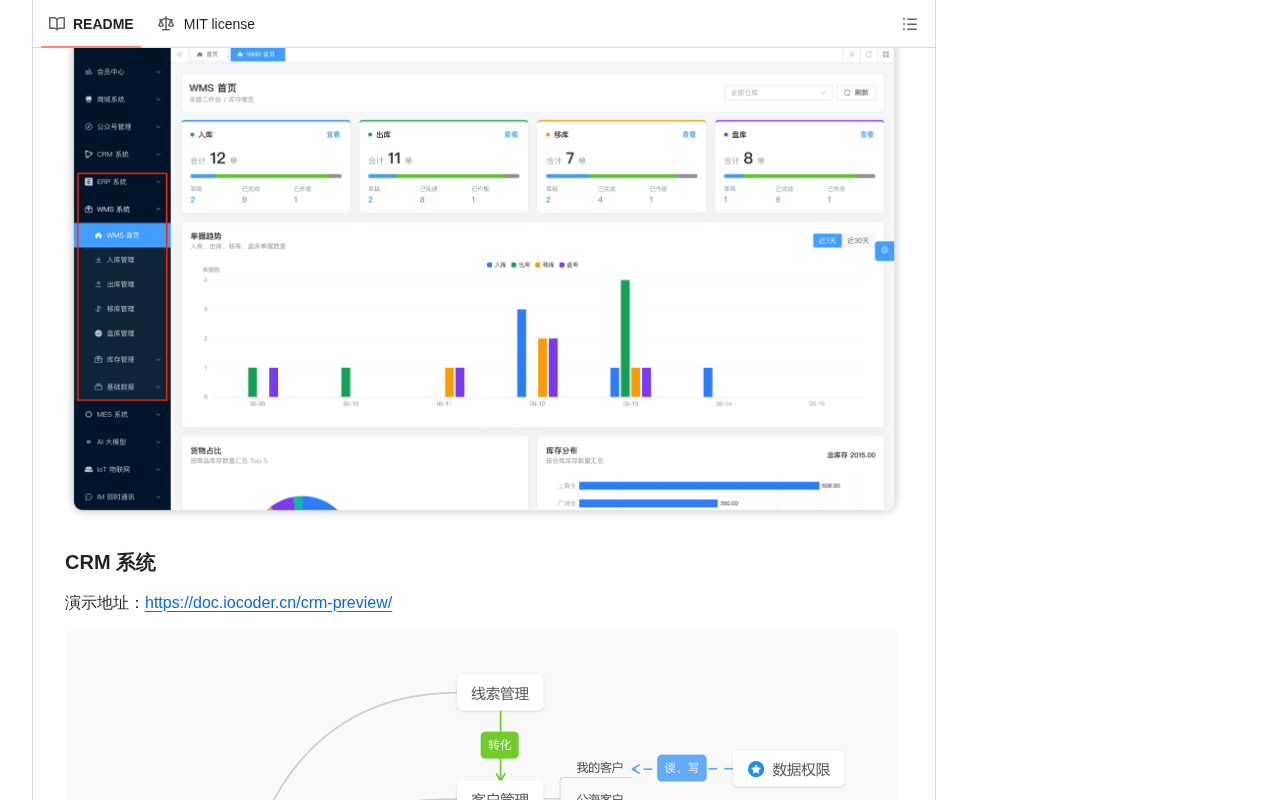
This is the key differentiator between RuoYi-Vue-Pro and other admin management systems. The project includes multiple vertical domain business modules:
| Module | Description |
|---|---|
| Mall | Complete e-commerce business support |
| CRM | Customer Relationship Management |
| ERP | Enterprise Resource Planning |
| MES | Manufacturing Execution System |
| IM | Instant Messaging |
| AI LLM | AI capability integration |
| IoT | Device access and management |
The inclusion of these modules elevates the project from a general-purpose admin framework to an enterprise development platform covering multiple industry scenarios.
Understanding the industry context of these vertical modules helps assess the project's practical value. ERP (Enterprise Resource Planning) is the core system for enterprise informatization, covering the entire business process chain including procurement, inventory, production, sales, and finance. The traditional market has long been monopolized by international vendors like SAP and Oracle, with implementation costs easily reaching millions or even tens of millions of yuan. MES (Manufacturing Execution System) serves as the bridge connecting ERP's planning layer and the shop floor equipment control layer, responsible for production scheduling, work order management, quality traceability, and other fine-grained manufacturing management—a key system for smart manufacturing and Industry 4.0. CRM (Customer Relationship Management) focuses on the entire customer lifecycle, including lead tracking, opportunity management, contract signing, and after-sales service—Salesforce grew into the world's highest-valued enterprise software company through the CRM SaaS model. Commercial software in these domains is expensive and difficult to customize, and open-source solutions provide small and medium enterprises with a low-cost path to digitalization. Of course, open-source modules typically cannot directly compare with mature commercial products in terms of feature depth and industry adaptability—they're better suited as starting points for rapid business model validation or as foundations for secondary development.
The AI LLM module integration reflects a major trend in current enterprise software. This module typically interfaces with APIs from large language models like OpenAI, ERNIE Bot, and Tongyi Qianwen to provide intelligent conversation, text generation, and knowledge Q&A capabilities for business systems. The IoT module focuses on device access and data collection, typically implementing communication between devices and the platform based on lightweight IoT protocols like MQTT, supporting device registration, status monitoring, data reporting, and remote control—with direct application value for smart factories, smart agriculture, and intelligent buildings.
Why This Project Deserves Attention
Community Activity and Ecosystem Maturity
The 36,900+ Stars and nearly 8,000 Forks clearly demonstrate community recognition. High activity levels bring faster bug fixes, richer documentation resources, and more active technical discussions. For enterprise technology selection, community activity is a key metric for measuring an open-source project's sustainability.
Dramatically Reducing Enterprise Development Costs
For SMEs and startup teams, building a system from scratch with permission management, workflows, multi-tenancy, and payment capabilities requires at least several months of development. RuoYi-Vue-Pro packages these common capabilities into out-of-the-box modules, potentially reducing project startup time from months to weeks.
Continuously Tracking Cutting-Edge Technology Trends
The project's ongoing integration of AI LLM and IoT modules demonstrates that the maintenance team is actively following industry technology trends. For enterprises looking to introduce AI capabilities into traditional business systems, this provides a low-cost experimentation platform.
Use Cases and Selection Recommendations
RuoYi-Vue-Pro is best suited for the following scenarios:
- Internal Enterprise Management Systems: Teams needing to quickly build OA, CRM, ERP, and other internal systems
- SaaS Product Prototypes: SaaS startup projects requiring multi-tenant architecture
- Java Architecture Learning Reference: Developers wanting to learn enterprise-grade Java project architecture design
- Secondary Development Foundation: Teams needing a mature and stable base framework for business customization
It's worth noting that rich functionality also means higher system complexity. If you only need lightweight admin management features, consider trimming unnecessary modules to avoid the maintenance burden of over-engineering.
Conclusion
RuoYi-Vue-Pro represents a high-caliber achievement of the domestic Java open-source community in the enterprise development platform space. From foundational RBAC permission management to cutting-edge AI LLM and IoT integration, it demonstrates how an open-source project can evolve from a simple admin template into a comprehensive development platform covering multiple industry scenarios through continuous iteration and community collaboration.
For teams on the Java tech stack, whether quickly launching new projects or seeking architectural references, RuoYi-Vue-Pro is a choice worth in-depth study and evaluation.
Related articles
 Product Reviews
The Programmer's Desk Setup Guide: Building a Workspace That Feels Like Home
Discover how programmers build productive, comfortable workspaces. From multi-monitor setups to ergonomic design, explore the desk philosophy that drives focus and flow.
 Product Reviews
Qoder vs Cursor Real-World Comparison: Which $20/Month AI IDE Is Better?
Hands-on comparison of Qoder vs Cursor AI IDEs: Agent autonomy, human interaction count, and architecture decisions. Qoder needed only 2 interactions vs Cursor's 8.
 Product Reviews
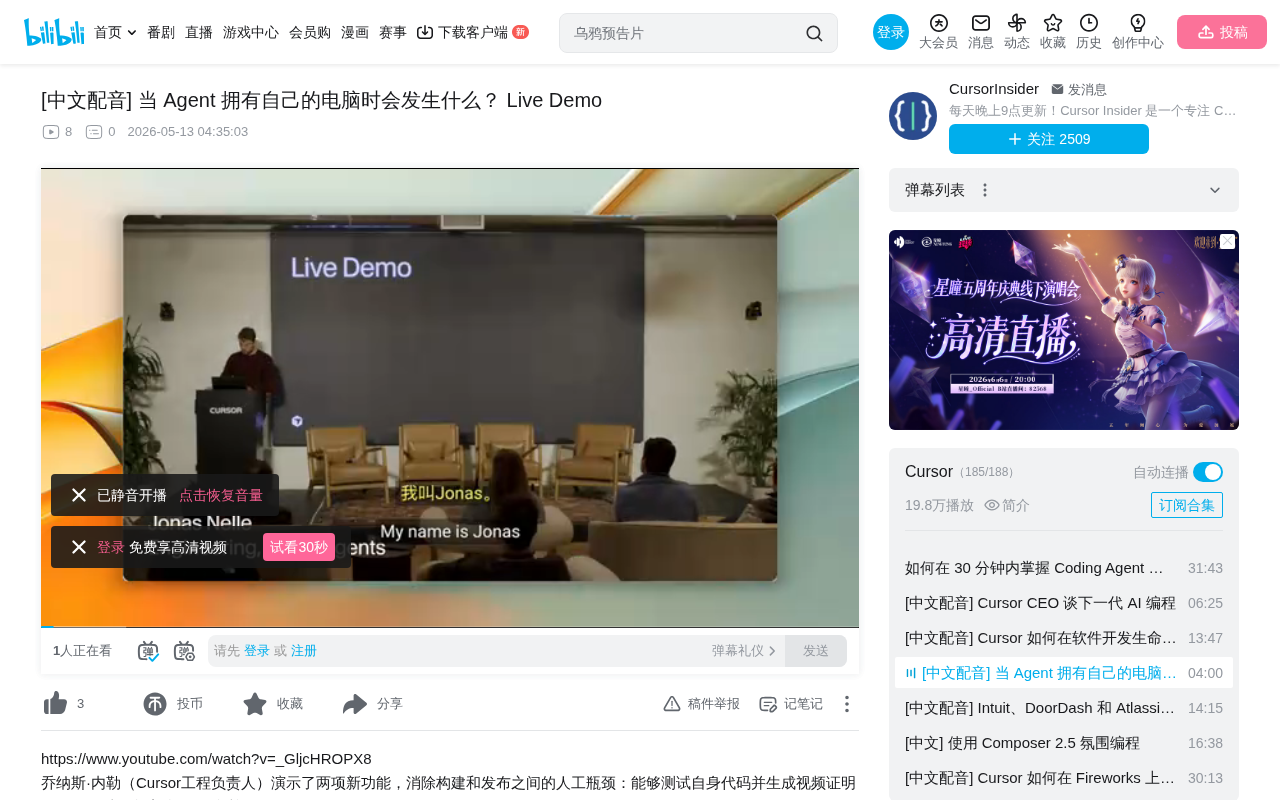
Cursor Cloud Agent Demo: Eliminating Bottlenecks Across the Entire Software Development Lifecycle
Deep analysis of Cursor's Cloud Agent demo showing how cloud VMs, automated test artifacts, and a full-chain control plane systematically eliminate human bottlenecks across the software development lifecycle.