RuoYi-Vue-Pro: In-Depth Analysis of an Enterprise-Grade Full-Stack Development Platform

RuoYi-Vue-Pro is an enterprise-grade Java full-stack platform covering CRM, ERP, AI, IoT, and more.
RuoYi-Vue-Pro is a comprehensive enterprise-grade development platform built on Spring Boot, MyBatis Plus, and Vue. With 36,900+ GitHub stars, it offers SaaS multi-tenancy, RBAC permissions, Flowable workflow engine, and integrated business modules including CRM, ERP, e-commerce, AI large models, and IoT. It serves as a one-stop solution for teams needing rapid enterprise application development.
Project Overview
RuoYi-Vue-Pro is a brand-new Pro version based on the classic RuoYi-Vue framework, led and restructured by developer YunaiV (芋道源码). It has garnered over 36,900+ Stars and nearly 8,000 Forks on GitHub, making it one of the benchmark open-source Java backend management system projects in China. The project uses Spring Boot + MyBatis Plus + Vue & Element as its core technology stack, covering everything from basic permission management to complex business scenarios.
Technical Architecture Analysis
Backend Technology Stack
The backend is built on Spring Boot, paired with MyBatis Plus as the ORM framework — a combination well-proven in the Java ecosystem that balances development efficiency with runtime performance. Compared to the original RuoYi-Vue, the Pro version has optimized and refactored all features, with significant improvements in code quality and architectural design.
Notably, the project supports SaaS multi-tenancy architecture, meaning a single codebase can serve multiple tenants with complete data isolation between them. This is crucial for rapidly launching ToB SaaS products, saving developers from building a multi-tenant system from scratch.
Frontend Technology Stack
The frontend uses the classic Vue + Element UI combination. For most enterprise backend management systems, this approach is mature, stable, component-rich, and well-supported by the community. The project also supports WeChat Mini Programs, achieving dual coverage across PC admin panels and mobile platforms.
Permission System Design
The project implements a dual control mechanism with RBAC dynamic permissions and data-level permissions. RBAC (Role-Based Access Control) handles function-level permission management, while data permissions control what data scope a user can access. This layered permission design is a standard requirement for enterprise-grade applications.
Core Feature Modules
Workflow Engine
It integrates the Flowable workflow engine, supporting process design, approval workflows, and other common enterprise process-driven needs. Whether it's leave approvals, contract signing, or procurement processes, everything can be configured through a visual interface.
Business System Integration
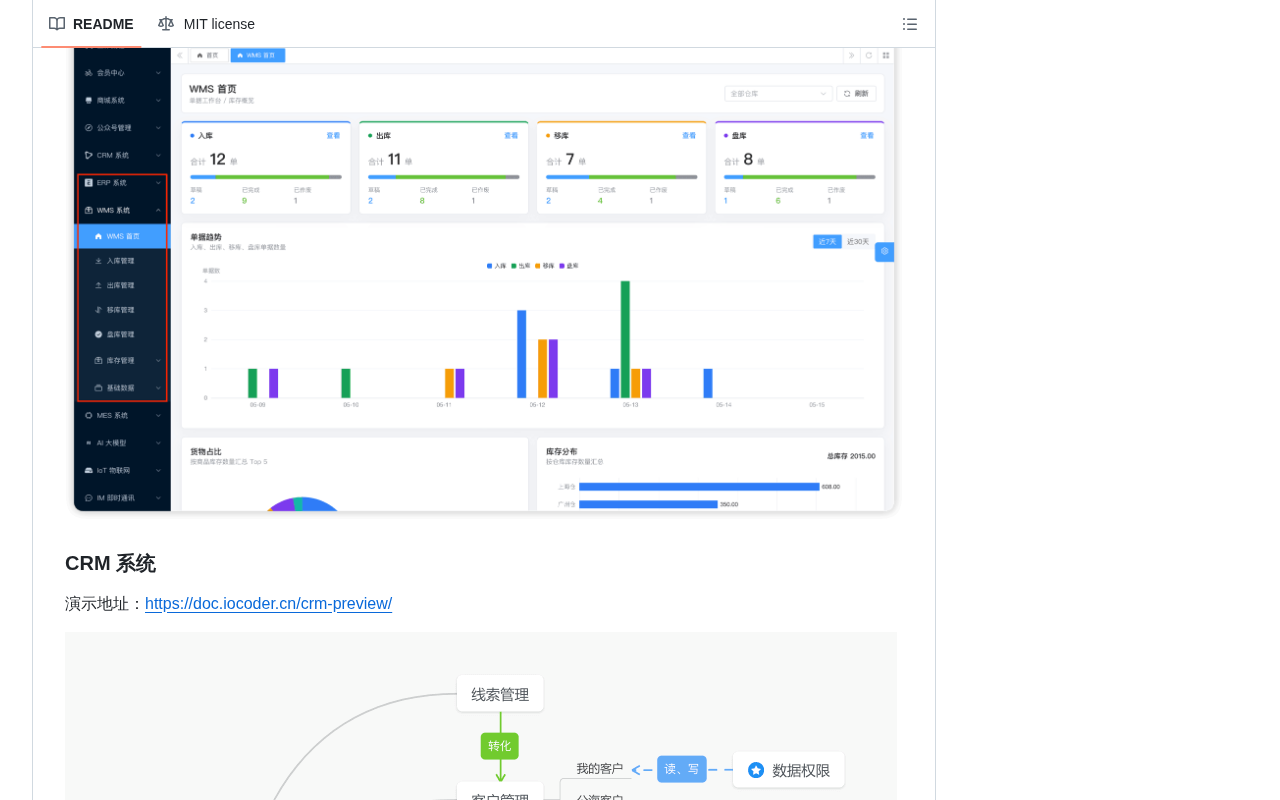
The project's ambition goes beyond a simple admin framework — it also integrates several complete business system modules:
- E-commerce System: Core capabilities for online retail scenarios
- CRM System: Customer Relationship Management
- ERP System: Enterprise Resource Planning
- MES System: Manufacturing Execution System
- IM (Instant Messaging): Real-time messaging capabilities
This "comprehensive and all-inclusive" design philosophy allows developers to selectively enable modules based on actual needs, significantly reducing the development cost of enterprise applications.
AI and IoT Capabilities
Keeping up with technology trends, the project also integrates AI large language model and IoT (Internet of Things) features. The AI LLM integration enables the system to quickly incorporate intelligent dialogue and content generation capabilities, while the IoT module provides foundational support for industrial internet and smart hardware scenarios.
Infrastructure Capabilities
The project also includes built-in infrastructure for third-party login, payment integration, SMS delivery, and other common utilities. These features may seem simple but are time-consuming to implement in practice — they come pre-packaged at the framework level.
Use Cases and Value
Who Should Use It
- Small and medium enterprise tech teams: Need to quickly build internal management systems
- Outsourcing/project-based companies: Need to deliver client projects efficiently
- Independent developers: Want to learn enterprise-grade Java project architecture
- Startup teams: Need a technical foundation for SaaS products
Project Advantages
Compared to similar open-source frameworks, RuoYi-Vue-Pro's core advantages include: extremely broad feature coverage, continuously optimized code quality, high community activity (nearly 8,000 Forks indicate widespread real-world usage), and relatively comprehensive documentation and tutorials.
Conclusion
RuoYi-Vue-Pro represents a development direction for open-source Java backend management frameworks in China — evolving from a simple "scaffolding tool" into an "enterprise-grade application platform." It's no longer just a starter template for permission management; instead, it aims to become a one-stop solution covering CRM, ERP, e-commerce, AI, and other multi-business scenarios. For Java developers, whether for production projects or learning purposes, this is a high-quality open-source project worth paying attention to.
Related articles
 Product Reviews
The Programmer's Desk Setup Guide: Building a Workspace That Feels Like Home
Discover how programmers build productive, comfortable workspaces. From multi-monitor setups to ergonomic design, explore the desk philosophy that drives focus and flow.
 Product Reviews
Qoder vs Cursor Real-World Comparison: Which $20/Month AI IDE Is Better?
Hands-on comparison of Qoder vs Cursor AI IDEs: Agent autonomy, human interaction count, and architecture decisions. Qoder needed only 2 interactions vs Cursor's 8.
 Product Reviews
Cursor Cloud Agent Demo: Eliminating Bottlenecks Across the Entire Software Development Lifecycle
Deep analysis of Cursor's Cloud Agent demo showing how cloud VMs, automated test artifacts, and a full-chain control plane systematically eliminate human bottlenecks across the software development lifecycle.