Rust Borrow Checker Exposes an 11-Year-Old Unsoundness Bug

Rust's borrow checker exposed an 11-year-old unsoundness bug, but the ecosystem's self-correction matters more.
The Rust community recently disclosed an 11-year-old unsoundness bug in the borrow checker that could let the compiler accept code triggering Undefined Behavior. Such bugs are more serious than ordinary ones, threatening Rust's core "zero-cost safe abstraction" promise. It went undetected due to narrow triggers, high implementation complexity, and the need for adversarial testing. Real-world impact is limited, but keeping toolchains updated and using Miri in security-sensitive projects is advised. The event reflects a mature ecosystem's self-correction, not a disaster.
Has Rust's Safety Myth Been Broken? An 11-Year-Old Bug Resurfaces
Rust's most prized feature—memory safety—recently faced a minor crisis of confidence. A developer disclosed on Hacker News that Rust's Borrow Checker contains an unsoundness bug that has been lurking for 11 years. This means the compiler, in certain edge cases, fails to properly enforce its core safety guarantees.
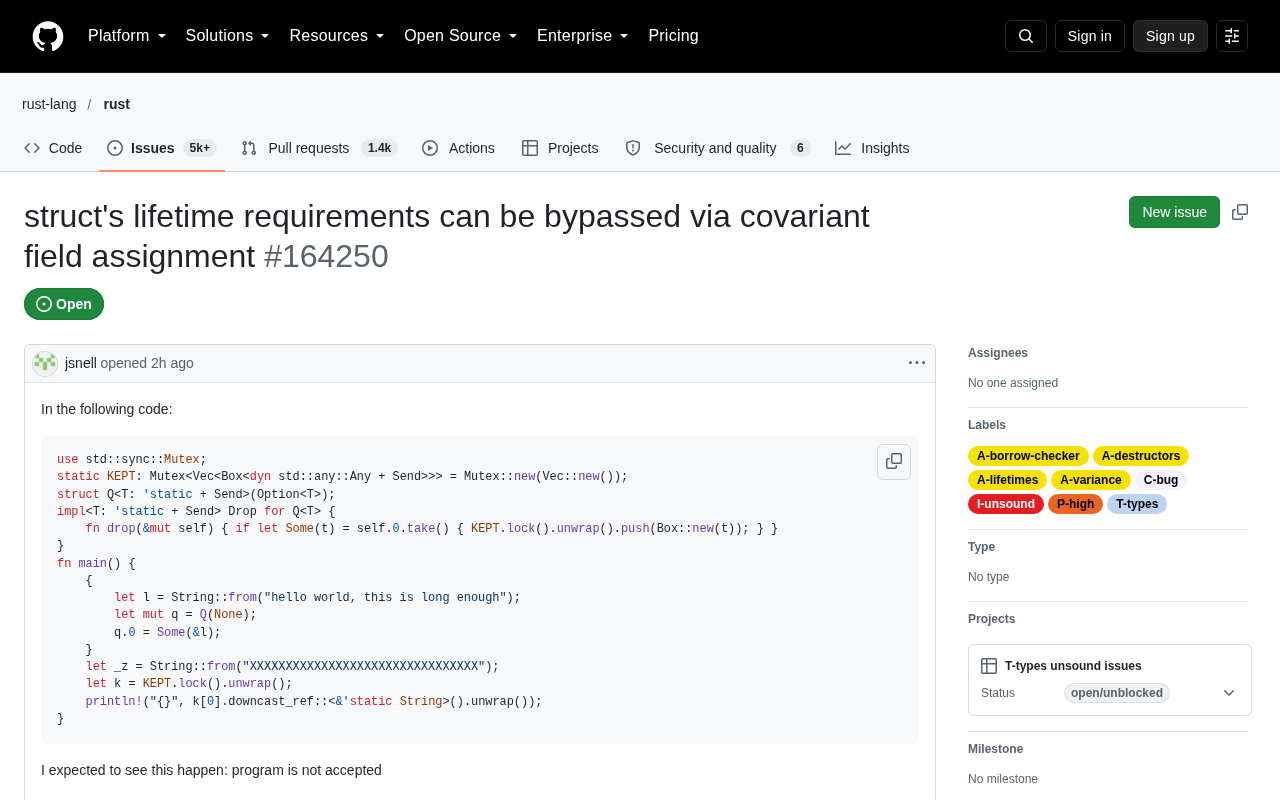
For a developer community that has long viewed Rust as the "safe answer" to systems programming, this news stings a bit. But more importantly, we need to understand: what does this bug actually mean? Does it shake Rust's safety foundation?
What Is "Unsoundness"? Why It's More Serious Than an Ordinary Bug
In Rust's context, "Soundness" is a technical term with a strict definition. If a compiler accepts a piece of code, but that code may trigger Undefined Behavior (UB) at runtime, then the compiler is unsound.
This is fundamentally different from an ordinary functional bug. An ordinary bug just makes the program produce wrong results; an unsound compiler bug means there's a crack in the safety barrier built by the type system and borrow rules. An attacker or a careless developer could exploit this crack to create memory-unsafety issues within "safe" Rust code.
The Rust community has extremely low tolerance for unsoundness bugs, because Rust's core promise is "zero-cost safe abstractions." Any soundness issue is treated as a top-priority fix.
Undefined Behavior (UB) is the key background for understanding soundness issues. In Rust (as well as C/C++), UB refers to operations for which the language specification explicitly guarantees no behavior—such as dereferencing a dangling pointer, data races, out-of-bounds access, and so on. Once a program triggers UB, the compiler and runtime bear no further correctness obligations; the program may crash, produce incorrect results, or even be exploited by attackers to execute arbitrary code. Rust's design goal is precisely to statically eliminate the vast majority of UB at compile time through ownership and borrow rules, ensuring that safe code cannot trigger UB. Therefore, when the compiler mistakenly accepts code that should have been rejected, it's equivalent to opening a hole in the safety barrier—far more dangerous than an ordinary logic error.
Miri is an experimental interpreter provided by the Rust project, specifically designed to detect Undefined Behavior. It interprets and executes Rust's intermediate representation (MIR), simulating memory allocation, pointer operations, and concurrency behavior, and can catch many UBs that normal compilation and execution cannot expose. Miri is commonly used to test unsafe code and edge-case type designs, and is currently one of the most practical UB defense lines in the Rust ecosystem.
Why Could This Bug Hide for 11 Years?
An unsoundness bug surviving for more than a decade sounds shocking, but it's not unprecedented in the history of programming language implementations. There are several practical reasons behind this.
The triggering conditions may be extremely narrow. Many unsoundness bugs only surface under specific type combinations, specific lifetime annotations, or specific compiler optimization paths. Everyday code is almost impossible to hit them; only dedicated fuzzing or formal verification tools have a chance of finding them.
Second, the implementation complexity of the borrow checker far exceeds what it appears to be on the surface. It must simultaneously handle a series of intertwined rules: ownership transfer, lifetime inference, borrow splitting, NLL (Non-Lexical Lifetimes), and so on. Any mishandling of a boundary case in any of these rules could plant a hidden hazard.
Furthermore, discovering such bugs often requires researchers to invest significant effort in constructing adversarial test cases—itself a niche and high-barrier endeavor.
The Borrow Checker is one of the core components of the Rust compiler, responsible for verifying ownership, borrowing, and lifetime rules at compile time. It ensures that references are always valid, that mutable and immutable borrows are mutually exclusive, and that data is properly freed when no longer in use. As Rust evolved, the borrow checker introduced Non-Lexical Lifetimes (NLL), which bases borrow scopes on actual usage rather than lexical scopes, greatly improving code flexibility and user experience. However, NLL and subsequent projects like Polonius are still being refined, and the complex lifetime inference and borrow splitting logic have become a high-incidence area for unsoundness bugs. Understanding the internal mechanics of the borrow checker helps developers recognize that Rust's safety guarantees are not magic, but rather the engineering result of a large number of precise rules and continuous verification.
The Real Impact on the Rust Ecosystem
In the short term, the exposure of this bug has limited impact on Rust's actual usage. The vast majority of applications and libraries will not trigger this particular unsoundness condition. The Rust team's standard response process for such issues typically includes: confirming the problem, assessing the scope of impact, releasing a fix patch, and issuing a security advisory when necessary.
In the medium term, such events actually drive continuous improvement of Rust's safety. Every public disclosure of an unsoundness bug pushes the community to strengthen related testing tools, such as Miri (Rust's Undefined Behavior detection tool) and various formal verification projects.
From a broader perspective, this reminds us: no language can provide absolute safety guarantees. Rust's safety is built on the correct implementation of the compiler, and any large software system inevitably has flaws. Acknowledging this is more conducive to the long-term health of the ecosystem than blind faith.
How Should Developers Respond?
For ordinary Rust developers, the most pragmatic approach is to keep the toolchain updated. Rust's release cadence is steady, and security fixes usually follow quickly in stable releases.
For security-sensitive projects, it's recommended to introduce Miri testing into the CI pipeline, especially when the project involves unsafe code or unusual type designs. Miri can catch many compiler-level Undefined Behaviors and is currently one of the most practical defense lines.
For language researchers and contributors, the process of discovering such bugs is itself a valuable case study. It demonstrates the behavioral boundaries of the borrow checker under extreme conditions and provides concrete directions for subsequent rule refinement.
Rust's 11-year-old bug is not a signal of disaster, but a manifestation of a mature ecosystem's self-correcting ability. What truly deserves attention is not how long the bug existed, but how the community reacted after its discovery—how they fixed it and how they prevent similar issues from happening again.
One-line Summary
Rust's borrow checker exposed an unsoundness bug that lurked for 11 years, but the ecosystem's self-correcting ability is more noteworthy than the bug itself.
Paragraph Summary
The Rust community recently disclosed an unsoundness bug in the borrow checker that lurked for 11 years, potentially causing the compiler to accept code that triggers Undefined Behavior. Unsoundness bugs are more serious than ordinary functional bugs because they directly threaten Rust's core promise of "zero-cost safe abstractions." The bug went undetected for so long due to narrow triggering conditions, the high implementation complexity of the borrow checker, and the fact that discovering such issues requires dedicated adversarial testing. For ordinary developers, the real-world impact is limited, but keeping the toolchain updated and introducing Miri testing in security-sensitive projects is recommended. The article argues that this event is not a disaster signal but a manifestation of a mature ecosystem's self-correcting ability, and it reminds us that no language can provide absolute safety guarantees.
Related articles

Chain of Thought Isn't Just for AI: How Humans Can Use CoT to Improve Thinking Quality
Chain of Thought isn't just a prompt trick for large models. Starting from a Hacker News discussion, this article analyzes why CoT works for human thinking too, breaks down actionable ways to transfer it, and highlights the key differences between human CoT and machine CoT.
Cloudflare Teams Up with OpenAI: Closi…
Cloudflare Teams Up with OpenAI: Closing the Loop from Vulnerability Discovery to Defense with AI
Cloudflare uses OpenAI Daybreak to investigate security vulnerabilities and generate reviewable remediation plans, while developers use Codex to boost coding efficiency and quality.

Orca Multi-Agent Orchestration in Practice: A Guide to Parallel Collaboration with Claude and Codex
Orca is Stable AI's free open-source agent workbench supporting 34 agents like Claude Code and Codex in parallel. Learn its Git worktree isolation, multi-model orchestration, and mobile management.