Rysh Forge in Action: One OpenAPI Spec, Automatically Turned into Claude-Callable Agent Tools

Rysh Forge turns an OpenAPI spec into Agent tools, MCP server, and SDK with one command, with built-in safety controls.
Rysh Forge is an enterprise AI toolchain that uses an OpenAPI spec as its single source of truth, generating a Rysh toolpack, MCP server, Python SDK, and documentation from a single `forge` command. Generated tools register live into running sessions, letting Claude answer in natural language from real API data. Write operations trigger mandatory human confirmation baked into the tool definition layer, and full API logs support auditing and compliance. The demo uses a simple two-operation API, so reliability at scale remains to be proven, but the workflow offers a clear path to native enterprise API integration.
From API Spec to Agent Tool — Almost No Manual Code
Getting large language models to reliably "reach out and touch" enterprise APIs has always been a pain point in AI engineering. Models can understand natural language, but making them dependably read data and execute write operations typically requires developers to hand-write mountains of glue code: wrapping tool definitions, building invocation layers, handling permission boundaries. Rysh Forge's answer is to compress that entire process into a single command.
In the demo, the author sets up a fictional billing API running on loopback (localhost), described by an OpenAPI spec with just two operations. In other words, the input is about as simple as it gets: a standard interface contract file, no extra configuration scripts.
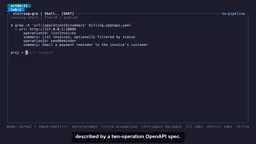
After running one forge command, the output is surprisingly complete: a Rysh toolpack, an MCP server (Model Context Protocol service), a Python SDK, and accompanying documentation. This means the same API definition gets projected simultaneously onto multiple "consumption surfaces" — usable by an Agent, callable by code, and readable by humans. That's the practical meaning behind the demo's closing tagline: "one engine, every surface."
OpenAPI Specification (formerly known as Swagger) is the industry-standard format for describing RESTful APIs, defining endpoint paths, request parameters, response structures, and authentication methods in JSON or YAML. Its core value lies in being machine-readable — not just human developers can understand it, but code generation tools, testing frameworks, and even AI models can parse it. The vast majority of enterprise API platforms and major cloud providers (such as AWS and Azure) natively support exporting OpenAPI spec files, which means Rysh Forge's input side requires almost no extra preparation — it plugs directly into existing infrastructure.
MCP (Model Context Protocol) is an open protocol introduced by Anthropic to provide large language models with a unified standard for tool invocation. It defines how models discover available tools, pass parameters, and receive results — analogous to USB for hardware peripherals. Any tool that conforms to the MCP spec can be called directly by a compatible model (like Claude) without per-model adaptation. Because Rysh Forge also outputs an MCP server, the generated tools inherently have the potential for cross-model reuse.
Tools Register Live, and Claude Calls Them in Plain English
Once the artifacts are generated, the crucial next step is bringing the tools to life inside a running session. In the demo, an integration enable command registers the generated tools live into the current session — no service restart or manual binding required. Once registered, the tools are immediately visible to the model.
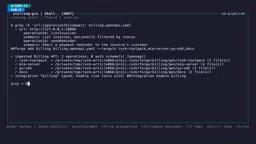
What follows is the most intuitive part: asking Claude questions in natural language. The user doesn't need to know which endpoint is being hit or how parameters are structured — just describe the need in plain English.

Claude receives the request, automatically matches and calls the generated read tool, then answers based on real data returned by the API itself. One detail worth emphasizing: the model's response is grounded in live data from the billing API, not inferences drawn from training data. For accuracy-critical use cases like billing and invoicing, traceability of the data source is a basic requirement.
Write Operations Require Confirmation — Permission Boundaries Are Baked Into the Tools
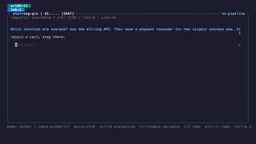
Reading data is low-risk, but the moment a write operation is involved — say, sending a billing reminder — the stakes immediately rise. This is where Rysh Forge demonstrates its commitment to operational safety: sending a reminder maps to a POST request, and the generated tool doesn't execute it outright. Instead, it pauses and asks the user for confirmation.
This "ask before acting" mechanism matters. In an agentic tool-calling paradigm, a model might misread intent or trigger unintended side effects. Embedding human-in-the-loop approval directly into the write operation's tool definition puts a gate on the automated workflow. In the demo, the tool only sends the reminder after the user approves, and the API logs precisely record both calls — one read, one write, nothing extra.
This combination of observability and ownership is exactly what distinguishes enterprise-grade deployments from toy demos. Every tool invocation leaves a trace, providing a solid foundation for future auditing, debugging, and compliance review.
Human-in-the-loop is a core safety principle in AI system design: preserving a human approval step at critical decision points in an automated workflow, rather than letting the model execute fully autonomously. This mechanism is especially important in agentic scenarios. Large language models are powerful reasoners, but their understanding of "intent" is fundamentally probabilistic. For irreversible operations — sending emails, charging payments, deleting data — a misread intent can have consequences that are hard to undo. Hard-coding the confirmation step into the tool definition layer (rather than relying on the model itself to decide whether to ask) architecturally eliminates the possibility of the model "skipping" the confirmation. This is meaningfully more reliable than trying to constrain model behavior through prompts alone.
What Problem Does This Workflow Actually Solve?
Breaking down the full demo, Rysh Forge is clearly aimed at the broader goal of making enterprise AI native — and its approach is refreshingly practical:
- Lower tool onboarding costs: Most enterprises already have OpenAPI specs for their APIs. Reusing those specs to generate tools avoids reinventing the wheel.
- Unified multi-surface output: The same definition simultaneously produces an Agent tool, an MCP server, an SDK, and documentation, reducing the maintenance burden from inconsistencies across surfaces.
- Built-in security policies: Read/write tiering and mandatory confirmation for write operations push risk controls upstream into the tool generation phase, rather than patching them in after the fact.
- Full-chain observability: API logs provide a complete record of model behavior, laying the groundwork for trustworthy production deployment.
To be fair, this demo is based on a fictional API with only two operations — an extremely small scale. Real enterprise APIs often have dozens or even hundreds of endpoints, complex authentication schemes, and deeply nested data structures. Rysh Forge's generation quality, tool reliability, and performance at scale all remain to be validated through more comprehensive testing. But in terms of workflow design philosophy, it demonstrates a clear path: use the OpenAPI spec as a single source of truth and automate its transformation into capabilities that Agents can safely invoke.
Takeaway
Rysh Forge's core value isn't any single feature — it's the seamless chain it builds from "API spec → Agent tool → natural language invocation → safe execution → auditable logs." For teams that want models like Claude to genuinely integrate with internal systems without losing control, this kind of toolchain offers a solid engineering pattern to learn from. Whether it can hold its ground in complex production environments remains to be seen through larger-scale real-world testing.
Related articles

Six Open-Source AI Agents Explained: From Personal Assistants to Autonomous Companies
A complete breakdown of six open-source AI Agent frameworks: OpenClaw, Hermes, Agent Zero, OpenHands, Paperclip, and Buzz — covering how they work, deployment, pros/cons, and which to choose.

OpenHands Drops 11 Versions in Two Months — Three Upgrades Actually Worth Your Time
OpenHands released 11 versions in two months (V1.12–V1.23), overhauling automation, Agent Profiles, and deployment. Here are the three upgrades worth your time, plus a comparison with Hermes and OpenCloud.

2,500 PRs a Month: The 'Michelin Kitchen' Workflow Behind AI-Powered Engineering
Lauren Tan (SpaceX AI/Cursor) reveals the engineering methodology behind 2,500 monthly PRs: verification skills, environment constraints, Michelin kitchen-style agent orchestration, and inner/outer loops.