S3 Prices Unchanged for a Decade: The Shifting Landscape of Cloud Storage Costs

Amazon S3 standard storage prices have been frozen at $0.023/GB-month since 2016 — a decade of zero price cuts.
Developer Simon Willison documented how Amazon S3 standard storage dropped roughly 85% from $0.15/GB-month in 2006 to $0.023 by 2016 — then stopped entirely. Three forces explain the freeze: slowing hard drive cost declines, S3's de facto standard status creating high customer switching costs, and AWS shifting strategy toward tiered products like Infrequent Access and Glacier rather than cutting standard prices. For businesses, this means cost optimization must come from active measures like tiering, lifecycle policies, and multi-cloud evaluation — not from waiting for vendor price cuts that may never come.
Amazon S3 (Simple Storage Service), as a foundational benchmark in the cloud computing era, has long been treated as a bellwether for cost trends across the cloud storage industry. Developer and tech writer Simon Willison sparked a thought-provoking discussion on Hacker News with a striking observation: the price of S3 standard storage hasn't dropped in a full decade.
A Price History Worth Examining
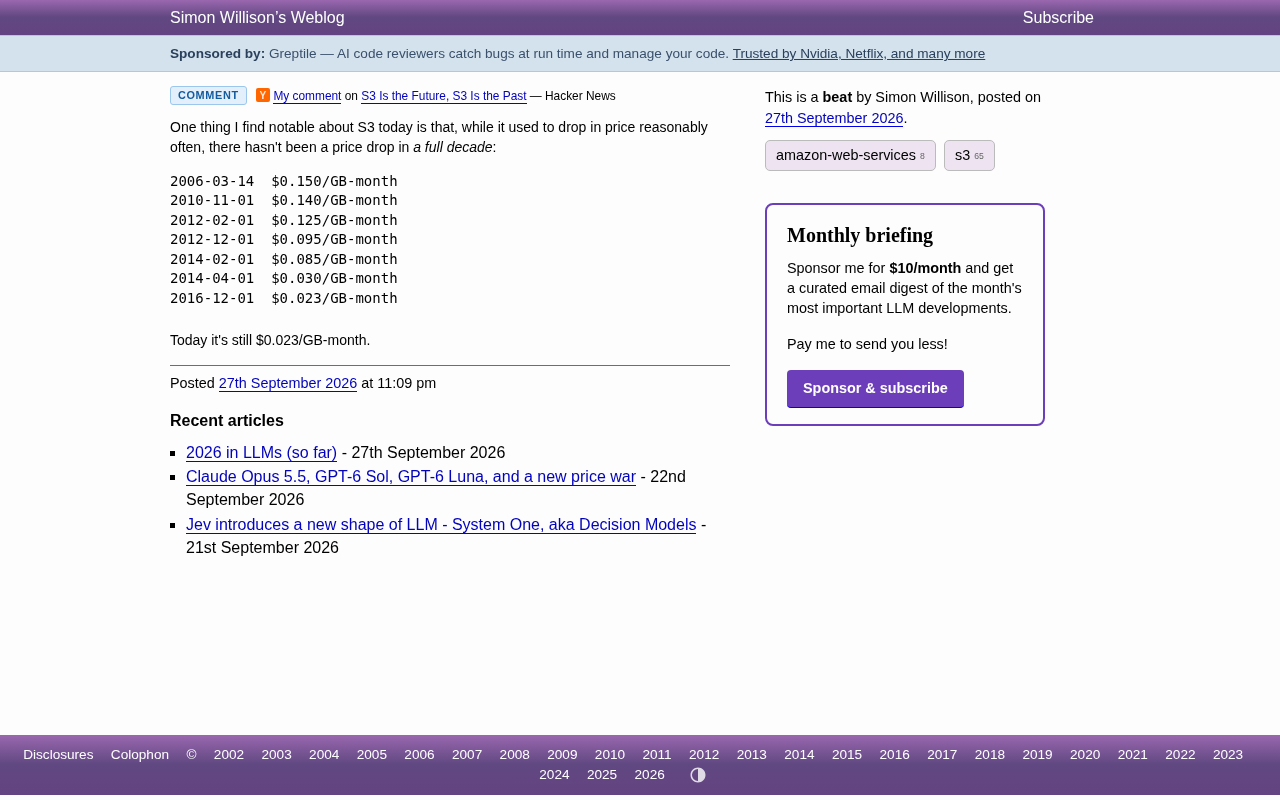
Willison traced every pricing change S3 standard storage has gone through since launch, revealing a clear downward curve:
2006-03-14  $0.150/GB-month
2010-11-01  $0.140/GB-month
2012-02-01  $0.125/GB-month
2012-12-01  $0.095/GB-month
2014-02-01  $0.085/GB-month
2014-04-01  $0.030/GB-month
2016-12-01  $0.023/GB-month
From its debut at $0.15 per GB per month in 2006 to $0.023 by late 2016, S3 standard storage prices fell roughly 85% over ten years. The April 2014 cut was particularly dramatic — prices plunged from $0.085 to $0.030, nearly a 65% drop in a single move, marking a high-water moment in the democratization of cloud storage costs.
But the story stops there. Willison notes that as of today, S3 standard storage still sits at $0.023/GB-month — a number that has held steady for exactly a decade.
From Frequent Cuts to a Long Freeze
In S3's first decade, price reductions were practically routine. Looking at the timeline above, AWS adjusted storage unit prices roughly every one to two years between 2010 and 2016. That cadence aligned closely with the sustained decline in hard drive costs and the fiercely competitive cloud market of that era. Price cuts were both a natural reflection of technological progress and a competitive strategy for AWS to cement its market leadership and win developer mindshare.
The past decade of frozen prices tells a very different story. Several factors are likely at play: the rate of decline in mechanical hard drive costs has slowed considerably in recent years, largely exhausting the cost-reduction dividend from storage media itself; S3 has established de facto industry standard status, leaving customers with extremely high switching costs and giving AWS little competitive pressure to cut prices further; and AWS has shifted its product strategy away from reducing the price of a single standard tier, instead introducing tiered storage options — such as Infrequent Access, Glacier, and Intelligent-Tiering — to offer differentiated pricing across use cases.
AWS's tiered storage lineup deserves a closer look. S3 Infrequent Access (IA) targets data that is accessed rarely but still needs to be retrievable quickly; its storage price is roughly 40% of the standard tier, though each retrieval incurs an additional fee. S3 Glacier and Glacier Deep Archive are designed for archival data that is almost never accessed — Deep Archive storage costs as little as ~$0.00099/GB-month, though data retrieval can take hours. Intelligent-Tiering is an automatic tiering mechanism where AWS monitors object access frequency and moves data between price tiers automatically, making it well-suited for workloads with unpredictable access patterns, though it carries a small per-object monitoring fee. This tiered ecosystem allows AWS to keep standard storage prices flat while still offering cost reduction pathways to price-sensitive users — and it has, to some extent, redirected attention away from the standard tier's decade-long price freeze.
What the Price Stagnation Signals
For businesses and developers who rely on cloud storage, this observation carries a real warning. When the core price of a foundational infrastructure service stays flat for ten years, it means the path of simply waiting for vendor price cuts to lower costs has largely run its course. Users need to take a more proactive approach — through storage tiering, lifecycle policies, data compression, and cross-cloud price comparison — to manage their spending.
The headline "S3 Is the Future, S3 Is the Past" captures an inherent tension: S3 remains an indispensable foundation for cloud-native architecture, yet its pricing model increasingly resembles a snapshot frozen in the past. The pioneer that once led the charge on price reductions has become a symbol of pricing inertia.
For the broader industry, S3's price stagnation may also signal that the cloud storage market has transitioned from a phase of aggressive expansion fueled by price competition into a more mature, stable phase where services, ecosystem integration, and data governance capabilities are the real differentiators. Cutting prices is no longer the primary lever for attracting customers.
Vendor lock-in is a critical backdrop for understanding S3's price freeze. S3 isn't just a storage bucket — it has become the data exchange hub at the heart of the entire cloud-native ecosystem. Countless AWS services (Lambda, Athena, EMR, SageMaker, and more) integrate natively with S3, and a vast number of third-party tools, open-source frameworks, and SaaS products treat the S3 API as the de facto standard interface. This means that once a company builds its core data architecture on S3, the real cost of migrating to a competitor — such as Google Cloud Storage or Azure Blob Storage — including data egress fees, application-layer rework, operational process changes, and the risk of service disruption, often far exceeds any savings on paper from lower storage rates. This high switching barrier gives AWS considerable pricing freedom, with no need to continuously pass savings on to customers in response to competitive pressure.
Takeaways for Users
This simple price list is a reminder that cloud computing is not permanently on a downward cost trajectory. When planning long-term architecture and budgets, you shouldn't assume storage prices will continue to fall over time. Making full use of AWS's multi-tier storage options, regularly auditing the distribution of hot and cold data, and even evaluating the economics of self-hosted storage or multi-cloud strategies are all practical approaches to navigating a world of stagnant list prices.
Willison's observation is brief, but backed by solid data, it illuminates a structural shift in the cloud storage industry that's easy to overlook. For any technical team that works with S3 over the long term, it's a reference point well worth factoring into cost planning decisions.
Related articles

Hands-On with the Gemini 4 Argon API: Thinking Levels and Background Mode Explained
A Free Code Camp crash course on the Gemini 4 Argon API: from getting a key and sending your first request to controlling reasoning costs with thinking levels, enabling multi-turn chat with previous_interaction_id, and generating a Breakout game in background mode—plus a Google engineer's take on the model's capabilities.

Reinforcement Learning Takes On Getting Over It: Distributed Training Strategies Behind 63% Progress
A developer uses deep reinforcement learning to tackle Getting Over It. The agent climbs from the bottom to 63% progress but gets stuck at the anvil. The project is open-sourced, using divide-and-conquer training and CPU-only training, seeking community collaboration to break the bottleneck.

Sigma FP2 Released: The World's Smallest Full-Frame Camera Gets Sensor and Screen Upgrades
Sigma launches the FP2 full-frame camera, retaining its smallest-and-lightest design with three key upgrades: improved sensor, articulating LCD screen, and longer battery life—built for portable video creators.