Sada-ASR: A Production-Grade Speech Recognition System for Arabic Dialects
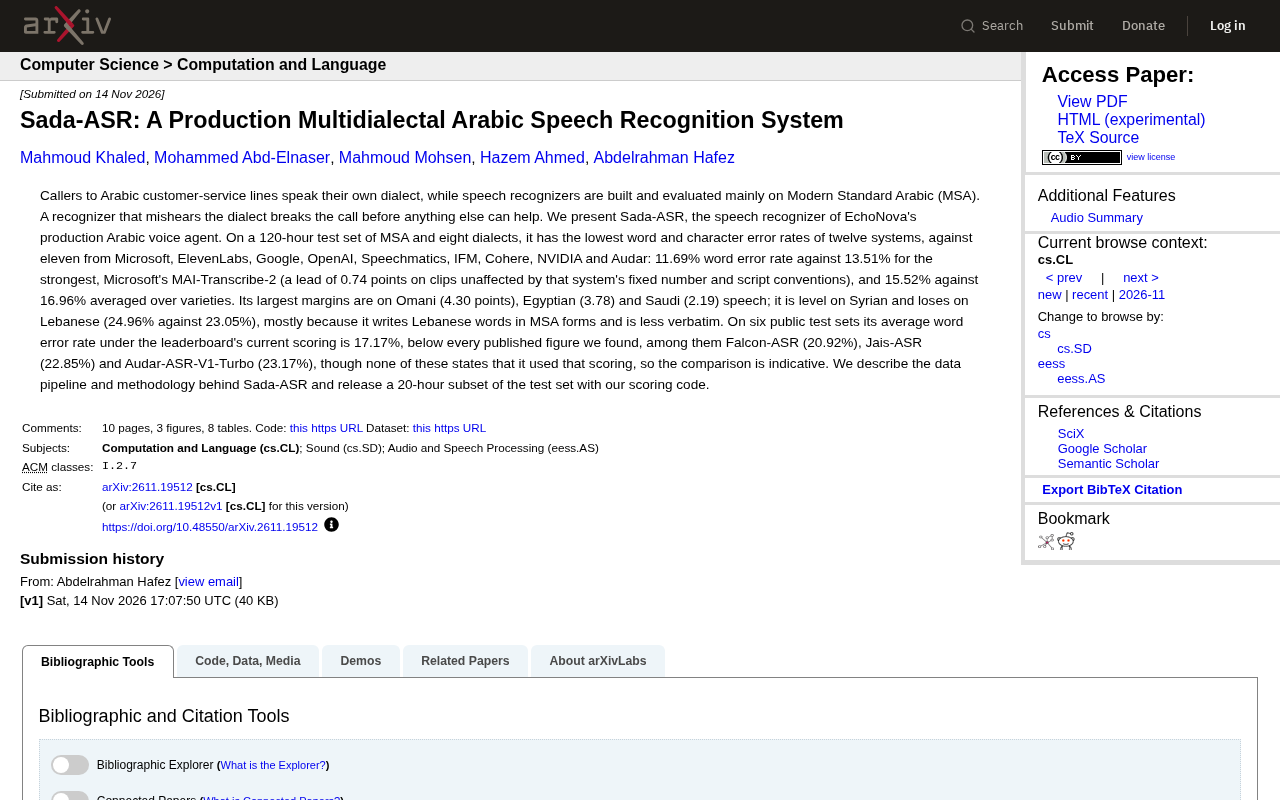
Sada-ASR is trained on multi-dialect data, achieves the lowest word error rate among twelve systems, and open-sources its test set to advance evaluation standardization.
EchoNova's production-grade Arabic voice assistant Sada-ASR addresses dialect recognition challenges. The team built a 120-hour test set covering MSA and eight dialects and compared it against eleven systems from Microsoft, Google, OpenAI, and others. Sada-ASR achieved the lowest overall word error rate at 11.69%, with clear advantages on Omani, Egyptian, and Saudi dialects, but lagged on Lebanese dialect due to transcription into MSA forms. On six public test sets, its average WER was 17.17%, lower than published systems such as Falcon-ASR, though the team acknowledges that inconsistent scoring standards make comparisons indicative only. Sada-ASR open-sourced a 20-hour test subset and scoring code, revealing three industry trends: dialect coverage, the trade-off between verbatim transcription and semantic understanding, and evaluation transparency.
Callers to Arabic customer service hotlines speak in their own dialects, yet speech recognition systems are primarily built and evaluated on Modern Standard Arabic (MSA). A recognizer that mishears dialects will derail a call before anything else can happen. EchoNova's production-grade Arabic voice assistant, Sada-ASR, is designed precisely for this pain point.
The Dialect Gap: Why Standard Arabic Recognizers Fail in the Real World
In the Arabic-speaking world, there is a significant gap between everyday spoken language and the written standard. Modern Standard Arabic (MSA) is the lingua franca of media, education, and official documents, but when people make phone calls, chat, or seek customer service, they naturally switch to local dialects such as Egyptian, Saudi, Omani, and Lebanese. These dialects deviate systematically from MSA in vocabulary, grammar, pronunciation, and even writing conventions.
Most existing speech recognition systems are trained and evaluated primarily on MSA data, causing error rates to soar in real customer service scenarios. Sada-ASR's starting point is clear: if the recognizer is inaccurate on dialects, no downstream intelligent service can function.
Modern Standard Arabic (MSA) is the written and formal spoken form used across the Arabic-speaking world, based on the language of the Quran and used in media, education, government documents, and cross-dialect communication. However, it is not the native language of any community; everyday speech is conducted in local dialects. Arabic dialects differ significantly at the phonological, lexical, and grammatical levels—for example, the Egyptian dialect pronounces /θ/ as /t/ or /s/, Gulf dialects retain some archaic sounds, and Maghrebi dialects are influenced by Berber and French. This "diglossia" causes MSA-centric speech recognition systems to degrade substantially in real conversations.
Benchmark: Twelve Systems Compete Head-to-Head
The Sada-ASR team built a 120-hour test set covering MSA and eight dialects. They compared it against eleven systems from Microsoft, ElevenLabs, Google, OpenAI, Speechmatics, IFM, Cohere, NVIDIA, and Audar—twelve systems in total.
The results are as follows:
- Overall word error rate (WER): Sada-ASR achieved 11.69%, while the strongest performer, Microsoft MAI-Transcribe-2, reached 13.51%. However, the Microsoft system has fixed handling of numbers and writing conventions; on segments unaffected by this, Sada-ASR's lead is 0.74 percentage points.
- Average WER across dialects: Sada-ASR achieved 15.52%, compared with an average of 16.96% for the other systems.
- Dialects with the largest advantage: Omani dialect leads by 4.30 percentage points, Egyptian by 3.78 points, and Saudi by 2.19 points.
- Dialect with parity: Syrian dialect.
- Dialect where it lags: Lebanese dialect, where Sada-ASR scored 24.96% versus 23.05% for competitors. The team explains this is mainly because Sada-ASR transcribes Lebanese vocabulary into MSA forms, resulting in lower verbatim fidelity.
Word error rate (WER) is the most commonly used evaluation metric in speech recognition, calculated as the total number of substitutions, deletions, and insertion errors between the recognition output and the reference transcription divided by the total number of reference words. Lower WER indicates more accurate recognition. However, WER is highly sensitive to text normalization: whether numbers are written as Arabic numerals or spelled out as words, whether punctuation is retained, whether dialect words are transcribed into standard language forms—all of these significantly affect the denominator and error counts. Therefore, WER values from different systems cannot be directly compared if they use different text normalization rules, which is why the paper's team emphasizes the limitations of cross-system comparisons.
Performance on Public Test Sets and Comparison Caveats
On six public test sets, using the current leaderboard's scoring criteria, Sada-ASR achieved an average WER of 17.17%, lower than all published figures the team could find, including Falcon-ASR (20.92%), Jais-ASR (22.85%), and Audar-ASR-V1-Turbo (23.17%).
However, the team acknowledges that none of these systems claim to use the same scoring criteria, so this comparison is indicative only and cannot be considered a strictly controlled experimental conclusion. This proactive disclosure of comparison limitations is uncommon in speech recognition papers, and it actually increases confidence in the results.
Falcon-ASR, Jais-ASR, and Audar-ASR-V1-Turbo are three publicly available Arabic speech recognition systems. Falcon-ASR was developed by the Technology Innovation Institute (TII) in the UAE, Jais-ASR originates from the Jais model series jointly launched by G42 and MBZUAI, and Audar-ASR comes from Audar. These systems have published WER metrics on public test sets in their respective papers or technical reports and are often used as benchmarks for Arabic ASR. But as the Sada-ASR team points out, they do not use unified scoring standards, so direct numerical comparisons should be made with caution.
Data Pipeline and Methodology: Behind the Scenes of a Production System
The value of Sada-ASR lies not only in benchmark numbers but also in the fact that it is a system actually deployed in production. The paper describes the data pipeline and methodology behind it, though the abstract does not elaborate on specific technical details. From the available information, it can be inferred that the system's training data necessarily covers multi-dialect speech-text pairs, and that targeted design was applied to text normalization, dialect annotation, and scoring logic.
Notably, the team chose to open-source a 20-hour subset of the test set along with the scoring code. This lowers the barrier to reproducibility for future research and provides a public foundation for standardized evaluation of dialect speech recognition.
Practical Insights for Production-Grade Speech Recognition
The Sada-ASR case reveals several deeper industry trends:
First, dialect coverage is becoming a competitive focus in speech recognition. The MSA-centric evaluation systems of the past have masked performance gaps in real scenarios. As the Arabic market becomes more digitized, demand for dialect recognition in customer service, finance, e-commerce, and other scenarios will continue to grow.
Second, the trade-off between verbatim transcription and semantic understanding. The lag on Lebanese dialect exposes a design choice: normalizing dialect vocabulary into MSA forms may facilitate downstream semantic understanding but sacrifices verbatim transcription accuracy. Production systems need to make trade-offs based on actual task objectives.
Third, evaluation transparency remains an industry shortcoming. The Sada-ASR team explicitly points out the inconsistency of scoring standards across systems, suggesting that the speech recognition field urgently needs unified evaluation protocols; otherwise, the persuasiveness of leaderboard numbers will always be limited.
For teams building multilingual or multi-dialect voice products, Sada-ASR offers a reference paradigm: driven by real-world data, validated by production deployment, and honest about comparison boundaries.
One-line Summary
Sada-ASR is trained on multi-dialect data, achieves the lowest word error rate among twelve systems, and open-sources its test set to advance evaluation standardization.
Paragraph Summary
EchoNova's production-grade Arabic voice assistant Sada-ASR is designed to address the dialect recognition challenge. The team built a 120-hour test set covering MSA and eight dialects and compared it against eleven systems from Microsoft, Google, OpenAI, and others. Sada-ASR achieved the lowest overall word error rate at 11.69%, with clear advantages on Omani, Egyptian, and Saudi dialects, but lagged on Lebanese dialect due to transcription into MSA forms. On six public test sets, its average WER was 17.17%, lower than published systems such as Falcon-ASR, though the team acknowledges that inconsistent scoring standards make comparisons indicative only. Sada-ASR has open-sourced a 20-hour test subset and scoring code, and its case reveals three industry trends: dialect coverage, the trade-off between verbatim transcription and semantic understanding, and evaluation transparency.
Related articles
Watching Movies in the Terminal: Building an SSH Streaming Service with Codex Multi-Agent Workflow
A creator uses Codex multi-agent workflow to build an SSH-accessible streaming service in the terminal, with planning, cloud async dev, AI-drawn scenes, and synced live channels.

AI Face Licensing: A New Micro-Drama Trend or a Hollywood Trap?
Actors are licensing their faces to micro-drama startups for AI digital doubles to perform. Popular in China, the model raises concerns in Hollywood over lost control and diluted bargaining power.
Amazon's First Digital Photo Frame Is 50% Off for Black Friday: Is the Alexa Frame Worth Buying?
Amazon's first digital photo frame, the Alexa Photo Frame, is nearly 50% off for Black Friday, with prices starting at $114. We analyze why this new product dropped in price just one month after launch, its positioning, who it's for, and buying advice.