SADL: A Size-Adaptive Decision Layer for Chronic Stroke Lesion Segmentation

SADL combines an 11-member nnU-Net ensemble with size-adaptive post-processing to achieve lesion-F1 of 0.7461 on chronic stroke segmentation.
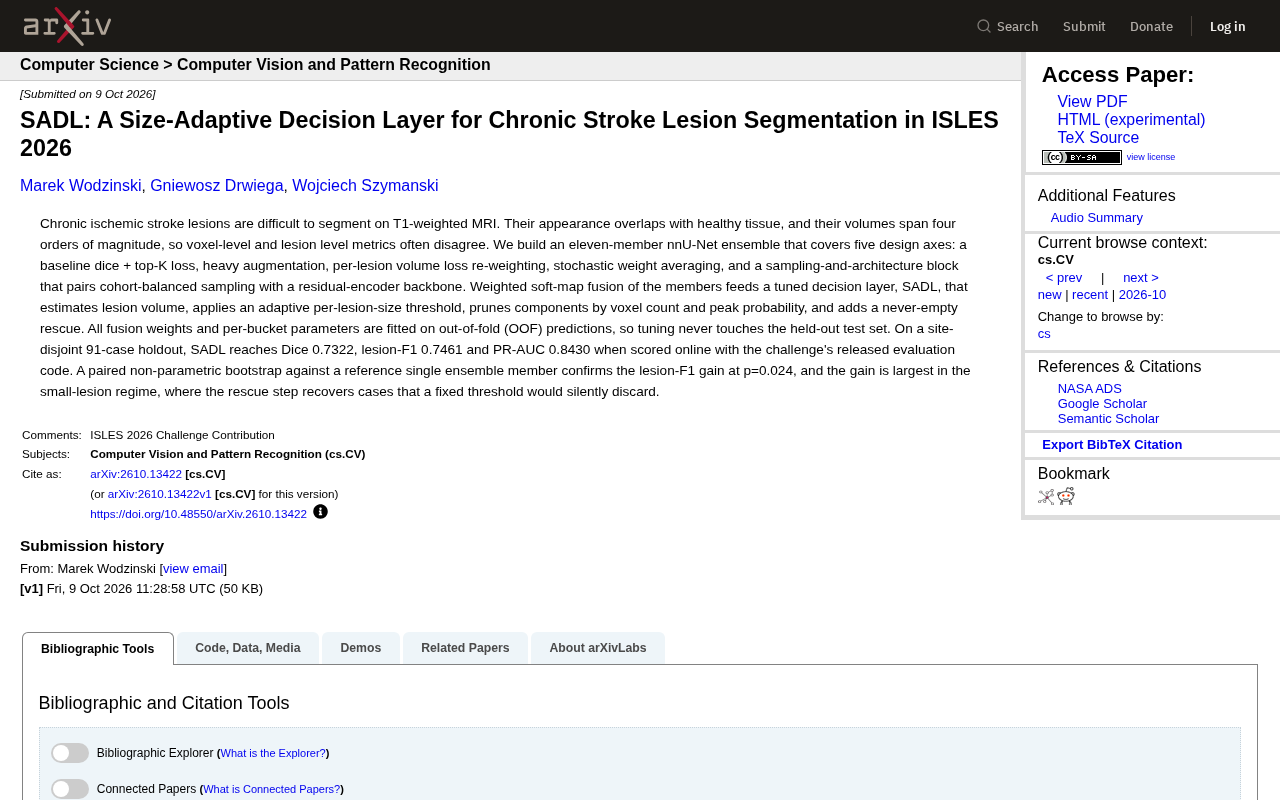
Chronic ischemic stroke lesions are difficult to segment due to blurry boundaries and volumes spanning four orders of magnitude, causing voxel-level and lesion-level metrics to conflict. For ISLES 2026, SADL combines an 11-member nnU-Net ensemble diversified across five design axes with a decision layer that applies size-bucketed adaptive thresholds, connected-component pruning, and a never-empty rescue mechanism. All parameters are fitted on out-of-fold predictions to prevent data leakage. On a 91-case site-disjoint held-out set, the method achieves Dice 0.7322, lesion-F1 0.7461, and PR-AUC 0.8430, with statistically significant gains (p=0.024) concentrated in the small-lesion regime.
Automated segmentation of chronic ischemic stroke lesions has long been one of the toughest challenges in medical imaging. On T1-weighted MRI, these lesions exhibit signal characteristics that closely overlap with healthy tissue, and their volumes can span four orders of magnitude — a combination that frequently puts voxel-level metrics (e.g., Dice) and lesion-level metrics (e.g., lesion-F1) at odds with each other. To address this, a study targeting the ISLES 2026 challenge proposes SADL (Size-Adaptive Decision Layer), an ensemble-plus-post-processing approach that delivers meaningful gains in segmentation accuracy.
Why Chronic Stroke Lesions Are So Hard to Segment
To appreciate SADL's contribution, it helps to understand the inherent difficulty of the problem. Chronic ischemic stroke lesions lack sharp boundaries in imaging, with gray-level distributions close to surrounding normal brain tissue — making models prone to missed detections or over-segmentation.
Compounding this is the extreme distribution of lesion volumes: from tiny punctate injuries to large-scale cortical infarcts, volumes span four orders of magnitude. This disparity makes any single fixed-threshold strategy fundamentally imbalanced — a conservative threshold misses small lesions, while an aggressive one introduces noise in large ones. As the authors note, it is precisely this scale variation that causes voxel-level metrics like Dice and lesion-level metrics like lesion-F1 to frequently produce conflicting assessments.
Eleven-Member Ensemble: Covering Five Design Dimensions
The backbone of SADL is an eleven-member nnU-Net ensemble, deliberately diversified across five design axes to maximize complementarity and robustness:
- Baseline loss function: A combination of Dice loss and top-K loss;
- Heavy data augmentation: Aggressive augmentation to improve generalization;
- Lesion-volume reweighting: Per-lesion volume-based loss reweighting to prevent small lesions from being overshadowed;
- Stochastic Weight Averaging (SWA): Smoothing weight fluctuations during training;
- Sampling and architecture modules: Pairing cohort-balanced sampling with a residual-encoder backbone.
Each of these five dimensions targets a specific class of difficulty in stroke segmentation, and together they form a diverse model population with broad coverage. Soft probability maps from individual members are aggregated via weighted soft-map fusion before being passed to the core SADL decision layer.
nnU-Net is a self-configuring medical image segmentation framework developed at the German Cancer Research Center (DKFZ). Its core design philosophy is to automatically determine network architecture, preprocessing pipelines, and training strategies based on dataset statistics — such as voxel spacing, image dimensions, and class ratios — achieving competitive baseline performance on most medical segmentation tasks without manual tuning. Its strong out-of-the-box generalizability has made nnU-Net the standard starting point in medical imaging segmentation competitions. Building a diverse ensemble on top of it requires deliberately introducing variation across dimensions like loss functions, data augmentation, and sampling strategies so that members complement rather than duplicate each other — which is exactly the motivation behind SADL's systematic diversification across five design axes. Stochastic Weight Averaging (SWA) traverses weight space at a relatively high learning rate during late training and averages multiple checkpoints, guiding the model to converge in flatter loss basins and thereby improving generalization — a technique that complements ensemble strategies at a different level.
The SADL Decision Layer: From Probability Maps to Final Predictions
SADL's innovation lies in the decision step after fusion. Rather than applying a single global threshold to the fused probability map, it executes a refined adaptive pipeline:
- Estimate lesion volume, then apply adaptive, lesion-size-bucketed thresholds accordingly;
- Prune connected components by voxel count and peak probability, discarding low-confidence fragments;
- Apply a "never-empty" rescue step to recover lesions in cases where a fixed threshold would otherwise produce an entirely empty prediction.
The rescue mechanism is particularly critical for small lesions. Fixed-threshold approaches silently discard small lesions whose probabilities fall just below the cutoff, and the never-empty rescue intercepts exactly these cases.
A notable methodological strength is rigor: all fusion weights and bucketing parameters are fitted on out-of-fold (OOF) predictions, with the held-out test set never touched during tuning. This design effectively prevents the data leakage common in similar work and ensures the credibility of reported results.
Connected component analysis is a classic image post-processing operation: in a binarized prediction map, spatially adjacent foreground voxels are grouped into individual regions, with each region representing a candidate lesion instance. In medical segmentation, thresholding a soft probability map often produces large numbers of isolated, fragment-like false positives; connected component pruning filters these low-confidence fragments by setting minimum voxel counts or peak probability thresholds, reducing false positives without sacrificing true lesions. SADL links pruning thresholds to lesion-size buckets, applying relatively lenient retention criteria for small lesions and stricter fragment penalties for large ones — achieving optimal precision-recall trade-offs across different scales. Out-of-fold (OOF) prediction is a product of the cross-validation framework: for each fold, validation-set samples are predicted by sub-models that have never seen those samples, and the aggregated result is a "clean" prediction set covering the full training data without information leakage — suitable for fitting downstream parameters.
Results: Largest Gains on Small Lesions
On a site-disjoint held-out set of 91 cases, scored online using the official challenge evaluation code, SADL achieves the following:
- Dice coefficient: 0.7322
- Lesion-level F1 (lesion-F1): 0.7461
- PR-AUC: 0.8430
To verify statistical significance, the authors apply a paired non-parametric bootstrap comparing SADL against a reference single-member ensemble, confirming that the lesion-F1 improvement is statistically significant (p = 0.024).
Perhaps more compelling is that the largest gains occur specifically in the small-lesion regime — exactly where the never-empty rescue operates. This empirically validates the targeted nature of the decision layer design: it addresses not a general weakness in model capacity, but a systematic bias introduced by the extreme scale distribution.
PR-AUC (Precision-Recall Area Under Curve) is a comprehensive metric for binary classification or detection tasks, particularly suited to scenarios with severe class imbalance. Compared to ROC-AUC, the PR curve is more sensitive to minority-class performance (here, lesion voxels or lesion instances): the x-axis (recall) reflects the model's ability to recover true lesions, while the y-axis (precision) reflects what fraction of predictions are truly lesions — a larger area under the curve indicates better overall trade-off across decision thresholds. In chronic stroke segmentation, small lesions are rare but clinically significant, and PR-AUC more directly captures model performance on these difficult, infrequent cases, making it a meaningful complement to Dice and lesion-F1 for a complete evaluation picture. The paired non-parametric bootstrap constructs an empirical null distribution by resampling prediction differences on the same set of cases with replacement, testing the statistical significance of differences between two methods without assuming any data distribution — particularly appropriate for small sample sizes like the 91 cases in this study.
Methodological Takeaways
SADL's approach offers lessons applicable to medical image segmentation and beyond. It demonstrates that when the underlying model is already mature (nnU-Net is an established strong baseline), a task-specific post-processing decision layer can yield substantial and interpretable gains.
In particular, the combination of size-bucketed thresholds, adaptive cutoffs, and rescue recall directly addresses the root cause of the conflict between voxel-level and lesion-level metrics. Compared to blindly stacking more models or collecting more data, this problem-structure-driven engineering approach is lower in cost and higher in interpretability. For clinical applications, the practical value of not missing small lesions typically outweighs marginal improvements in overall Dice — and SADL makes a pragmatic trade-off in exactly this direction.
Related articles

Chain of Thought Isn't Just for AI: How Humans Can Use CoT to Improve Thinking Quality
Chain of Thought isn't just a prompt trick for large models. Starting from a Hacker News discussion, this article analyzes why CoT works for human thinking too, breaks down actionable ways to transfer it, and highlights the key differences between human CoT and machine CoT.
Cloudflare Teams Up with OpenAI: Closi…
Cloudflare Teams Up with OpenAI: Closing the Loop from Vulnerability Discovery to Defense with AI
Cloudflare uses OpenAI Daybreak to investigate security vulnerabilities and generate reviewable remediation plans, while developers use Codex to boost coding efficiency and quality.

Orca Multi-Agent Orchestration in Practice: A Guide to Parallel Collaboration with Claude and Codex
Orca is Stable AI's free open-source agent workbench supporting 34 agents like Claude Code and Codex in parallel. Learn its Git worktree isolation, multi-model orchestration, and mobile management.