SageMaker JumpStart First Three Quarters Review: Over 100 New Models Added

SageMaker JumpStart added over 100 models in the first three quarters, lowering the selection barrier across supply, deployment, and ecosystem.
This article reviews the main changes in Amazon SageMaker JumpStart during the first three quarters of 2026: more than 100 new models covering 30 providers, significantly expanding supply breadth; a simplified Model Hub to reduce catalog browsing and decision costs; preconfigured deployment options to reduce repeated debugging of instance specifications and inference parameters; and deep link integration with Hugging Face, connecting external community model research with in-platform deployment. The article notes that model count is only the starting point for selection; license clarity, performance and cost calibration under default configurations, and the timeliness of catalog-community synchronization are the factors teams should focus on when evaluating cloud model platforms.
Amazon SageMaker JumpStart delivered a dense list of model expansions in the first three quarters of 2026: over 100 new models from 30 providers. For development teams that need to quickly select foundation models in the cloud, this is not an ordinary catalog update, but the result of the platform advancing simultaneously in three directions: "model supply—deployment experience—ecosystem connection." Based on official review information, this article outlines the core changes and practical impact of this period.
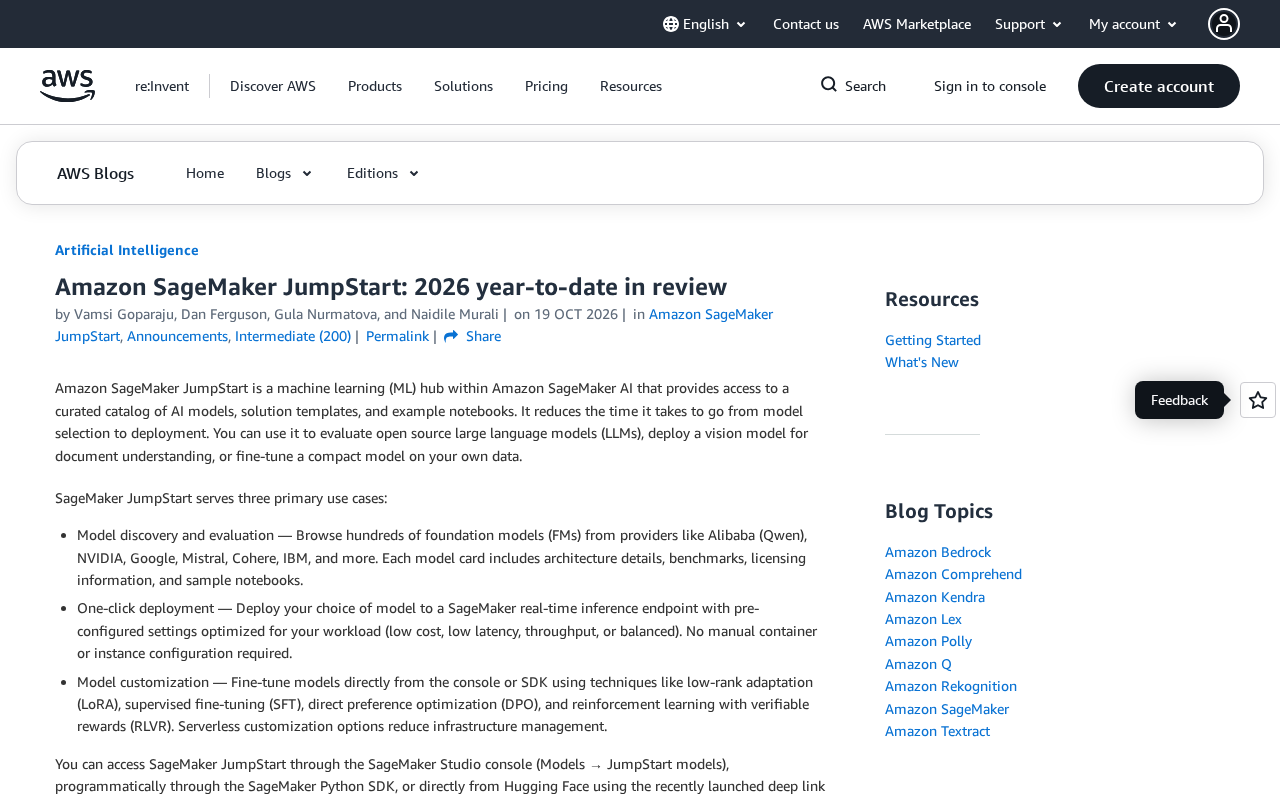
Model Supply: What 30 Providers and 100+ New Models Mean
JumpStart has always been positioned as an "out-of-the-box model catalog," and the scale of this expansion deserves attention. More than 100 new models come from 30 providers, averaging three to four models per provider, which shows that the platform is intentionally broadening provider coverage rather than betting only on a few leading vendors. For users, greater model diversity directly lowers the cost of "switching platforms just to use one specific model."
This breadth expansion also has an implicit meaning: different providers differ significantly in model architecture, license terms, and inference cost. By presenting these options together, JumpStart moves the starting point of selection comparison into the platform itself. When evaluating models, teams can first run horizontal trials under the same deployment workflow, and then decide whether to go deeper into customization.
The Relationship Between Foundation Models and Model Catalogs
Foundation models refer to models pre-trained on large-scale general-purpose corpora that can be adapted to multiple downstream tasks through fine-tuning or prompting, usually categorized by modality such as text, image, and audio. A model catalog is the platform's indexing layer for these models, performing four functions: discovery, version labeling, license display, and deployment entry points. The value of a catalog is not determined solely by the number of entries, but by whether the metadata is complete—for example, whether the model card explains training data, context length, supported languages, and commercial terms. When using catalogs such as JumpStart, developers should judge "whether it is included" and "whether it is suitable for production" separately, prioritizing verification of license type and inference framework compatibility before deciding whether to include it in the evaluation process.
Simplified Model Hub: Reducing the Cognitive Burden of Catalog Browsing
The first experience improvement mentioned in the official review is the simplified Model Hub. Once a model catalog expands to hundreds of entries, search and filtering themselves become a burden. The simplified Hub is intended to help developers locate target models faster, rather than repeatedly jumping between categories and tags.
From a product logic perspective, the value of such changes is often underestimated. The growth in catalog size is not always positively correlated with usability—the more entries there are, the higher the decision cost. JumpStart chose to simplify the interface at the point when the number of models exceeded one hundred, using convergence at the interaction layer to offset expansion at the supply layer.
Preconfigured Deployment: From "It Runs" to "Less Configuration"
The second improvement is preconfigured deployment options. For most teams, the truly time-consuming part is not choosing a model, but getting the model running in the target environment with reasonable instance specifications, parameters, and inference configuration. Preconfigured deployment fixes common deployment combinations, reducing manual parameter tuning and repeated trial and error.
This direction is consistent with the broader trend of managed AI platforms: encapsulating infrastructure details so developers can focus on application logic. However, preconfiguration also involves trade-offs—default configurations may not fit all workload characteristics, and teams still need to measure latency and cost in practice while pursuing faster time to market.
What Instance Specifications and Inference Configuration Mean
When deploying models in the cloud, instance specifications refer to the type of virtual machine allocated to the inference task. Core variables include GPU model and memory capacity, number of vCPUs, memory bandwidth, and network throughput. Whether a model can be loaded into GPU memory, how high single-inference latency is, and how many concurrent requests can be supported are all determined jointly by these specifications and the model's parameter count. Inference configuration covers batch size, maximum sequence length, quantization method (such as FP16 or INT8), and autoscaling policy. The essence of preconfigured deployment is to combine a set of validated specifications and configurations into a template, skipping the process of tuning from scratch. But templates are usually aimed at general scenarios, and teams still need to measure P95 latency and cost per token based on their own request distribution to avoid default values becoming bottlenecks under high concurrency or long-text scenarios.
Hugging Face Deep Link Integration: Connecting the Ecosystem Entry Point into the Platform
The third notable change is deep link integration with Hugging Face. Hugging Face is the core hub for open-source model distribution, and deep links mean that users can jump directly from JumpStart to the corresponding model page, and vice versa. For developers accustomed to first researching model cards and community feedback on Hugging Face, this link connects the two stages of "research" and "deployment."
From an ecosystem perspective, this kind of integration has more long-term value than simply increasing the number of models. The competitiveness of a model catalog depends not only on how many entries it contains, but also on whether the entries can connect to active documentation, discussions, and version updates. Deep link integration keeps JumpStart's catalog synchronized with the external community and reduces the problem of information silos.
Hugging Face's Position in the Open-Source Model Ecosystem
Hugging Face is currently the largest hosting platform for open-source models and datasets. Its Model Hub brings together hundreds of thousands of model repositories and is accompanied by model cards, community discussions, version history, and open-source libraries such as transformers. Model cards usually record training data sources, evaluation results, known biases, and usage limitations, and are an important basis for developers to judge model usability. A deep link refers to a URL that bypasses the platform homepage and points directly to a specific model page. JumpStart's deep link integration with Hugging Face enables developers to jump from within the platform to the corresponding repository with one click to view original documentation and update records, avoiding misuse of old model versions due to outdated catalog information.
Practical Implications for Development Teams
Taken together, JumpStart's strategy in this period can be summarized as follows: attract selection with broader model supply, lower the barrier to use with a simplified Hub and preconfigured deployment, and maintain catalog timeliness through ecosystem integration. For teams evaluating cloud model platforms, several points deserve consideration:
- The number of models is a starting point, not the endpoint; focus on whether commonly used models are included and whether licenses are clear;
- Preconfigured deployment can accelerate validation, but performance and cost should be calibrated for your own workloads before launch;
- The degree of linkage with communities such as Hugging Face determines the catalog's ability to stay fresh amid rapid model iteration.
It should be noted that this review is based mainly on officially disclosed model launch counts and feature improvements, and does not cover specific performance benchmarks or pricing details. In actual selection, it is still recommended to conduct small-scale comparative testing based on your own business scenarios.
One-line Summary
SageMaker JumpStart added over 100 models in the first three quarters, lowering the selection barrier across supply, deployment, and ecosystem.
Paragraph Summary
This article reviews the main changes in Amazon SageMaker JumpStart during the first three quarters of 2026: more than 100 new models covering 30 providers, significantly expanding supply breadth; a simplified Model Hub to reduce the browsing and decision costs caused by catalog expansion; preconfigured deployment options to reduce repeated tuning of instance specifications and inference parameters; and deep link integration with Hugging Face, connecting external community model research with in-platform deployment. The article notes that model count is only the starting point for selection. License clarity, performance and cost calibration under default configurations, and the timeliness of catalog-community synchronization are the factors teams should focus on when evaluating cloud model platforms.
Related articles

Chain of Thought Isn't Just for AI: How Humans Can Use CoT to Improve Thinking Quality
Chain of Thought isn't just a prompt trick for large models. Starting from a Hacker News discussion, this article analyzes why CoT works for human thinking too, breaks down actionable ways to transfer it, and highlights the key differences between human CoT and machine CoT.
Cloudflare Teams Up with OpenAI: Closi…
Cloudflare Teams Up with OpenAI: Closing the Loop from Vulnerability Discovery to Defense with AI
Cloudflare uses OpenAI Daybreak to investigate security vulnerabilities and generate reviewable remediation plans, while developers use Codex to boost coding efficiency and quality.

Orca Multi-Agent Orchestration in Practice: A Guide to Parallel Collaboration with Claude and Codex
Orca is Stable AI's free open-source agent workbench supporting 34 agents like Claude Code and Codex in parallel. Learn its Git worktree isolation, multi-model orchestration, and mobile management.