Sai: An Autonomous Agent Fleet That Operates Your Computer Like a Human

Sai is a GUI agent that operates computer interfaces directly without APIs, scoring 73% on OSWorld.
Sai is an AI automation product positioning itself as a "robosecretary" that bypasses APIs entirely, simulating human interaction with graphical interfaces — reading screens, clicking buttons, and filling forms — making it capable of automating legacy desktop apps and internal enterprise systems with no API access. It uses a fleet architecture for parallel task distribution across multiple machines and supports Windows, macOS, and Linux. Scoring 73% on the OSWorld benchmark, it ranks among the top performers in its category. While its Product Hunt #3 debut reflects strong market demand for capable AI agents, the author cautions that benchmark scores don't guarantee production readiness, and challenges around security, error recovery, and UI change resilience still need to be addressed.
What Is Sai: A Computer-Operating Agent That Doesn't Need APIs
Sai debuted on Product Hunt with the tagline "world's first robosecretary," built around a bold premise — instead of calling software APIs to complete tasks, it operates computer interfaces directly, just like a human would. Reading the screen, clicking buttons, typing into forms: this interaction model means it can cover far more scenarios than traditional automation tools.
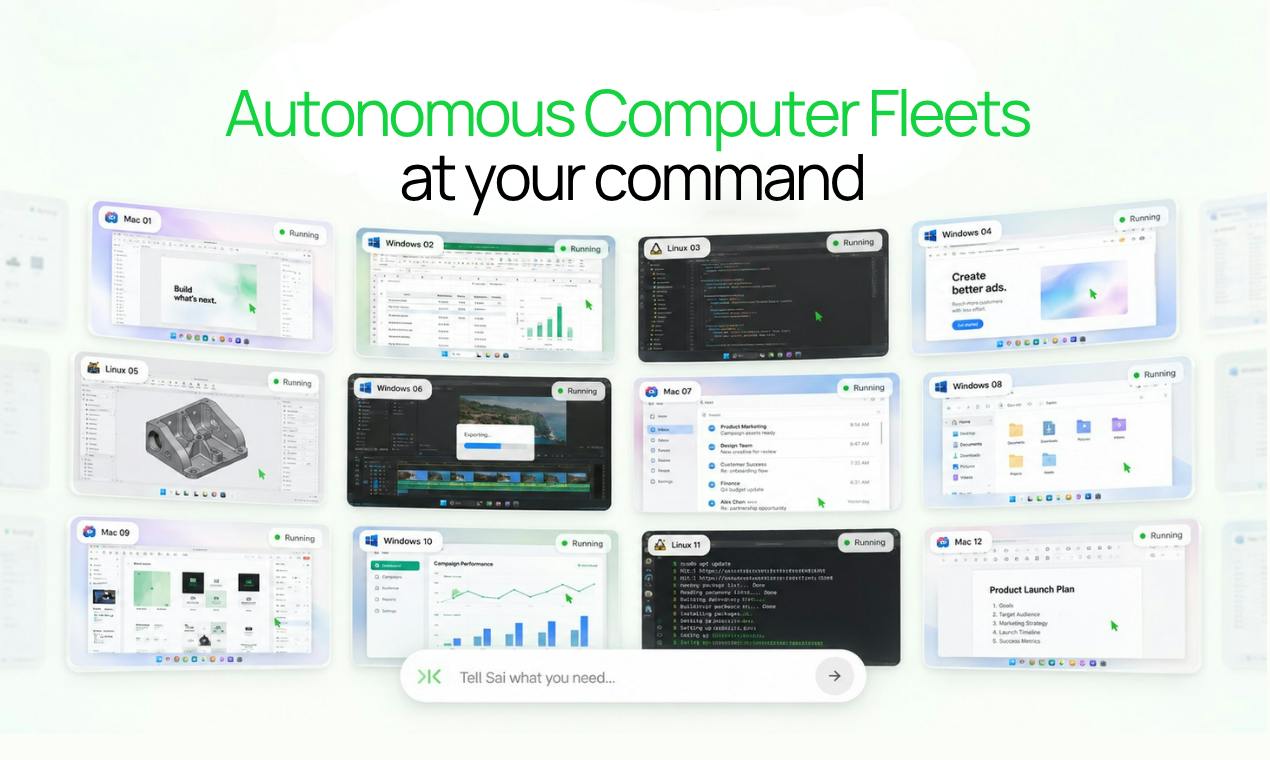
The product's core pitch is "a fleet of autonomous computers" — a squad of autonomously running machines that handles endless screen-based work on your behalf. This "fleet" design means tasks can be distributed and executed in parallel across multiple machines rather than processed serially on a single device, which has real value for workflows involving high-volume repetitive operations.
Why the "Read Screen, Click" Approach Deserves Attention
Most automation tools rely on APIs exposed by software applications. But in the real world, a huge number of programs simply don't have APIs: legacy desktop apps, internal enterprise portals, systems hidden behind login pages. These are precisely the most tedious and hardest-to-automate parts of daily business operations.
Sai's technical approach sidesteps this limitation entirely. It's trained to interact directly with computer graphical interfaces — operating at the GUI layer, regardless of whether any programmatic interface exists underneath. According to its documentation, Sai supports all three major operating systems: Windows, macOS, and Linux — notably broad coverage for a product in this category. For teams shackled to legacy systems, this "API-agnostic" automation capability could theoretically unlock a wide range of previously unreachable use cases.
This technical approach is commonly referred to in academia and industry as a "Computer Use Agent" or "GUI Agent." The underlying implementation relies on multimodal large language models — the model takes screenshots as visual input, interprets the current interface state, and outputs specific action instructions like mouse coordinates and keyboard inputs. Anthropic's Claude Computer Use, released in 2024, was one of the earlier demos that captured industry attention; OpenAI Operator, Google Project Mariner, and others have since followed, signaling that this approach is evolving from the experimental stage toward productization. Compared to API-based RPA (Robotic Process Automation), GUI agents are primarily fragile due to their interface dependency: if a target application updates its button positions or page layout, the agent's visual localization logic may break and require re-adaptation. This is the core engineering challenge these products face in terms of production environment stability.
73% on OSWorld: A Score Worth Examining Rationally
The key performance metric Sai highlights is a 73% score on the OSWorld benchmark. OSWorld is an industry benchmark that evaluates an agent's ability to complete tasks in real operating system environments — testing actual operational capability in open desktop settings, covering complex tasks like file management, application operation, and cross-software coordination.
73% is a leading result among current computer-operating agents, but it deserves objective framing: this type of benchmark's "perfect score" is still far from "fully reliable," meaning a significant share of tasks still can't be completed correctly on the first attempt. For enterprise users, integrating this kind of agent into critical business workflows requires clear expectations around error rates and human fallback mechanisms. A high benchmark score does not equal plug-and-play readiness in production.
OSWorld is an open evaluation benchmark jointly released by Shanghai Jiao Tong University and other institutions. It includes 369 tasks executed on real operating systems (Ubuntu, Windows, macOS), spanning web browsers, file managers, Office suites, and more. The benchmark requires agents to complete end-to-end operations in a fully interactive desktop environment, measured by Task Success Rate. When the benchmark was released in 2024, the strongest baseline model scored only around 12%, while humans achieved roughly 72% — making the rapid subsequent improvement of models particularly striking. It's worth noting that benchmark scores reflect performance on a standardized test set; real enterprise environments often involve more open-ended tasks and more diverse interfaces, so transfer effectiveness remains uncertain.
Product Positioning and Market Traction
Sai reached #3 on Product Hunt on its launch day, earning 191 upvotes and 22 comments, and was categorized under both Productivity and Artificial Intelligence. This level of traction reflects clear market demand for AI agents that can "actually get things done."
Judging by its self-described positioning as a "robosecretary," Sai is targeting scenarios that free people from repetitive computer tasks: data entry, moving information between systems, form filling, internal process execution, and more. These tasks consume enormous amounts of knowledge workers' time, yet are difficult to automate with traditional scripts because they're scattered across software with no APIs.
A Few Questions Worth Thinking About
This category of "AI that operates computers" is emerging as an important direction in the agent space. Compared to assistants that only chat, agents that can actually click and operate are a step closer to "truly working on your behalf." But they also introduce new challenges: how is security managed (an agent with login credentials represents a much larger attack surface), how are erroneous operations rolled back, and how stable is the system when interfaces change after updates?
What Sai currently presents is a compelling vision paired with a relatively strong benchmark result. For teams tracking AI automation, it's worth following how it performs in genuinely complex real-world environments, and whether the "computer fleet" parallel architecture can deliver on its efficiency promise at scale. Whether it can make the leap from demo to trustworthy production tool still requires time to prove out.
Related articles

Chain of Thought Isn't Just for AI: How Humans Can Use CoT to Improve Thinking Quality
Chain of Thought isn't just a prompt trick for large models. Starting from a Hacker News discussion, this article analyzes why CoT works for human thinking too, breaks down actionable ways to transfer it, and highlights the key differences between human CoT and machine CoT.
Cloudflare Teams Up with OpenAI: Closi…
Cloudflare Teams Up with OpenAI: Closing the Loop from Vulnerability Discovery to Defense with AI
Cloudflare uses OpenAI Daybreak to investigate security vulnerabilities and generate reviewable remediation plans, while developers use Codex to boost coding efficiency and quality.

Orca Multi-Agent Orchestration in Practice: A Guide to Parallel Collaboration with Claude and Codex
Orca is Stable AI's free open-source agent workbench supporting 34 agents like Claude Code and Codex in parallel. Learn its Git worktree isolation, multi-model orchestration, and mobile management.