Sainsbury's Suspends AI Facial Recognition: Misidentification Incident Exposes Deep Risks in Retail Surveillance

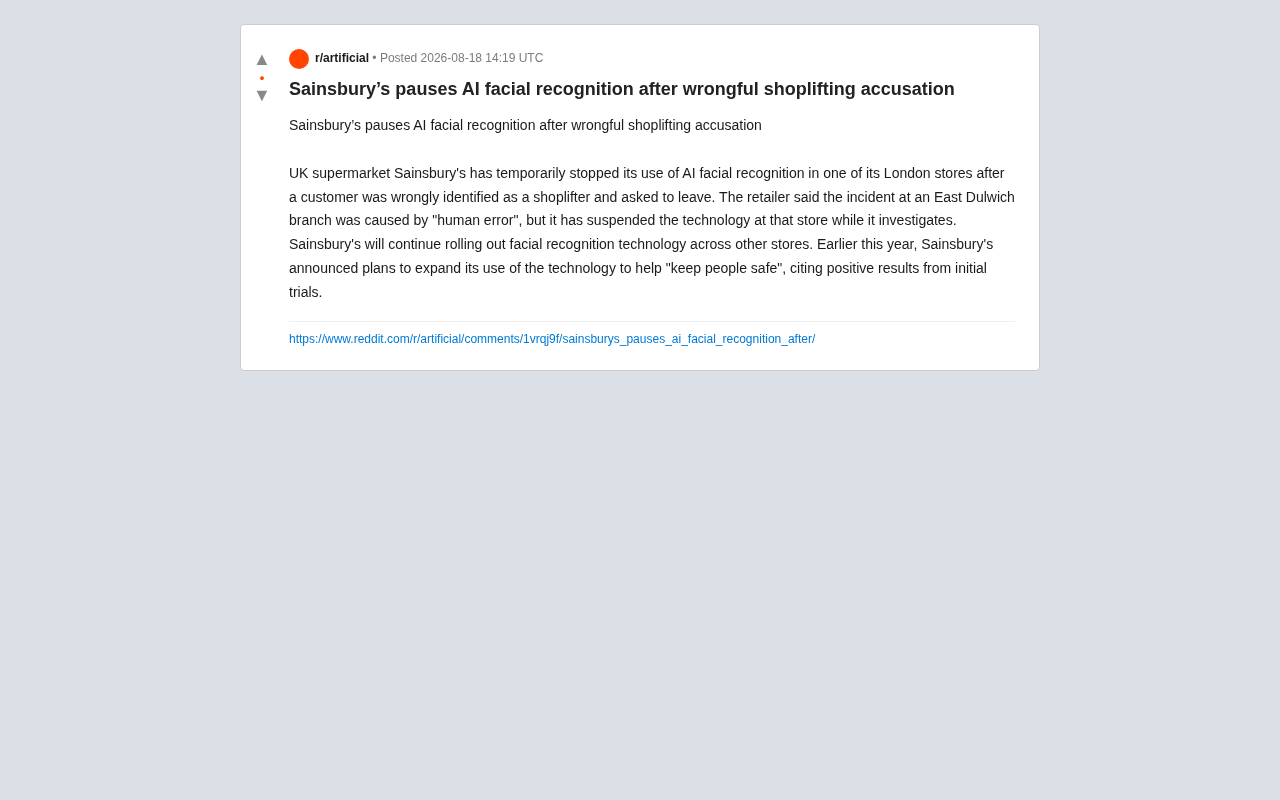
Sainsbury's pauses AI facial recognition at a London store after wrongly flagging an innocent customer as a shoplifter.
Sainsbury's suspended facial recognition technology at its East Dulwich store after the AI system misidentified a customer as a suspected shoplifter. The incident highlights systemic risks including automation bias, algorithmic fairness gaps across demographics, and inadequate oversight mechanisms. While the retailer blamed "human error," the case exposes deeper challenges in deploying biometric AI for high-stakes decisions and raises urgent questions about privacy regulation in UK retail.
Incident Recap: A Trust Crisis Triggered by AI Misidentification
UK supermarket giant Sainsbury's has recently found itself embroiled in a controversy over AI ethics. At one of its stores in East Dulwich, London, a customer was wrongly identified by a facial recognition system as a suspected shoplifter and asked to leave the premises. The incident quickly drew public attention, once again putting the increasingly widespread use of AI surveillance technology in retail under the spotlight.
Facing scrutiny, Sainsbury's attributed the misidentification to "human error" and announced a temporary suspension of the technology at the affected store while launching an internal investigation. Notably, the company made clear that the suspension applies only to that particular location, and its plans to roll out facial recognition technology at other branches will continue.
The Retail AI Surveillance Wave: Technical Background and Current Applications
The use of facial recognition technology in retail settings is nothing new. Previously, Sainsbury's had publicly announced plans to expand deployment of the technology, citing "positive results" from initial trials and emphasizing its purpose of helping to "keep people safe."
In the UK and globally, retailers are increasingly turning to AI tools to combat the growing problem of shoplifting. Industry data shows that theft-related losses—referred to in the industry as "shrinkage"—cost retail businesses enormous sums each year. According to a 2024 report by the British Retail Consortium (BRC), the UK retail sector loses over £1.7 billion annually to theft, with a marked upward trend since the pandemic. The growth in Organised Retail Crime is particularly notable—these are typically gang-operated operations that systematically steal high-value goods for resale. Against this stark backdrop, retailers are urgently seeking technological solutions, and facial recognition is seen as a tool with greater proactive prevention capabilities than traditional CCTV. By comparing the facial features of entering customers against a "known offenders database," the system can theoretically provide real-time alerts about potential risks.
However, the technical foundations of such systems mean they inherently carry a risk of misidentification. Facial recognition algorithms are typically built on Convolutional Neural Network (CNN) architectures in deep learning, completing identity matching by extracting facial feature vectors and calculating similarity in high-dimensional space. Leading algorithms such as ArcFace and FaceNet achieve over 99% accuracy on standard test sets, but these tests are often conducted under controlled laboratory conditions. In real-world retail environments, customers may be wearing masks, hats, or glasses; lighting conditions change throughout business hours; and camera angles are rarely optimal—all factors that significantly reduce recognition accuracy. More critically, multiple academic studies (including the landmark 2018 research from MIT Media Lab) have confirmed that commercial facial recognition systems exhibit significant accuracy disparities across different racial and gender groups, with notably higher misidentification rates for dark-skinned individuals and women. When a system's matching results are directly used for high-impact decisions like "ejecting a customer," a single misidentification can cause serious psychological harm and reputational damage to an innocent person.
The Deeper Issues Behind "Human Error": How Automation Bias Amplifies Risk
Sainsbury's attribution of responsibility to "human error" deserves scrutiny. This framing implies a critical aspect of how the system operates: the AI only provides a match probability or alert, and the final decision on whether to take action typically requires manual confirmation by store staff.
This reveals a core contradiction in AI-assisted decision-making—automation bias. This concept was first systematically studied in the aviation field and is a classic finding in human factors engineering and cognitive psychology. It refers to the tendency of human decision-makers to unconditionally accept recommendations from automated systems, even when other information suggests the output may be incorrect. When employees over-trust algorithmic output, they may skip necessary verification steps and execute the machine's judgment as established fact.
The roots of this phenomenon are multi-layered: first, humans naturally tend to view computer systems as "objective" and "precise" authoritative sources; second, in high-workload environments (such as a busy supermarket), frontline staff lack the time and motivation to question system alerts; third, if an employee questions a system's judgment and the system turns out to be correct, they may face accountability from management, whereas blindly following the system—even when it errs—is more likely to be "understood" by the organization. This asymmetric incentive structure further reinforces compliant behavior. In other words, even when the technology itself is flawed, "human error" is often the combined result of system design deficiencies and gaps in human-machine collaboration.
Simply attributing the problem to an individual employee's mistake may obscure deeper systemic risks:
- How high is the algorithm's false positive rate? Has the system disclosed its false positive rate in real deployment environments?
- Has the store established adequate review mechanisms? What standardized verification process should staff follow when the system raises an alert?
- Does the misidentified person have an accessible appeals channel? Will their facial data be promptly removed from the suspect list?
If these questions remain unanswered, merely suspending the technology at a single store is unlikely to truly eliminate the underlying risks.
The Ongoing Battle Between Privacy and Regulation
This incident has also reignited discussions about the regulation of biometric technology. In the UK, the commercial use of facial recognition technology has long been caught in a tug-of-war between privacy advocates and law enforcement and commercial institutions.
Currently, the UK has no dedicated legislation for facial recognition technology. Commercial use of the technology is primarily governed by UK GDPR and the Data Protection Act 2018. Under this framework, facial features are classified as "special category personal data," requiring stricter lawful bases for processing than ordinary personal data. The UK Information Commissioner's Office (ICO) has repeatedly expressed concerns about the commercial use of facial recognition—in 2021, the ICO issued a £7.5 million fine to Clearview AI for illegally collecting facial data, sending a clear enforcement signal. However, the UK government's overall stance leans toward being technology-friendly, and the Data Protection and Digital Information Bill advanced in 2023 was criticized by privacy advocates for lowering rather than strengthening protections for biometric data.
In contrast, the EU's AI Act classifies real-time remote biometric identification in public spaces as a "high-risk" and partially prohibited application category. This regulatory divergence has become particularly significant post-Brexit, meaning retailers operating in the UK enjoy greater freedom in technology deployment than their EU counterparts—but with potentially insufficient corresponding accountability constraints.
Critics point out that supermarkets scanning customers' faces and comparing them against databases without their knowledge or explicit consent raises serious privacy concerns in itself. When misidentification occurs, innocent customers not only suffer public humiliation but may also have their personal information incorrectly added to "suspect" records. Retailers, on the other hand, emphasize the technology's practical value in deterring crime and protecting staff and customer safety.
From a broader perspective, Sainsbury's approach—suspending at the problem store while continuing to expand elsewhere—reflects the real-world trade-off businesses make between commercial benefits and ethical risks. The allure of technological convenience and cost savings often overrides careful consideration of individual rights protection.
Implications for AI Deployment: How to Prevent the Next Misidentification
This seemingly isolated retail incident actually sounds an alarm for all organizations using AI in high-stakes decision-making scenarios.
First, AI systems should not be granted unconstrained final decision-making authority. Especially when decisions directly affect individuals' rights, human review cannot be merely a formality—it must function as a genuinely effective safeguard. Organizations need to ensure through institutional design that employees are motivated, capable, and have the time to question system outputs, rather than creating a culture of "algorithmic obedience."
Second, enterprises need to establish transparent mechanisms for handling misidentifications and processing appeals. Providing affected individuals with clear avenues for redress is a basic requirement of responsible AI deployment. This includes clearly informing customers that their facial data is being collected and processed, providing immediate channels for registering objections, and setting automatic deletion timelines for misidentification records.
Third, thorough preparation before technology deployment is indispensable. This includes sufficient accuracy testing in real-world environments (rather than relying solely on laboratory data from vendors), public disclosure of performance metrics, and fairness assessments across different demographic groups (different races, ages, and genders)—all of which should become standard procedures. The National Institute of Standards and Technology (NIST) Face Recognition Vendor Test (FRVT) provides a reference framework for such assessments, but companies often selectively ignore its findings on bias and error rates.
As AI technology accelerates its penetration into retail, security, finance, and other sectors, finding the balance between efficiency gains and rights protection will be a long-term challenge that both enterprises and regulators must face together. Sainsbury's suspension may be just a microcosm of this ongoing struggle.
Related articles

Build an AI Super Employee System at Zero Cost: A Full Breakdown of Automated Agent Workflows
A deep breakdown of the AI super employee system demoed on Bilibili: agent orchestration, digital human voiceovers, map and enterprise lead generation, 24/7 customer service, and legal modules. We analyze the business logic and compliance risks behind zero-cost signup to help entrepreneurs judge the real ROI of this AI digital employee system.

The Essential Difference Between Chatbots and AI Agents: Crossing from Conversation to Execution
What's the difference between a chatbot and an AI agent? Based on the MCP series on the Learn Tech channel, this article uses examples like booking flights and summarizing notes to explain: a chatbot only gives answers, while an agent actually completes tasks through a think-act-observe loop. It breaks down the four core components—model, tools, memory, and goal—as well as MCP's role as a bridge, and discusses agents' applicable boundaries and permission risks.

Free GitHub Repo: 342 Hours of AI Courses, from Math to MCP Servers
A free GitHub repo offers 342 hours of AI courses: 523 lessons across 20 phases, from math fundamentals to agent building and MCP servers. Nearly 100,000 learners have started.