SalesRep.com: A 24/7 AI Sales Rep That Follows Up Until the Deal Closes

SalesRep.com uses AI virtual sales reps to follow up 24/7 across platforms and languages, ideal for small e-commerce teams.
SalesRep.com is an AI virtual sales rep tool launched on Product Hunt. It pulls real-time pricing and inventory from Shopify, WooCommerce, PrestaShop, Meta Catalog, or custom APIs, then automatically sends product cards and quotes via WhatsApp, Instagram, Messenger, email, and SMS, following up until the deal closes. It supports auto-detection of 30+ languages and allows human takeover at any time. Pricing starts at $39/month with a 21-day free trial and no credit card required. The article notes it's better suited for small e-commerce teams with standardized products and pricing/inventory-focused inquiries, while its ability to handle complex B2B negotiations is limited. It also warns merchants to watch for practical risks like handoff fluidity and data synchronization accuracy.
In e-commerce and cross-border sales, how quickly you respond to customer inquiries often directly determines conversion rates. But human sales reps can't be online around the clock, and fragmented communication across multiple languages and platforms leaves teams exhausted. SalesRep.com, launched on Product Hunt, aims to solve this with AI—positioning itself as a "virtual sales rep" that follows up with customers 24/7 until the deal closes.
What It Does: The Full Workflow from Quote to Follow-Up
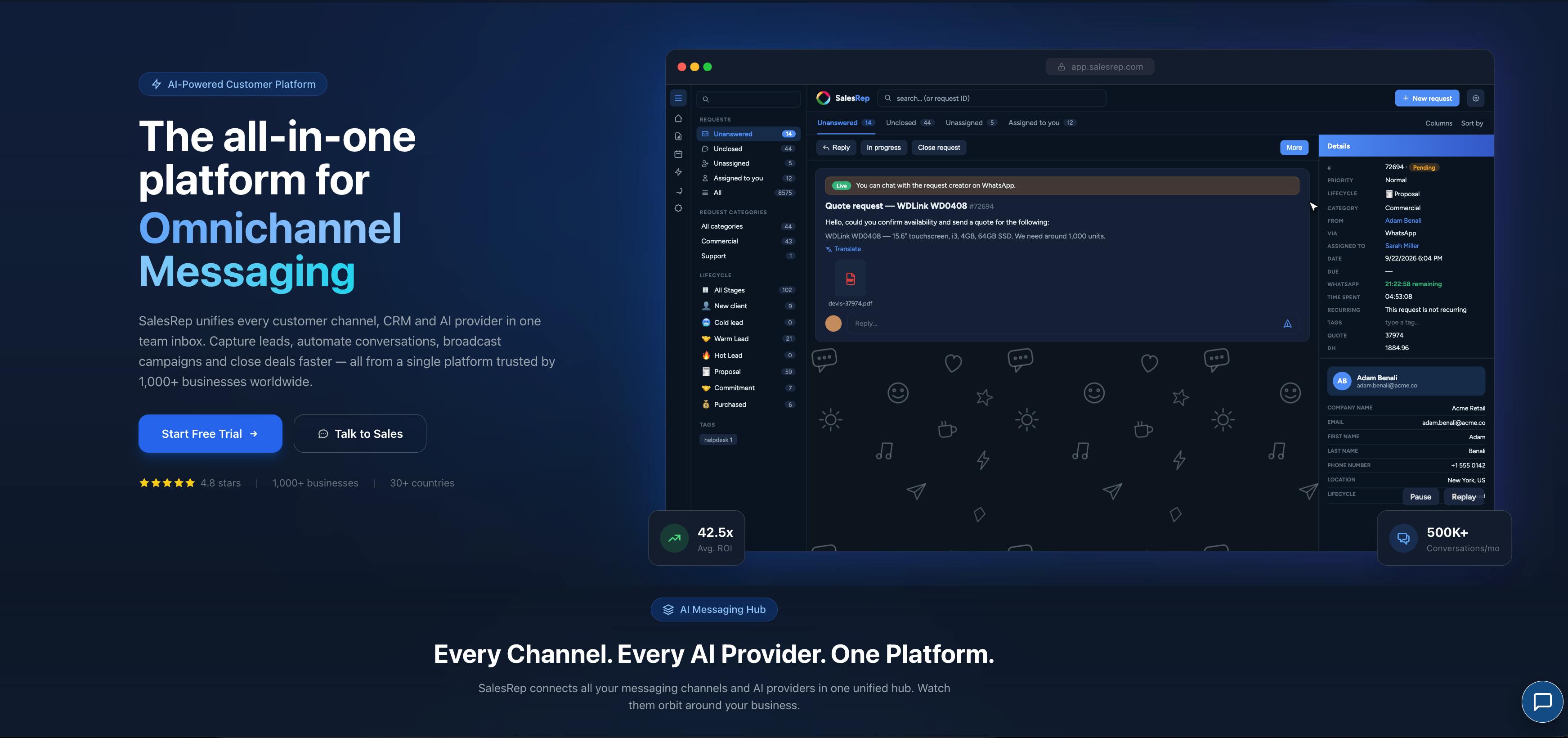
The core logic behind SalesRep is to replace the repetitive parts of sales conversations that humans currently handle. According to the official description, it can pull real-time pricing and inventory from Shopify, WooCommerce, PrestaShop, Meta Catalog, or a custom database/API, then respond to customers through WhatsApp, Instagram, Messenger, email, SMS, and other channels.
During conversations, it instantly sends product cards and quotes, and keeps following up until the deal is done. Human agents can take over at any point throughout the process, preventing the AI from going off the rails in complex negotiations. It supports over 30 languages with automatic detection, saving cross-border sellers the hassle of configuring multilingual scripts.
About Shopify, WooCommerce, PrestaShop, and Meta Catalog
These names represent the mainstream website-building and product management systems in e-commerce. Shopify is the most popular SaaS e-commerce platform in North America—merchants can open a store without setting up their own servers. WooCommerce is an open-source e-commerce plugin for WordPress, suited for merchants who already have their own website. PrestaShop is a widely used open-source e-commerce system in Europe, especially common in French-speaking regions. Meta Catalog (formerly Facebook Catalog) is Meta's product catalog service—after merchants upload product data, it can be accessed uniformly across Facebook and Instagram ads, shops, and direct messages. SalesRep's ability to connect with these systems means merchants don't need to build a separate product database; the AI can read existing pricing, inventory, and product information directly, lowering integration costs. The custom database or API option targets mid-to-large teams with existing custom backends.
Pricing and Trial: A Low-Barrier Entry Point
SalesRep's full-feature pricing starts at $39/month, with a 21-day free trial that doesn't require a credit card. This pricing strategy targets small and mid-sized e-commerce teams—ones with clear sales automation needs but unwilling to bear enterprise-level SaaS procurement costs.
For merchants already using Shopify or WooCommerce, integration costs are relatively manageable since pricing and inventory data can be read directly from existing systems without maintaining a separate product database.
The Trade-Offs of Multi-Platform Coverage
Channel coverage is an obvious selling point for SalesRep. WhatsApp, Instagram, Messenger, email, and SMS essentially cover the mainstream communication habits of overseas consumers, and product cards and quotes can be sent within any channel, maintaining a consistent experience.
However, this also brings up a practical issue: each channel has different API limitations and message template specifications. The official documentation doesn't clarify whether features are fully equivalent across channels. In practice, rich media display capabilities on channels like SMS and email are typically weaker than on WhatsApp and Instagram, so merchants need to verify how product cards appear on each channel themselves.
About API and Message Template Limitations Across Channels
While WhatsApp, Instagram, Messenger, SMS, and email are all messaging channels, the technical rules behind them vary significantly. The WhatsApp Business API has strict template review requirements—merchants can't freely send marketing content outside the 24-hour customer service window. Instagram and Messenger both belong to Meta, and their APIs are relatively open, but rich media card styles are constrained by platform specifications. SMS is a plain-text channel where images and buttons basically can't be displayed. Email relies on HTML rendering, and display varies across different clients. So-called "omnichannel coverage" often only means unified reach—the actual content formats and automation levels are not equivalent. When choosing a tool, merchants need to verify product card, quote, and button rendering on the channels their target customers use most, rather than assuming all channels offer the same experience.
Several Practical Considerations Worth Noting
Looking at Product Hunt data, the project received 68 upvotes, ranked 19th, with only 2 comments. The traction isn't particularly strong, meaning third-party testing feedback is limited and more capabilities need to be verified through hands-on trials.
One key point is the actual smoothness of "human handoff." In sales conversations, customer emotions, price negotiations, and custom requests can exceed the AI's processing boundaries at any moment. Whether the handoff is timely and whether context can be seamlessly transferred to a human directly determines whether this tool improves efficiency or creates chaos.
Another is data accuracy. The AI relies on real-time pricing and inventory pulled from upstream systems. If synchronization is delayed or an API errors out, the AI could quote wrong prices to customers—a costly mistake in sales scenarios. We recommend thoroughly testing the data synchronization pipeline before going live.
About the Technical Meaning of "Human Handoff"
Human handoff in the AI customer service space refers to a conversation state migration mechanism: when the AI determines that the current conversation exceeds its capabilities, or when a customer explicitly requests a human, the system needs to transfer the complete conversation history, customer identity, and collected context to a human agent, who then seamlessly continues. Ideally, the customer wouldn't perceive any interruption or repeated questions. But in practice, handoff delays, context loss, and agent scheduling gaps are common problems. SalesRep markets "takeover at any time" as a selling point but doesn't disclose the trigger conditions for handoff or the specific method of context synchronization—this is exactly the critical area that needs real-world testing. In sales scenarios, a failed handoff can directly lead to customer loss, with consequences far greater than in ordinary customer service scenarios.
Who It's For
SalesRep is better suited for small and mid-sized e-commerce teams with highly standardized products and inquiries focused mainly on pricing and inventory. For B2B sales requiring complex solution discussions and long-cycle negotiations, the AI's role is relatively limited. The 21-day free trial is enough to run through a complete sales cycle, making it the lowest-cost way to assess its real value.
About the Boundaries of AI Sales Tools
AI sales reps excel at high-frequency, standardized, information-query-type conversations—quotes, inventory, shipping times, size recommendations, and so on. These questions have clear answers and short decision paths, so the AI's response speed and 24/7 availability can directly translate into conversion rates. But B2B sales or high-ticket products often involve custom solutions, multiple rounds of negotiation, contract terms, and long-term relationship maintenance—these depend on understanding the customer's organizational structure, budget cycles, and unspoken needs, which current large language models struggle to handle independently. Therefore, tools like SalesRep are more accurately positioned as "sales assistants" rather than "sales replacements"—they free salespeople from repetitive Q&A, letting humans focus on high-value negotiation and relationship building. When evaluating, merchants should first assess what proportion of their inquiries are standardized questions, then judge the return on investment.
Related articles

@ai-sdk/vue 3.0.306 Patch Release Syncs with [email protected] Update
@ai-sdk/vue 3.0.306 released, synced with [email protected]. A routine patch release for the Vercel AI SDK ecosystem with no public API changes; the Vue adapter layer stays version-aligned with the core package.

Gemini 4 Argon API Launches: The Era of Million-Token Output Begins
Google launches Gemini 4 Argon with sparse MoE architecture, up to 1M output tokens, and a 68.90% Vals Index score, available across API, AI Studio, and the Gemini app.

DukaanAI: Turning Product Photos into Inventory Lists with Open-Source AI
DukaanAI is an AI inventory tool for small retailers that turns product photos into inventory entries using the open-source Gemma 3 model, with local inference, editable fields, and CSV export.