Sam Altman Taken Out of Context: Is Local AI Inference Really a Waste of Resources?

Altman's original point was that idle DRAM makes for poor resource allocation; it was distorted into a denial of local AI.
A Reddit user found that Sam Altman's remarks about local AI inference were taken out of context in circulation. In the original interview, Altman pointed out that using DRAM for local inference is poor resource allocation because that memory sits idle most of the time. But the social media version lost this premise and simplified it into "local inference is a waste," sparking mockery. The article argues that local LLMs have irreplaceable value in privacy and autonomy but do face challenges in cost efficiency. The two are not contradictory; they simply discuss different dimensions. The incident reflects the widespread problem of missing context in the transmission of technical views.
A Controversy Sparked by One Sentence
A Reddit user discovered that Sam Altman's remarks about local AI inference had been widely circulated on social media and drew a wave of mockery. Many tech YouTubers and community users were debating whether "Altman doesn't understand technology." But this user found the transcript of the original interview and discovered that the version being circulated had omitted crucial context.
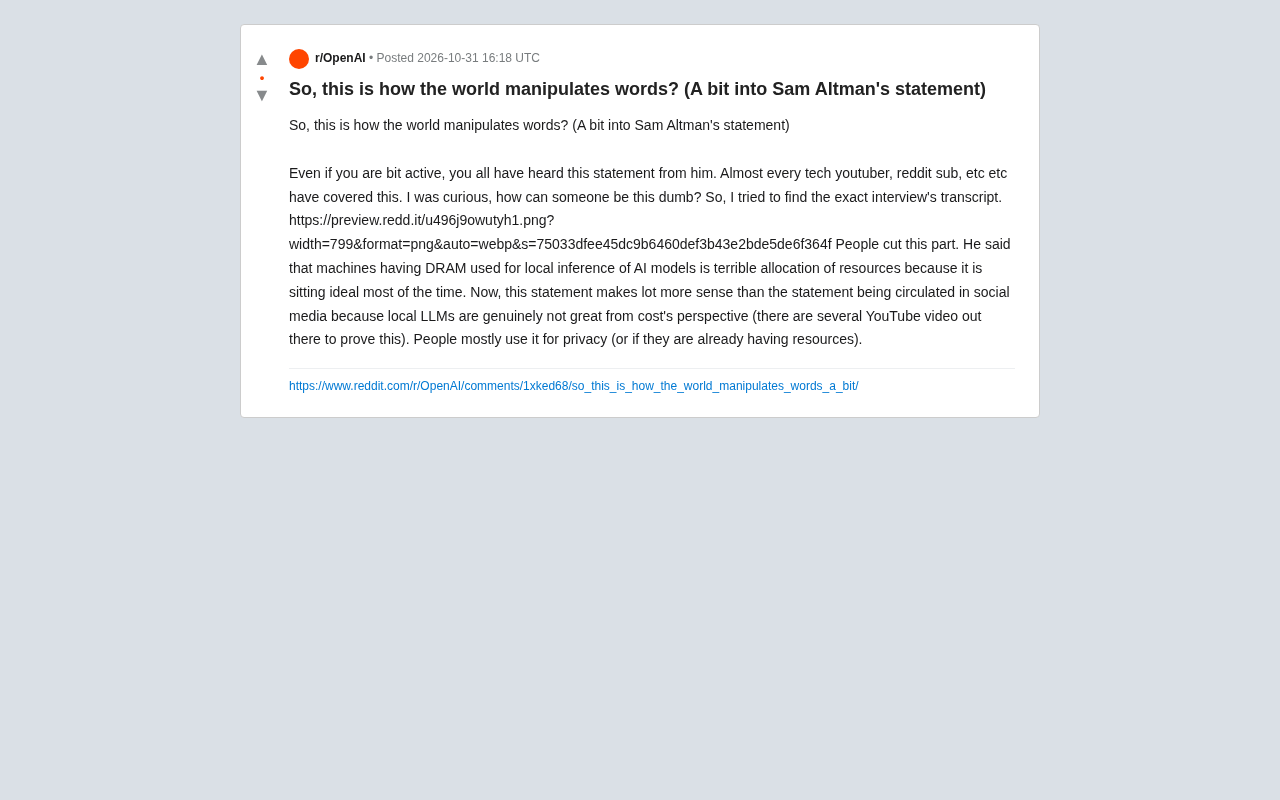
According to the interview screenshot shared by the user, Altman's original point was that using DRAM for local AI model inference is "poor resource allocation" because that memory sits idle most of the time. This statement is fundamentally different from the version simplified on social media into "local inference is a waste."
This incident reflects a broader problem: how the nuanced views of tech executives get compressed into easy targets for attack during circulation.
The Chain of Out-of-Context Transmission
On platforms like Reddit and YouTube, information often passes through multiple retellings. According to the Reddit user's observation, virtually every tech YouTuber and Reddit subreddit covered Altman's quote, but no one mentioned the premise about DRAM sitting idle.
This pattern of transmission is not unusual. A controversial statement attracts more clicks and discussion than a full explanation. When "local inference is a waste of resources" is pulled out on its own, it immediately angered the local LLM enthusiast community, because for them the value of local deployment lies in privacy and autonomous control, not cost efficiency.
But the view in its full context is actually closer to a cost judgment: if DRAM sits idle most of the time, then using it for local inference is indeed not the optimal use of resources. This is a completely different proposition from "local AI has no value."
The Real Cost Dilemma of Local LLMs
Setting aside transmission bias, running large language models locally does face cost challenges. The Reddit user mentioned that multiple YouTube videos have argued the disadvantages of local LLMs from a cost perspective. This is not a denial of the legitimacy of local inference, but a pointer to its economic boundaries.
The core advantage of local inference lies in privacy protection. Users can run models without sending data to the cloud, which is crucial for businesses and individuals handling sensitive information. In addition, users who already own high-performance hardware face lower marginal costs, making local inference more attractive.
But purely from a resource allocation standpoint, dedicated DRAM truly produces no value when idle. Altman's comment was aimed at efficiency at this level, not at denying the technical feasibility or scenario value of local inference.
The Hardware Logic of DRAM and Local Inference
DRAM (dynamic random-access memory) is a computer's main memory, used to temporarily hold data that the CPU or GPU is processing. When running large language models locally, model weights typically need to be loaded into VRAM or memory, and model sizes often run to tens of GB, placing high demands on DRAM capacity. However, the inference process does not continuously occupy all memory bandwidth: between two requests, the memory may sit idle. What Altman meant by "idle" is precisely this intermittent load characteristic. For cloud service providers, dedicated DRAM can improve utilization through multi-tenant scheduling; but for individual users, configuring large-capacity memory for occasional inference tasks does indeed involve insufficient resource utilization. Understanding this hardware-level distinction helps clarify the scope of the cost judgment.
The Missing Context in the Transmission of Technical Views
The core lesson of this incident lies in the importance of context in technical discussion. A cost judgment made by a tech company CEO in an interview, once stripped of its premises, became a statement that looked arrogant and ignorant.
The Reddit user's follow-up question, "How could anyone be this stupid," ultimately turned into a questioning of the transmission mechanism rather than of Altman himself. This reversal shows that before evaluating any technical view, it is necessary to trace back to the original context.
For readers following AI industry developments, this case reminds us that trending statements on social media are often compressed and reprocessed, and taking them at face value may deviate from the original meaning. On complex topics like local AI inference that involve cost, privacy, and hardware configuration, full context is especially critical.
Out-of-Context Quoting and the Transmission Mechanism of Internet Memes
Information transmission on social media follows "meme" logic: the shorter and more controversial a statement, the easier it is to copy and spread. Research shows that emotionally charged assertions spread far faster than full arguments with attached premises. When a complex view is compressed into a slogan-like phrase, the qualifiers in the original context (such as "DRAM sitting idle") are often the first to be lost, because they add cognitive burden during transmission. This phenomenon is not unique to the AI field, but it is especially prominent in tech communities, because technical discussion itself relies on precise context and premises. The Reddit user's approach of tracing back to the original interview transcript is precisely an effective means of countering this transmission bias.
Editorial Perspective
Altman's original statement was a technical judgment about resource allocation efficiency, not a wholesale denial of local AI. The premise about DRAM sitting idle that was lost in social media transmission is precisely the key to understanding this sentence. Local LLMs have irreplaceable value in privacy and autonomy, but they do face constraints in cost efficiency. The two are not contradictory; they simply discuss different dimensions.
This incident also reflects the AI community's high sensitivity to the "local vs. cloud" topic. Against the backdrop of increasingly strained computing resources, any statement about resource allocation easily triggers positional disputes. Returning to the original context may help bring the discussion back to the technology itself.
One-line Summary
Altman's original point was that idle DRAM makes for poor resource allocation; it was distorted in transmission into a denial of local AI.
Paragraph Summary
A Reddit user found that Sam Altman's remarks about local AI inference were taken out of context in circulation. In the original interview, Altman pointed out that using DRAM for local inference is poor resource allocation because that memory sits idle most of the time. But the social media version lost this premise and simplified it into "local inference is a waste," sparking mockery from tech YouTubers and community users. The article argues that local LLMs have irreplaceable value in privacy and autonomous control, but do face challenges in cost efficiency. The two are not contradictory; they simply discuss different dimensions. The incident reflects the widespread problem of missing context in the transmission of technical views, reminding readers to trace back to the original record before evaluating statements.
Related articles
 Tech Frontiers
MuJoCo: An Analysis of DeepMind's Open-Source General-Purpose Physics Simulator
An in-depth analysis of Google DeepMind's open-source physics simulator MuJoCo: high-performance C++ kernel, MJCF modeling format, contact solving principles, MJX GPU acceleration, and robot reinforcement learning use cases.
 Tech Frontiers
Claude API Quick Start: The Official Quickstarts Project Collection
Anthropic's official claude-quickstarts project collection helps developers quickly build deployable apps with the Claude API. Nearly 20k stars, Python-based, great for beginners and prototyping.
 Tech Frontiers
AI Agents Connecting Directly to APIs: Which Calls Can Be Safely Allowed?
AI agents can call any API, but the real challenge is deciding which calls can be safely allowed. This article analyzes allowance decisions from three dimensions—intent matching, least privilege, and controllable impact—and argues that the control layer should sit outside the agent, combined with audit traceability to build a trustworthy API call governance mechanism.