Same Moon: Free Bedtime Stories for Displaced Children
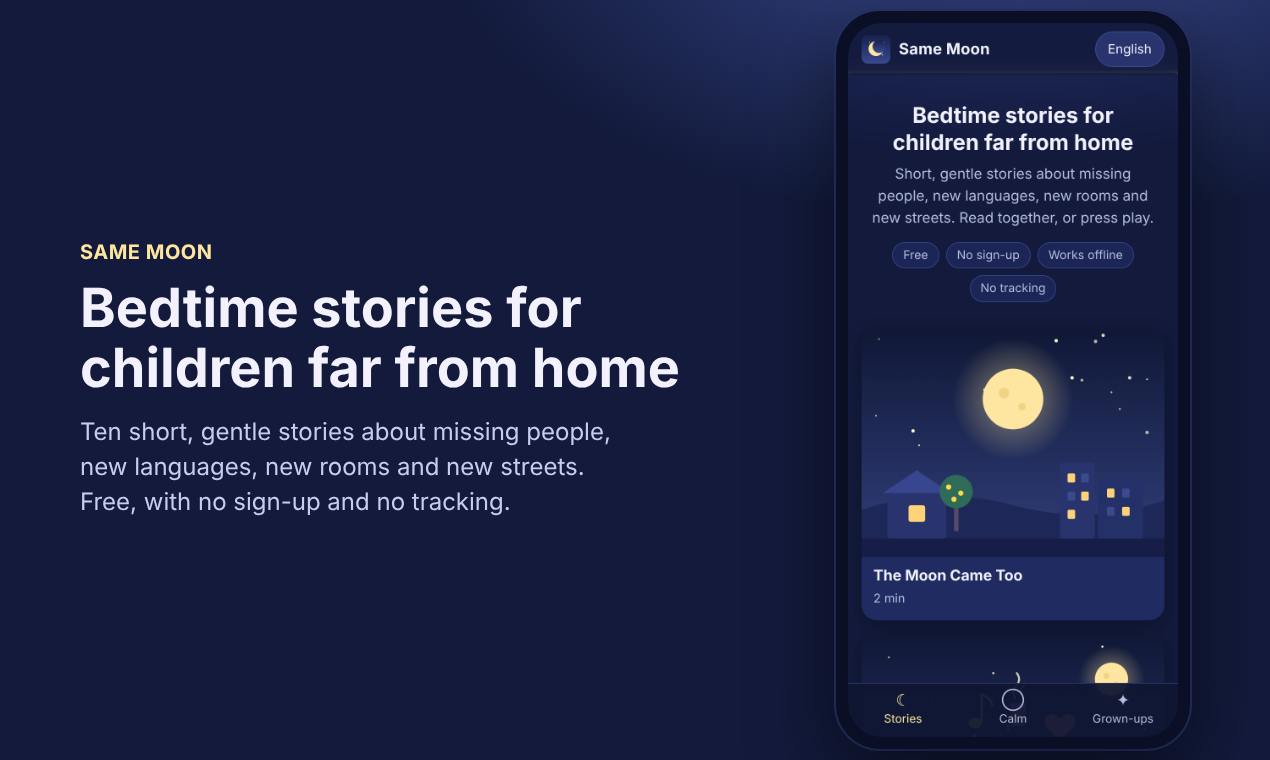
Same Moon helps displaced children with free trilingual bedtime stories, emphasizing offline access and human review.
Same Moon is a public-interest project launched by Sherief Elsayed on Product Hunt that provides free bedtime stories in English, Arabic, and Spanish for children forced to leave their homes, earning 80 votes and ranking 18th. It focuses on the bedtime story as a predictable daily ritual that offers emotional comfort to children lacking stability. The design explicitly targets low-end devices and weak networks: tiny initial load, offline support, no registration, no tracking, deployed on Google Cloud Run. On the content side, every story and narration voice is human-reviewed before reaching children, ensuring content safety and appropriate tone. The article argues its value lies not in technical complexity but in clearly defining its users and use cases, offering a reference for public-interest tech: offline-first, multilingual service to mother-tongue communities, and human review to offset automation risks.
On Product Hunt, a project called Same Moon is trying to help children forced to leave their homes in the simplest way possible—by offering gentle bedtime stories for free in English, Arabic, and Spanish. The project was launched by Sherief Elsayed and received 80 votes and 3 comments after going live, ranking 18th.
Why bedtime stories?
For refugee and displaced children, stability and a sense of security are often luxuries. The bedtime story—a seemingly simple daily ritual—is precisely what can offer children a predictable source of comfort. Same Moon chose to focus on this scenario, covering in three languages the mother tongues commonly spoken among many displaced communities, so that stories become not just entertainment but a vehicle for emotional connection.
The project's category tags on Product Hunt include Kids, Charity & Giving, and Education, and its tech stack is deployed on Google Cloud Run. Judging from its positioning, it is more of a lightweight public-interest tool than a commercial product.
Designed for cheap phones and weak network conditions
Same Moon's core design principles are very clear: it targets low-end devices and limited network conditions. According to its description, the product has a very small initial load size, supports offline use, requires no registration, and performs no tracking whatsoever. This means that even in temporary settlement sites or unstable network environments, children can still listen to stories smoothly.
These constraints have forced an extremely minimal product form. There is no account system, no push notifications, and no social features—users simply open it and use it. For the target users, this restraint is precisely the most practical choice.
Offline-first is a product design strategy: an app's core functionality remains fully usable without a network connection, with the network used only for optional syncing or updates. It is typically implemented by caching story audio and interface resources locally on first load, then reading them through a Service Worker or local database. For a product like Same Moon that targets temporary settlement sites and weak network environments, offline-first means that even if the network drops or data is limited, a child's bedtime ritual won't be interrupted mid-way by a loading animation. This strategy also requires strict control of bundle size, because the more content is cached, the higher the first-load cost—especially sensitive on cheap devices and slow networks.
Every story and voice is reviewed by humans
In an era flooded with AI-generated content, Same Moon has chosen a slower path: every story and every narration voice is reviewed by a real person before it reaches a child's ears. This detail is explicitly emphasized in the original description and constitutes a key safeguard for the product's content safety.
Given that the target audience is children—especially children who may be in a psychologically sensitive period—human review matters not only for filtering inappropriate content but also for ensuring that tone, pacing, and emotional expression are genuinely suited to the bedtime setting.
Content moderation refers to the manual or automated checking of content for safety and appropriateness before publication. A common approach is to use automated models for initial screening (identifying violence, discrimination, inappropriate language, etc.), followed by human review of borderline cases. Same Moon emphasizes that every story and narration voice is reviewed by a real person, which is a purely manual gatekeeping model—more costly but better suited to children's scenarios: review covers not only the text but also audio-level suitability such as tone, pace, and emotional atmosphere, dimensions that automated tools currently struggle to judge reliably. For children who may be in a psychologically sensitive period, human review also takes on the responsibility of checking cultural sensitivity and the naturalness of mother-tongue expression—aspects that machine translation or synthesized speech tend to overlook.
Three design ideas worth noting
Based on the available information, Same Moon's practice offers several references for public-interest digital products: first, adapt to real-world usage environments with offline-first design and extremely low load costs; second, serve mother-tongue communities directly through multiple languages; third, use human review to offset the risks of automated content distribution. Together, these choices point in one direction—technology serving those who need it most, not the other way around.
The product is currently accessible through its Product Hunt page; the exact number of stories and the depth of language coverage await further disclosure.
One observation
Same Moon's value may not lie in technical complexity, but in reminding us that the application scenarios for AI and digital tools can be very specific. When a product clearly knows who its users are, under what conditions they will use it, and what kind of emotional support they need, the length of the feature list becomes secondary. For developers concerned with educational equity and public-interest technology, this is a case worth noting.
Related articles

MIT PhD Takes You from Scratch to Build DeepSeek: A 25-Hour Hardcore Course
MIT PhD Raj Dandekar launches a 25+ hour Bilibili course building DeepSeek from scratch—MoE, MLA, GRPO, hand-written code plus math derivations, aiming to reproduce mini R1.
DeepSeek Harness in Practice: From Installation to Plugin Ecosystem, Building a Fully Automated AI Workflow
Based on a hardcore Bilibili tutorial, this guide systematically covers DeepSeek Harness installation, three plugin installation methods, and real-world use cases to help developers quickly build customizable AI Agent workflows.
DeepSeek Harness in Practice: From Installation to Automated Workflows
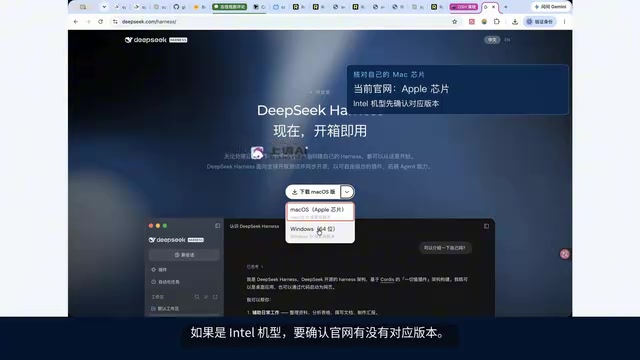
Hands-on DeepSeek Harness tutorial covering Mac/Windows installation, login, workspace binding, model & permission setup, and minimal closed-loop verification for AI automation workflows.