Sampling Is Not Curiosity: Why LLM Agents Should Investigate

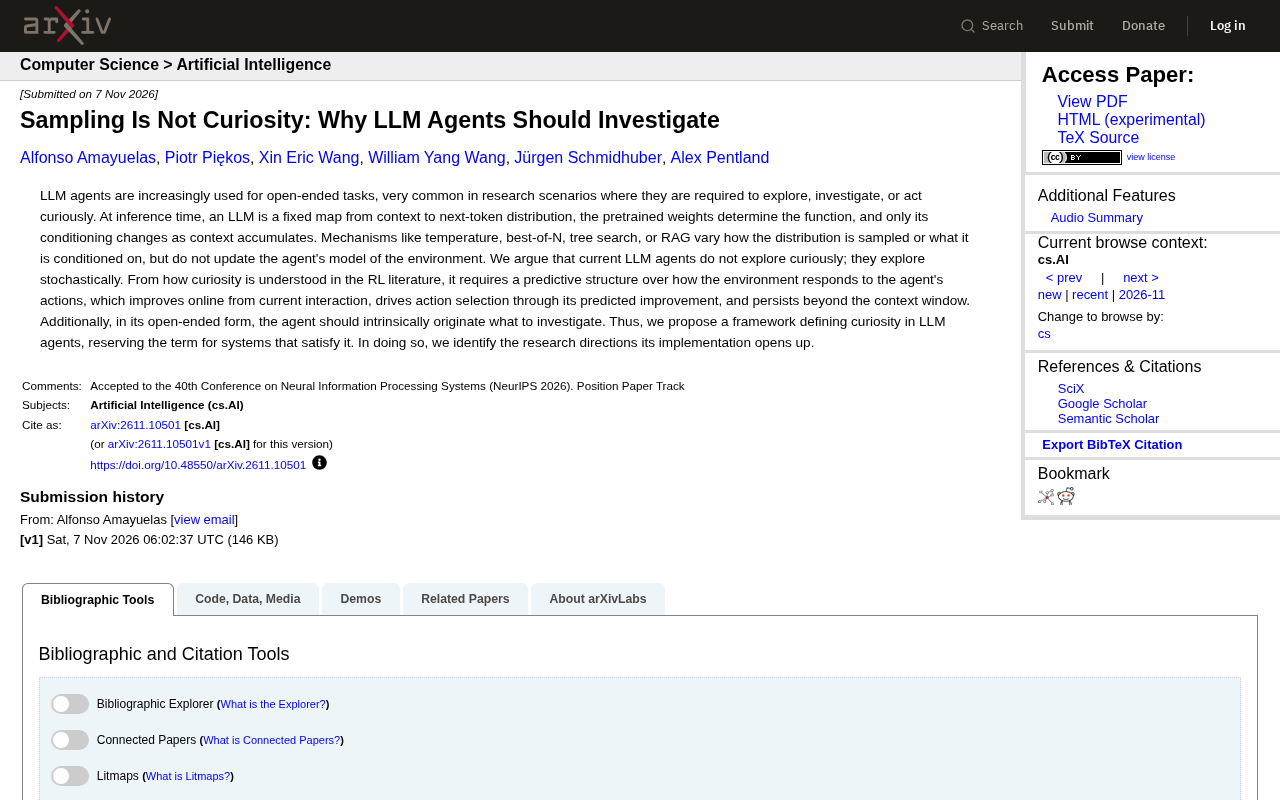
Current LLM agent exploration is just random sampling, lacking a predictive structure that can be updated online and drive action selection—so it is not genuine curiosity.
The article points out that the "curiosity" shown by LLM agents in open-ended tasks is actually random sampling. At inference time an LLM is a fixed mapping; temperature scaling, best-of-N, tree search, and RAG only change the sampling method or conditioning, without updating the agent's internal model of the environment. Curiosity in reinforcement learning requires three conditions: online improvement of prediction, driving action selection, and persistence beyond the context window, along with autonomously generated investigation goals. Current agents lack this predictive structure, so their exploration is random. The article proposes a framework for defining curiosity and notes that achieving genuine curiosity requires new research directions, such as an updatable environment model, coupling with action selection, and autonomous generation of investigation goals. Multi-source discussions agree that "sampling is not curiosity" but diverge on whether an explicit environment model is needed. For developers, increasing sampling diversity cannot substitute for genuine exploratory capability.
LLM agents are increasingly used for open-ended tasks, especially in research scenarios where they need to explore, investigate, or demonstrate curiosity. However, an article titled "Sampling Is Not Curiosity: Why LLM Agents Should Investigate" points out that the so-called "curiosity" of current agents is merely random sampling, not genuine exploration. This article draws on that view to analyze the essential difference between sampling and curiosity, and explores possible paths toward genuinely curious agents.
The Essential Difference Between Sampling Mechanisms and Curiosity
At inference time, an LLM is a fixed mapping from context to the next-token distribution; the pretrained weights define this function, and only the condition (i.e., the context) changes as it accumulates. Mechanisms such as temperature scaling, best-of-N, tree search, or RAG merely alter how the distribution is sampled or what the conditioning content is, but they do not update the agent's internal model of the environment.
In other words, these mechanisms make the agent's behavior appear diverse, but they do not let it "learn" anything about how the environment responds to its actions. The article therefore makes a sharp point: current LLM agents are not exploring curiously—they are exploring randomly.
Temperature Scaling is a parameter that controls output randomness during LLM inference. A higher temperature (e.g., >1) biases sampling from the next-token distribution toward lower-probability tokens, producing more diverse outputs; a lower temperature (e.g., <1) sharpens the distribution, producing more deterministic outputs. It only changes the shape of the sampling distribution, not the model weights or internal representations.
Best-of-N is an inference-time sampling strategy: generate N candidate outputs for the same prompt, then use a reward model or verifier to pick the best one. Tree search (e.g., Tree of Thoughts) expands multiple reasoning branches and backtracks to find better solutions. RAG (Retrieval-Augmented Generation) retrieves relevant documents from an external knowledge base before generation and inserts them into the context, thereby changing the conditioning content. All of these techniques operate on inference-time sampling or conditioning, and none of them involve updating the model parameters.
How Curiosity Is Defined in Reinforcement Learning
To understand genuine curiosity, we need to return to the reinforcement learning literature. There, curiosity is understood as a predictive structure of how the environment responds to actions. This structure must satisfy three conditions:
- Online improvement: it can learn from the current interaction and improve its predictive ability;
- Driving action selection: it guides the agent's action choices through improvements in prediction;
- Persistence: it can outlast the context window and exist over the long term.
Moreover, in open-ended scenarios, the agent should also intrinsically generate the source of "what to investigate," i.e., decide the direction of exploration itself rather than relying on external prompts.
Based on this, the article proposes a framework for defining curiosity in LLM agents, reserving the term "curiosity" for systems that satisfy the above conditions. This definition elevates curiosity from a behavioral manifestation to a system capability.
In reinforcement learning, Intrinsic Reward is a reward signal generated by the agent itself, as distinct from external environmental rewards, and is commonly used to encourage exploration. Common forms include prediction-error-based rewards (e.g., ICM, the Intrinsic Curiosity Module), state-visit-count-based rewards (e.g., count-based methods), and information-gain-based rewards. What these mechanisms share is that the agent maintains a predictive model of environment dynamics and uses prediction error or information gain as the driving force for exploration. This is consistent with the "predictive structure" emphasized in the article—curiosity is essentially the agent using improvements in its own predictive ability to guide behavior, rather than relying on external rewards or random sampling.
Limitations of Current Agents and Directions for Realization
Current LLM agents lack this predictive structure, so their "exploration" is essentially random. Even with sophisticated sampling strategies, the agent does not update its understanding of the environment, let alone actively choose actions that maximize knowledge gain.
The article points out that achieving genuine curiosity requires new research directions. For example, how can an agent maintain an updatable environment model during inference? How can this model be coupled with action selection? How can the agent autonomously propose investigation goals? These questions do not yet have mature answers, but the proposed framework provides a clear starting point for future research.
Consensus and Divergence Across Multiple Perspectives
This article from an RSS feed cross-validates with discussions in several recent AI research communities. According to interpretations of related papers by Bilibili creators and YouTube channels, most views agree with the core judgment that "sampling is not curiosity," believing that the performance of current agents in open-ended tasks is more a matter of statistical diversity than cognitive drive.
However, there is disagreement on "whether an explicit environment model is needed." Some researchers believe that large-scale pretraining already implicitly contains world knowledge, and that agents can approximate the predictive structure through in-context learning; others insist that only an explicit, online-updatable model can satisfy the definition of curiosity. The article's author clearly leans toward the latter but acknowledges that this is an open question.
Implications for LLM Agent Development
For developers building LLM agents, this analysis highlights a key blind spot: increasing sampling diversity or search breadth cannot substitute for genuine exploratory capability. If an agent needs to complete research-type or investigative tasks, mechanisms must be designed to let it learn from interactions and persist environmental knowledge.
This may mean that future agent architectures need to integrate inference-time learning more tightly with action selection, rather than merely sampling from a fixed model. The framework proposed in the article provides criteria for assessing whether an agent possesses curiosity and points the way for future research.
Related articles

Prompt Engineering for Beginners: From Writing Prompts to Engineering Thinking
Starting from the essence and four functions of prompts, this article systematically explains the six-step process, four success criteria, learning value, and practical limitations of prompt engineering to help you build a complete understanding.

Anthropic Launches Nasdaq IPO: AI Giant's Listing and Risk Disclosures
Anthropic officially launches its Nasdaq IPO under ticker ANT, with market valuation expected to potentially exceed SpaceX's record. The prospectus devotes nearly 100 pages to AI risks, while first-half revenue grew over 14x but net losses widened sharply, reigniting the AI bubble debate.

Rust cURL Clone Uses 4,832 unsafe Blocks—Is the Memory Safety Myth Broken?
A Rust cURL clone uses 4,832 unsafe keywords, challenging Rust's memory safety narrative. We analyze what unsafe really means, compare Fil-C, and examine rewrite motives.