Samsung Cut Off My Washing Machine's Network—Claude Helped Me Restore Smart Control

User uses Claude to reverse-engineer Samsung washing machine protocol in two hours, restoring smart linkage functionality.
A Reddit user shared his experience using Claude to restore the internet connectivity of a ten-year-old Samsung washing machine. This €1,400 flagship washer once supported Smart Control, but became a "dumb" device after Samsung discontinued the service. The user reverse-engineered the communication protocol with Claude's help, getting the washing machine reconnected to SmartThings in just two hours and restoring automatic linkage with the dryer. The incident raises questions about big companies' device support strategies and highlights the security risks of DIY smart device takeover. The open-source project shows that 2014-2018 models share the same protocol, and the community can collaborate and contribute.
A Reddit user shared his experience using Claude to restore the internet connectivity of a ten-year-old Samsung washing machine. This €1,400 washer once supported Smart Control, but Samsung later discontinued the service, turning it into a "dumb" device. With Claude's help, the user successfully reverse-engineered the communication protocol, got the washing machine reconnected to SmartThings, and even enabled linkage with the dryer.
A Flagship Washer's "Disconnection" Ordeal
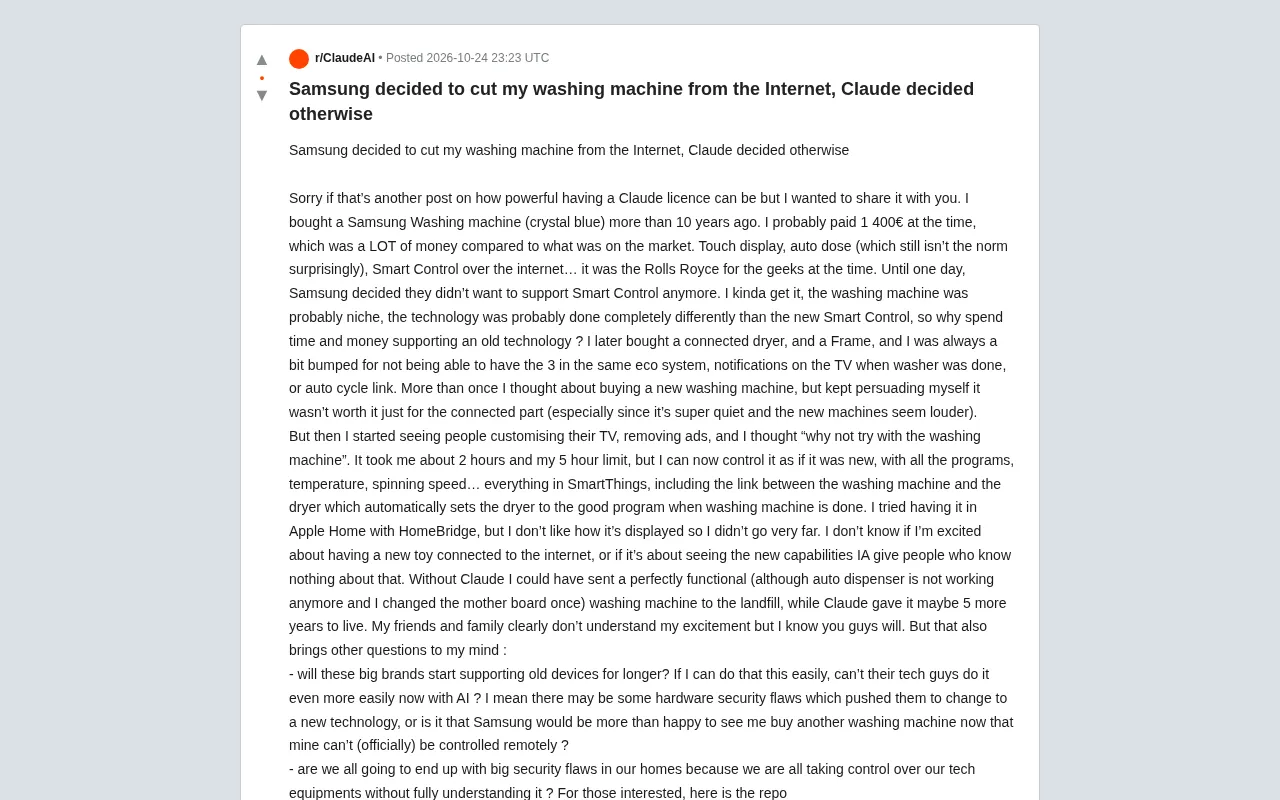
Ten years ago, this Samsung Crystal Blue washing machine was a true flagship product: touchscreen, automatic detergent dispensing, internet remote control, priced at €1,400—far above the market average at the time. The user described it as "the Rolls-Royce in a geek's eyes." But the good times didn't last—Samsung announced it would stop supporting the Smart Control feature.
The user understood: niche product, aging technology, and the manufacturer was unwilling to keep investing in maintenance costs. But the ensuing problem was that the connected dryer and Frame TV he later purchased couldn't form an ecosystem linkage with the washer—notifications pushed to the TV when laundry finished, automatic dryer program setup after washing completed—all these scenarios became pipe dreams. He had considered replacing the washing machine multiple times, but gave up because the old machine ran quietly while newer models were actually noisier.
The turning point came when he saw someone customizing a TV and removing ads. A thought popped up: why not try the washing machine?
Two Hours, Claude Brought the Old Machine Back to Life
The user set himself a 5-hour time limit, but actually completed the modification in about 2 hours. Now he can control this old washing machine in SmartThings just like a new one: selecting programs, adjusting temperature, setting spin speed—all functions available. More importantly, the linkage between the washer and dryer was restored—after washing finishes, the dryer automatically switches to the corresponding program.
He admitted he doesn't know programming, just "a geek." Without Claude, this fully functional washing machine (though auto-dispensing had failed and the mainboard had been replaced once) might have already been sent to a landfill. Claude至少为它续命了五年。
According to the GitHub repository he shared (smartthings-samsung-drc-washer), Samsung washing machines produced between 2014 and 2018 appear to use the same communication protocol. This is his first such project, and he welcomes community contributions of code and suggestions.
Reverse engineering refers to the process of inferring a product's internal workings and reconstructing an interactive interface by analyzing its behavior, communication data, or binary files without original design documents or source code. In smart home scenarios, this typically means capturing network traffic between the device and cloud services, parsing its protocol format (such as HTTP requests, MQTT messages, or custom TCP frames), and then simulating the official client's behavior. Traditionally, this requires deep network protocol knowledge and programming experience, but AI coding assistants can help analyze packet structures and generate parsing code, significantly lowering the barrier to entry.
SmartThings is Samsung's smart home platform, supporting centralized control of compatible devices via mobile app or voice assistant. Device integration with SmartThings typically requires following Samsung-defined device integration specifications, including identity authentication, status reporting, and command dispatch. When the official cloud service support for old devices ends, the communication link between the device and SmartThings is severed. The key to restoring functionality lies in reimplementing the device-side protocol logic so that it can pass SmartThings authentication and correctly respond to control commands, which often involves simulating mechanisms like OAuth tokens and Device Shadows.
Why Don't Big Companies Extend Support Themselves?
This raises a sharp question: if an ordinary user can easily restore old device functionality with AI, can't Samsung's engineers do the same? The user proposed several possibilities:
- Security vulnerabilities at the hardware level force manufacturers to change technical solutions;
- Manufacturers are happy to see users buy new machines due to missing features;
- The cost-benefit of maintaining old protocols isn't worthwhile, even if technically feasible.
This is not an isolated case. Smart home devices "bricking" has become a common pain point—after manufacturers stop cloud service support, users are often left helpless. AI tools are changing this situation—they lower the barrier to reverse engineering, allowing non-professional developers to engage in protocol analysis and code writing.
Security Risks: Hidden Concerns Behind Convenience
The user also clearly pointed out the risks: as more and more people take over their smart devices without fully understanding them, will home networks be exposed to greater security risks? Reverse engineering may bypass original security mechanisms, and users often lack sufficient security knowledge to assess the risks.
This is not to deny the value of DIY, but to remind the community that when sharing code and tutorials, security considerations should be included. The collaborative model of open-source projects may accelerate vulnerability discovery, but could also provide entry points for malicious actors.
Firmware is the low-level software embedded in hardware devices, responsible for controlling basic operations and communication functions. In reverse engineering and DIY modifications, backing up the original firmware is crucial, because once incorrect or maliciously modified firmware is flashed, the device may brick or introduce security vulnerabilities. Additionally, isolating smart devices on a separate network (such as a VLAN or guest network) can limit lateral movement of potential attacks, preventing tampered devices from becoming a springboard into the home network. While these measures cannot completely eliminate risks, they can significantly reduce the security costs of DIY projects.
Multi-Source Cross-Verification and Community Response
The post sparked discussion on Reddit, with multiple netizens confirming similar experiences. According to some commenters, Samsung's old appliance SmartThings protocol does have a unified interface, but official documentation was never made public. Other users pointed out that brands like LG and Whirlpool also have similar service termination issues, and AI-assisted reverse engineering may become a universal solution for extending device lifespan.
You may not have noticed that some comments mentioned Samsung launched an "extended support" program in certain markets, but coverage is limited and doesn't include ten-year-old models. This may indicate that manufacturers are not entirely indifferent, but commercial logic still dominates.
For users wanting to try, the original poster suggests starting with the GitHub repository, while reminding them to back up original firmware, isolate device networks, and be mentally prepared for failure.
Final Thoughts
The significance of this story goes beyond saving money on a washing machine. It demonstrates how AI empowers ordinary people with "digital repair rights"—when manufacturers abandon support, users no longer have to passively accept obsolescence. Of course, the boundaries of security and ethics still need careful exploration. As AI coding assistants become widespread, similar DIY projects will only increase, and manufacturers, communities, and regulators all need to think: how to find a balance between innovation, commercial interests, and user rights.
One-line Summary
User uses Claude to reverse-engineer Samsung washing machine protocol in two hours, restoring smart linkage functionality.
Paragraph Summary
A Reddit user shared his experience using Claude to restore the internet connectivity of a ten-year-old Samsung washing machine. This €1,400 flagship washer once supported Smart Control, but became a "dumb" device after Samsung discontinued the service. The user reverse-engineered the communication protocol with Claude's help, getting the washing machine reconnected to SmartThings in just two hours and restoring automatic linkage with the dryer. The incident raises questions about big companies' device support strategies and highlights the security risks of DIY smart device takeover. The open-source project shows that 2014-2018 models share the same protocol, and the community can collaborate and contribute.
Related articles

iPhone Duo Transformed into a Windows 98 Gaming PC: Hands-On Test and Experience
XDA tests turning the iPhone Duo foldable into a Windows 98 gaming PC using RetroArch and DOSBox Pure with virtual 3DFX, running Unreal Tournament, Half-Life, and Quake 3, plus Windows XP feasibility and limits.

Type-Safe Keep Rules in R8 and DEX Optimization in Practice
Google Play requires over 25% DEX optimization. This article explains the R8 configuration analyzer, Jetpack Keep type-safe annotations, and the Android CLI validation tool to help Android developers narrow keep rules, improve shrinking/optimization/obfuscation, and reduce ANRs.

Why Are Old Buildings More Beautiful Than New Ones? Pulitzer Prize-Winning Author Reveals an Overlooked Economic Truth
Pulitzer Prize-winning author Robert Caro found that poorer countries built more beautiful buildings. He reveals how cheap skilled craftsmen created the intricate details of old New York architecture, and how rising labor costs changed architectural aesthetics.