San Francisco Agentic Engineering Meetup: Embracing the Weirdness of Coding Agents

Simon Willison hosts an SF meetup embracing the weirdness of early-stage coding agent experiments.
Developer and AI blogger Simon Willison is co-hosting a "Birds of a Feather" in-person meetup in San Francisco with Jesse Vincent, focused on the emerging field of agentic engineering. Deliberately positioned as an informal show-and-tell for early explorers, the event welcomes unpublished work, quirky experiments, and half-finished projects with no clear market fit — explicitly not a product pitch or fundraising event. The gathering reflects a clear-eyed acknowledgment of how uncertain and early-stage agentic technology still is, and signals the gradual formation of a developer community around coding agents.
Prominent developer and AI blogger Simon Willison has announced that he and Jesse Vincent will co-host an in-person meetup in San Francisco for developers working with coding agents. The event, formatted as a "Birds of a Feather" session, focuses on an emerging and still-maturing field — agentic engineering — offering builders who are doing "strange and interesting things" with coding agents an informal space to connect.
A "Show-and-Tell" for Early Explorers
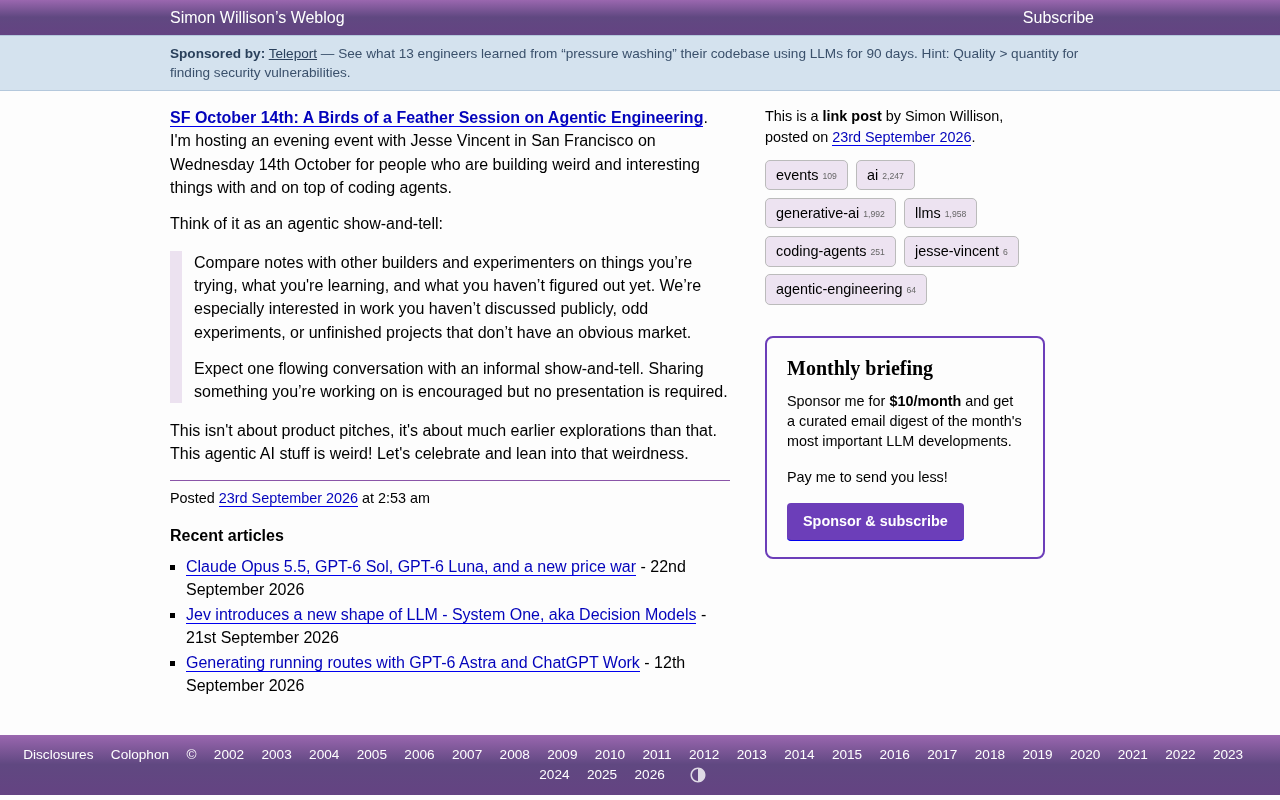
This isn't a product pitch event — it's a show-and-tell for people in the early stages of exploration. The organizers have made a point of emphasizing that they're most interested in work that hasn't been publicly discussed yet, quirky experiments, and half-finished projects with no clear market fit.
Share what you're trying, what you've learned, and what you haven't figured out yet with other builders and experimenters. We're especially interested in work you haven't talked about publicly, strange experiments, or unfinished projects without an obvious market.
This framing is telling. At a time when AI startups are almost universally chasing fundraising narratives and commercialization paths, this event does the opposite — encouraging participants to share explorations that are unformed, or may never be commercialized at all. Simon Willison put it plainly: "This agentic AI stuff is weird! Let's celebrate and embrace that weirdness."
"Birds of a Feather" is a time-honored informal gathering format in the tech conference world, taking its name from the English proverb "Birds of a feather flock together." The format originated in technical standards organizations like the IETF and is typically self-organized by people with a shared interest in a specific topic — no fixed agenda, no formal presentations, just participants sitting together to talk and ask questions. Unlike keynotes or Demo Days, the core value of a Birds of a Feather session lies in helping people at similar stages of exploration find each other. When a new technical direction hasn't yet formed a mainstream narrative, this format often does more to facilitate genuine experience-sharing than formal conferences. Simon Willison's choice of this format for an agentic engineering gathering is itself a signal about his read on the field's current maturity: it's far too early to be summarizing best practices — what's needed now is a space where explorers can come together and talk honestly about what confuses them.
What Is Agentic Engineering?
"Agentic engineering" is a concept that has been gaining traction in AI development circles. It refers to the engineering practice built around autonomous agents — moving beyond simply calling a large model to generate text or code, toward building systems that can autonomously plan, execute multi-step tasks, call tools, and even self-iterate.
Coding agents are the most active sub-field within this space. From code completion assistance to fully automated systems that can independently understand requirements, modify codebases, run tests, and submit results, coding agents are evolving rapidly. The "engineering" that surrounds them — how to design prompts, how to orchestrate workflows, how to build applications on top of agents — is itself a discipline still being worked out.
The event's emphasis on building "on top of" coding agents captures the defining characteristic of agentic engineering: agents are no longer just end-user tools, but are becoming a new layer of development infrastructure and platform.
From a toolchain perspective, the technical stack involved in agentic engineering differs significantly from traditional software engineering. A typical coding agent system spans several key layers: context management (maintaining relevant information about a codebase across long-running tasks), tool calling (enabling models to execute terminal commands, read and write files, and call external APIs), task decomposition and orchestration (breaking complex goals into executable sub-steps), and feedback loops (using test results and error messages to enable self-correction). Representative products like Devin, GitHub Copilot Workspace, Cursor's Composer mode, and open-source projects like SWE-agent and OpenHands each represent different technical approaches to this direction. There are currently no unified best practices — prompt strategies, context window utilization, and multi-agent collaboration architectures are all still in rapid flux, which is precisely what the organizers mean when they say the discipline is "still being worked out."
Why "Embracing the Weirdness" Matters
This event sends a signal worth reflecting on: agent technology is still in a highly uncertain exploratory phase. The organizers' deliberate exclusion of product pitches and their explicit welcome of unfinished projects reflects a respect for the natural rhythms of early-stage technology.
Historically, many important technical directions have grown out of experiments that initially seemed "useless" or strange. When a technology is new enough and its boundaries are blurry enough, open, non-utilitarian community exchange often accelerates collective understanding more effectively than closed commercial competition. Participants sharing failures, sharing confusion, sharing "the parts they haven't figured out yet" — this is precisely the kind of information that's most scarce at the frontier.
For readers tracking AI development trends, this kind of in-person meetup also reflects a broader pattern: as coding agents move from concept to practical use, a developer community is forming around them, and the accumulation of shared norms and practical experience will be a key ingredient in the field's maturation.
Event Details
- Topic: Birds of a Feather Session on Agentic Engineering
- Organizers: Simon Willison and Jesse Vincent
- Location: San Francisco, CA
- Format: Informal evening gathering — sharing encouraged, formal presentations not required
For developers in the Bay Area who are doing early-stage work with coding agents, this may be a rare opportunity to openly discuss unfinished ideas. For a broader audience, the event itself is a window into the emerging community ecosystem around agentic engineering as a nascent field.
Related articles

ChatGPT Space Launches: Team Collaboration and New Pages Features Explained
ChatGPT Space is OpenAI's new team collaboration feature with Pages, real-time collaboration, and Slack/Google Drive sync. We break down its privacy design, multi-platform integration, and the full workflow from conversation to document.

Migrating Apache Spark UDFs to GPU Acceleration with AI Agents
NVIDIA developer blog explains how AI Agents rewrite Apache Spark UDFs for GPU acceleration, covering migration criteria, agent rewriting and verification workflows, plus pitfalls like result consistency and CPU-GPU transfer overhead.

Zed Editor v0.40.4-rc2 Released: Usage Credits Now Available Without Upgrading
Zed editor releases v0.40.4-rc2, allowing users to use usage credits for AI features without upgrading to a paid plan, lowering the trial barrier.