San Francisco to Singapore Time Difference: The Trans-Pacific Routine of Silicon Valley Tech Workers

The SF–Singapore time difference reveals the trans-Pacific reality of AI-era tech globalization.
The 15–16 hour time difference between San Francisco and Singapore has become a defining feature of life for tech professionals as AI companies expand globally. This article explores why these two cities are increasingly connected, the physiological challenges of extreme jet lag, and how the flow of talent, capital, and technology across the Pacific is reshaping the industry landscape.
A Tweet That Reveals the Bigger Picture of Tech Globalization
Recently, a tweet about the time difference between San Francisco (SF) and Singapore (SG) struck a chord across the tech community. The poster quipped: "The jet lag from SF to SG always hits at the weirdest times, but it also gives you the best naps of your life."
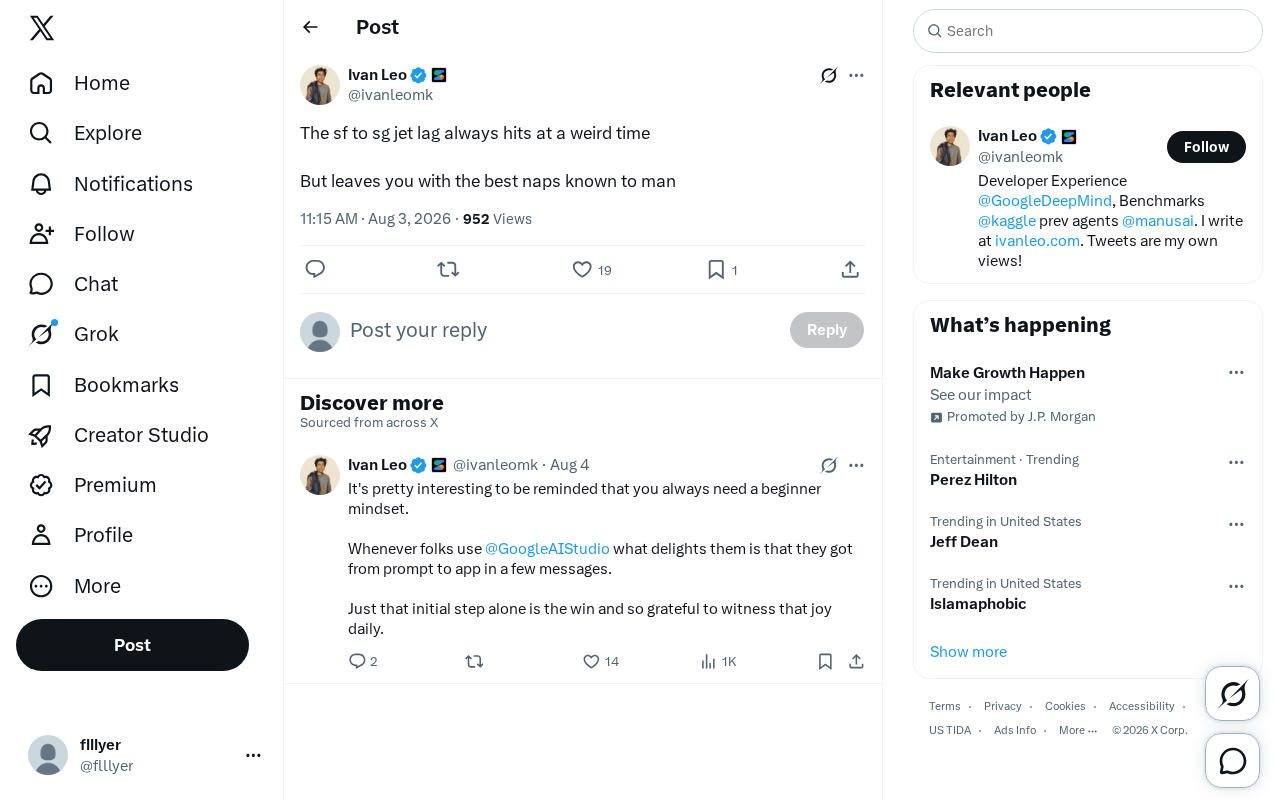
What seems like a lighthearted tweet actually reflects an increasingly common phenomenon in today's tech industry: frequent trans-Pacific travel has become the norm for tech professionals. The San Francisco Bay Area, the global epicenter of AI and tech innovation, is forging ever-tighter connections with Singapore, Asia's tech and financial hub.
Why San Francisco and Singapore?
Two Complementary Tech Centers
The San Francisco Bay Area needs little introduction — it's home to AI giants like OpenAI, Anthropic, Google, and Meta, along with countless startups. Singapore, meanwhile, has rapidly emerged as the gateway to Asia-Pacific tech.
With its strategic geographic location, stable policy environment, favorable tax regime, and English-speaking business culture, Singapore has attracted a wave of tech companies to set up their Asia-Pacific headquarters there. From ByteDance to numerous Web3 and AI startups, Singapore has become the launchpad of choice for many Silicon Valley companies looking to enter Asian markets.
Singapore's status as a tech hub is no accident — it's the result of long-term strategic planning. Since launching its "Smart Nation" initiative in 2014, the Singapore government has continuously ramped up investment in digital infrastructure and AI R&D. In 2023, the government announced an additional allocation of over S$500 million for its AI development strategy, aiming to become a global center for AI solution development and deployment by 2030. Furthermore, the Economic Development Board (EDB) has long provided landing support for multinational tech companies, from tax incentives to talent visas (such as the Tech.Pass program), creating a comprehensive policy attraction pipeline. These institutional designs have helped Singapore stand out among competing Asia-Pacific cities like Hong Kong and Tokyo, making it Silicon Valley's preferred gateway to Asia.
San Francisco to Singapore: The 15–16 Hour Time Difference Challenge
The time difference between San Francisco and Singapore is approximately 15 to 16 hours (depending on daylight saving time), meaning that when it's late at night in San Francisco, it's daytime in Singapore. This near-complete day-night inversion is exactly why jet lag "hits at the weirdest times," as the tweet describes.
Direct flights across the Pacific typically take over 17 hours, making it one of the longest commercial air routes in the world. Singapore Airlines resumed its direct San Francisco–Singapore route in 2018, operating it with the Airbus A350-900ULR (Ultra Long Range variant). This aircraft was specifically designed for ultra-long-haul flights, equipped with additional fuel tanks and a reduced seat count (approximately 160 seats, compared to about 300 on the standard version) to enable nearly 19 hours of uninterrupted flying. The very existence of this route is a product of globalized business demand — enough high-value business travelers to make it economically viable for an airline to operate such an extreme route.
Tech professionals who frequently shuttle between these two cities inevitably battle severe jet lag. Jet lag is essentially a misalignment between the body's circadian rhythm and the external time environment. The body's "master clock" resides in the suprachiasmatic nucleus (SCN) of the hypothalamus, which regulates the secretion rhythms of melatonin and cortisol through light signals. Generally, the human body can naturally adjust only about 1–1.5 hours of time difference per day, which means a 15–16 hour gap would theoretically require over 10 days to fully adapt. Yet frequent travelers often need to fly back before fully adjusting, and prolonged exposure to this state of "social jet lag" may increase the risk of metabolic syndrome and cognitive decline. The "best naps" mentioned in the tweet are actually a manifestation of the intense sleep pressure that occurs during jet lag adjustment — a deep, compensatory sleep triggered by extreme exhaustion.
Industry Trends Behind the Jet Lag
Global Expansion Has Become Standard for AI Companies
The reason this tweet resonated so widely is that it reflects the reality of talent and capital flows in the AI era. As AI technology moves toward commercial deployment, more and more Silicon Valley companies need to establish business footholds in Asia:
- Market expansion: The Asia-Pacific region boasts a massive user base and a rapidly growing digital economy
- Talent acquisition: Singapore and surrounding regions are home to a large pool of outstanding engineering and product talent
- Regulation and compliance: Establishing entities across different jurisdictions to navigate increasingly complex data and AI regulations
In recent years, Silicon Valley AI companies have been accelerating their presence in Singapore at a notable pace. OpenAI established its first Asian office in Singapore in early 2025; Google has invested billions of dollars in data centers and cloud computing infrastructure there; and Anthropic is actively building a Singapore team. At the same time, a large number of AI startups are choosing to register entities in Singapore as the legal and operational base for their Asia-Pacific operations. The driving force behind this trend goes beyond market expansion — it also includes Southeast Asia's relatively flexible AI regulatory environment. Compared to the EU AI Act's strict tiered restrictions on high-risk AI systems, Singapore has adopted a more pragmatic "light-touch" regulatory framework, relying primarily on industry self-regulatory guidelines rather than mandatory legislation. This regulatory philosophy is enormously appealing to fast-iterating AI companies and has further solidified Singapore's position as the Asia-Pacific landing point for AI firms.
For the professionals caught up in this movement, trans-oceanic travel is no longer an occasional event — it's part of everyday work life.
Balancing Remote Collaboration with In-Person Travel
Despite the maturity of remote work tools, the tech industry still places high value on face-to-face communication — whether for fundraising roadshows, client visits, or team building. This explains why physical trans-Pacific travel remains so frequent even in an era when video conferencing is ubiquitous.
The tech industry's attitude toward remote work underwent a dramatic shift after the pandemic. While collaboration tools like Zoom, Slack, and Notion have made asynchronous work more efficient than ever, extensive research and corporate experience have shown that deep trust-building, complex negotiations, and creative brainstorming still heavily depend on in-person interaction. Research from MIT's Human Dynamics Lab found that the volume of nonverbal information conveyed in face-to-face communication — including micro-expressions, body language, and spatial awareness — is several times greater than in video conferences, and is critical for building collaborative trust. This is why even in 2024–2025, key business activities such as venture capital due diligence, major client signings, and core team alignment still require "flying over to talk in person." For AI companies operating across the Pacific, this means that executives and key personnel must maintain a high-frequency travel cadence, constantly seeking balance between efficiency and human connection.
The "best naps" brought on by jet lag are, in a sense, a byproduct of this high-intensity globalized work style: the body is repeatedly pulled between time zones, yet must rapidly adapt to new rhythms.
Personal Experiences as a Window into the Industry Ecosystem
These authentic, firsthand accounts from frontline practitioners often reveal more about an industry's pulse than any formal report. A casual joke about jet lag speaks to the macro trend of increasingly deep integration between Silicon Valley and Asia's tech ecosystems.
For those watching the AI and tech industry, these seemingly mundane daily details are vivid snapshots of the industry's globalization process. As more and more professionals grow accustomed to commuting between SF and SG, it signals that the trans-Pacific flow of technology, capital, and talent is accelerating.
Conclusion
Starting from a lighthearted tweet about jet lag, we've glimpsed a microcosm of tech industry globalization. The long flight route between San Francisco and Singapore connects not just two cities, but two critical nodes in global AI innovation.
For tech professionals living in this era, overcoming jet lag and adapting to the rhythms of globalized work has become a required course in their careers. And that "best nap of your life"? It may just be one of the few gentle consolations this fast-moving age has to offer.
Related articles

Workbuddy for Absolute Beginners: How a Desktop AI Agent Fits Into Real Workflows
A beginner's guide to the Workbuddy desktop AI agent: installation, claiming credits, file management, and building automated workflows—compared with CodeX for fit and cost, helping professionals shift from AI question-askers to AI managers.

OpenAI's New Agent Stack: Computer Use, Decisions API, and Ultra-Fast Workflows
OpenAI Dev Day unveiled a new agent stack: Computer Use outperforms humans, Decisions API delivers ultra-low-latency classification via Luna, Agents API opens the same Computer Use capabilities, and GPT-6.1 Sol costs only one-seventh of Astra. Core updates, benchmark data, and developer insights.

Liang Wenfeng Open-Sources DeepInfo Inference Framework, Takes On U.S. Ban
DeepSeek open-sources its DeepInfo inference framework after its models, featuring GPU/CPU cross-pipelining, small-model prediction with large-model verification, and full Huawei Ascend and NVIDIA chip support—facing the U.S. federal ban head-on. This article analyzes its significance for AI deployment and open-source strategy.