Satlyt Raises $8M to Build an AI Computing Platform in Space

Satlyt raises $8M to build open, cross-platform AI software for on-orbit satellite computing.
Satlyt, founded by former Google and SpaceX product managers, has raised $8 million to run AI inference directly on satellites, shifting data processing from ground downlinks to orbital edge computing to address surging bandwidth bottlenecks. The company's core strategy is an open, cross-platform software layer — positioning itself as the "Android of space" against SpaceX's closed, vertically integrated approach — aiming to serve multiple satellite manufacturers and build network effects as a universal computing platform. While the value proposition is clear for latency-sensitive use cases like disaster monitoring and defense reconnaissance, Satlyt remains an early-stage startup with a long road from vision to large-scale product deployment and market validation.
A New Player in Space Computing
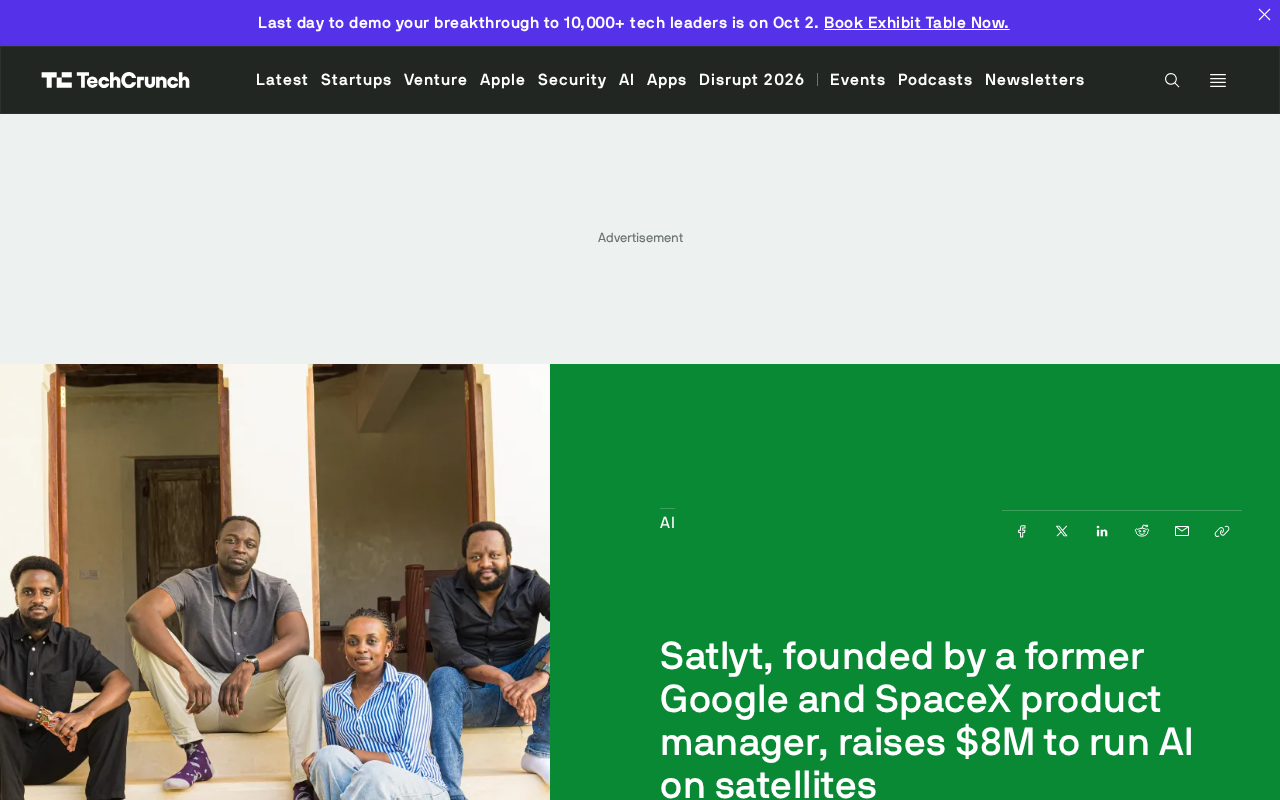
Satlyt, a startup founded by former Google and SpaceX product managers, has closed an $8 million funding round. The company has an ambitious goal: running AI computation directly on satellites, so data processing happens in orbit rather than being routed back to the ground.
The founders' combined experience at two of the most influential tech companies in the world gives Satlyt a unique vantage point in the orbital computing space — they understand both software ecosystem development (Google) and aerospace hardware and launch logistics (SpaceX). That kind of cross-domain background is relatively rare among orbital computing startups.
The "Android of Space" Positioning
Satlyt's most distinctive strategic bet is positioning itself as the "Android of orbital computing." It offers open software that can run across satellite platforms built by multiple manufacturers, rather than locking into a single hardware vendor.
This stands in sharp contrast to SpaceX's approach. According to Satlyt, SpaceX takes a closed, vertically integrated "iPhone-style" approach — deeply coupling hardware and software within a self-contained ecosystem. Satlyt, by contrast, is betting on the scale effects of open compatibility: as more satellite operators need on-orbit computing capability, a software layer that works across platforms becomes increasingly attractive.
The core advantage of the Android model lies in ecosystem breadth. By serving many satellite manufacturers and operators, Satlyt could theoretically become the industry's universal computing layer, lowering the barrier for each company to develop its own on-board AI systems. This "sell the shovels, not mine the gold" strategy carries real commercial logic as the space economy rapidly expands.
Why Run AI on Satellites?
Traditional satellites mostly play the role of data collectors — capturing images, sensing signals, then beaming raw data back to the ground for processing. But as satellite counts surge and the volume of collected data explodes, downlink bandwidth is becoming a serious bottleneck.
Running AI directly in orbit means satellites can perform data filtering, analysis, and inference on the spot, transmitting only the genuinely valuable results back to Earth. This can dramatically reduce communication bandwidth requirements and cut response latency — a critical advantage for applications like disaster monitoring, defense reconnaissance, and real-time Earth observation. That's exactly the kind of software infrastructure Satlyt aims to provide for this "edge computing in orbit" paradigm.
On-board processing isn't an entirely new concept, but it has historically been constrained by satellite power budgets, form factors, and the limited computational capacity of radiation-hardened chips. In recent years, edge AI chips designed for harsh environments — such as space-hardened variants of the NVIDIA Jetson series and Ubotica's Intel Myriad-based solutions — have begun commercializing, making it feasible to run lightweight neural network inference on CubeSats and small satellites. Meanwhile, the rise of low Earth orbit constellations means individual satellites have extremely short ground-station visibility windows (typically just 5–10 minutes per pass). If every pass requires downlinking full raw remote-sensing imagery, ground receiving stations become a severe bottleneck. On-board AI can complete tasks like object detection and change analysis during a pass, transmitting only coordinates, bounding boxes, or compressed feature vectors — compressing data volumes by orders of magnitude. This "infer first, then downlink" model has already seen early validation in time-sensitive applications like wildfire spread monitoring and vessel tracking.
Open vs. Closed: A Familiar Battle
The contrast between Satlyt and SpaceX is essentially the open-versus-closed debate that has played out repeatedly across the tech industry. Android captured dominant global smartphone market share through its open ecosystem, while iPhone maintained premium pricing and tight control through its closed experience.
Transplanted to space, this contest won't necessarily replay the same way. Space computing is still an early-stage market with no unified standards and a relatively limited customer base. Whether an open platform can genuinely attract enough satellite vendors depends on the maturity and reliability of its software and its ability to generate network effects. An $8 million raise is still just a starting point — there's a long road ahead before this grand narrative can be validated.
That said, Satlyt's emergence at least reflects a broader trend: space is gradually shifting from a pure hardware race to a competition over software and computational capability. Whoever can deliver more powerful, more flexible intelligence in orbit may be well-positioned for the next phase of the space economy.
The competitive landscape in space computing currently includes several other types of players: companies like D-Orbit and Orbital Sidekick offer in-orbit servicing platforms, some with on-board processing capabilities; traditional aerospace giants like Lockheed Martin's SmartSat platform are advancing software-defined satellite architectures. By comparison, Satlyt's positioning is closer to a pure software layer — akin to providing an operating system and AI runtime environment for satellite hardware — rather than developing or operating satellites itself. This asset-light model is theoretically faster to scale with lower marginal costs, but it also means the company's commercial value depends entirely on partner satellite counts and customer adoption rates. In an early market, the cold-start dilemma of "platform without apps, apps without platform" will be the most significant real-world challenge.
Final Thoughts
As an early-stage funding story, Satlyt is more about vision than results. The core narrative is compelling: use open software to unify a fragmented satellite computing market, replicating the path Android took in the mobile era. Whether this plays out in practice still depends on subsequent product delivery and customer adoption — but it offers a differentiated case study worth watching in an increasingly crowded space AI landscape.
Industry Context
From a structural standpoint, the current satellite software market is highly fragmented: remote sensing operators like Planet, Maxar, and Airbus Defence each maintain proprietary on-board software stacks that are incompatible with one another. This closely resembles the pre-2007 smartphone landscape, when operating systems like Symbian, Windows Mobile, and Palm OS all coexisted without a common standard. Android broke through by making its platform freely available to hardware manufacturers and building a unified app ecosystem, so developers only needed to target one API to reach many devices — and Satlyt is attempting to replicate that flywheel effect at the orbital computing layer.
Worth noting: the "Android model" historically also suffered severe fragmentation. Deep manufacturer customization caused version fragmentation, and Google ultimately reasserted control through Google Play Services. If Satlyt follows the same path, a key challenge will be maintaining platform consistency and security certification standards while preserving openness.
Related articles

Chain of Thought Isn't Just for AI: How Humans Can Use CoT to Improve Thinking Quality
Chain of Thought isn't just a prompt trick for large models. Starting from a Hacker News discussion, this article analyzes why CoT works for human thinking too, breaks down actionable ways to transfer it, and highlights the key differences between human CoT and machine CoT.
Cloudflare Teams Up with OpenAI: Closi…
Cloudflare Teams Up with OpenAI: Closing the Loop from Vulnerability Discovery to Defense with AI
Cloudflare uses OpenAI Daybreak to investigate security vulnerabilities and generate reviewable remediation plans, while developers use Codex to boost coding efficiency and quality.

Orca Multi-Agent Orchestration in Practice: A Guide to Parallel Collaboration with Claude and Codex
Orca is Stable AI's free open-source agent workbench supporting 34 agents like Claude Code and Codex in parallel. Learn its Git worktree isolation, multi-model orchestration, and mobile management.