SAUCE: A New Reference-Free, Explainable Method for Dialogue Summarization Evaluation

SAUCE proposes a reference-free, fact-based dialogue summarization evaluation pipeline that can localize hallucinations and omissions.
SAUCE is a reference-free evaluation method for open-ended, cross-lingual dialogue summarization that measures factual accuracy and coverage by judging entailment between the conversation and summary statements. Compared with traditional metrics and black-box LLM evaluators, SAUCE maps scores to discrete verifiable facts, directly localizes hallucinations and omissions, and is especially good at capturing information loss from transcription and translation errors. Preliminary studies show high consistency with human judgment, but large-scale validation is still pending. The research provides an explainable auditing tool for engineering deployment of speech summarization.
Evaluating dialogue summaries has always been a thorny problem: when conversations lack clear goals and are mixed with multilingual content and speech recognition errors, traditional metrics often fall short. A study called SAUCE proposes a reference-free, fact-based evaluation pipeline that attempts to make the judgment of summary quality traceable and explainable.
Why dialogue summarization evaluation needs new thinking
Large language models (LLMs) are increasingly being applied in speech scenarios, but how to evaluate the dialogue summaries they generate still lacks reliable means. Unlike meetings or task-oriented dialogues with clear conclusions, open-ended chit-chat has no clear endpoint, and what should be retained or discarded in a summary has no standard answer in itself.
What's more troublesome is the cross-lingual speech scenario: transcription errors and translation errors accumulate layer by layer, and the information loss in the final summary is hard to attribute. According to the study, existing popular summarization metrics often fail to accurately reflect true quality in such cases, and it is also difficult to point out whether the problem lies in transcription, translation, or summarization.
SAUCE's core mechanism: measuring factual coverage through entailment
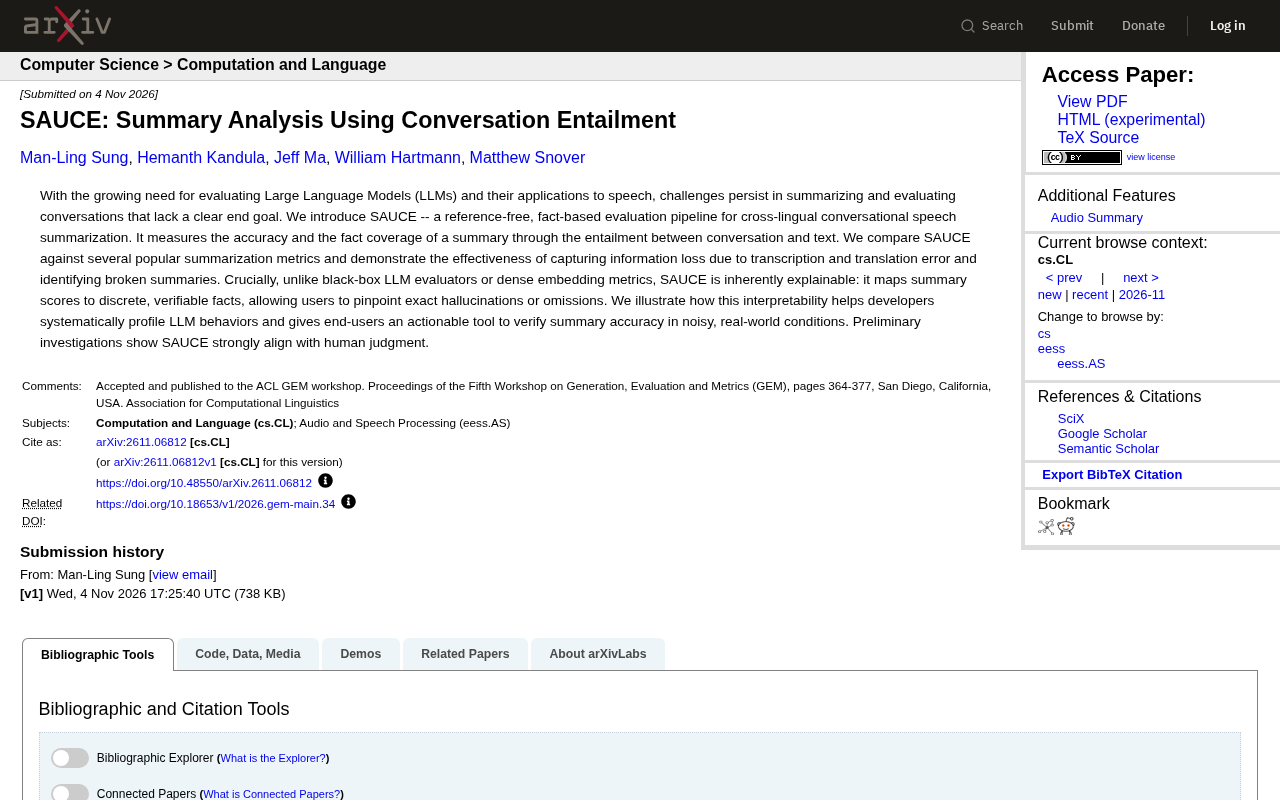
SAUCE stands for Summary Analysis Using Conversation Entailment, which evaluates summaries using the entailment relationship between the conversation and the summary. Its basic idea is not complicated: compare the statements in the summary with the original conversation, determine whether the conversation supports these statements, and thereby measure both the accuracy and factual coverage of the summary.
This design has two key features. First, it is reference-free, requiring no human-written reference summary for comparison, making it suitable for scenarios like open-ended dialogue where there is no single correct answer. Second, it is fact-based, with evaluation results grounded in individually verifiable facts rather than an abstract score.
The study compared SAUCE with several popular summarization metrics, and the results show that it is more effective at capturing information loss caused by transcription and translation errors and at identifying incomplete summaries.
Textual Entailment is a fundamental task in natural language processing, referring to determining whether a given premise logically entails a hypothesis. In summarization evaluation, this technique is used to measure whether each statement in the summary is supported by the original conversation content: if the conversation entails the statement, it is considered factually consistent; if not, or if it contradicts, it is flagged as a hallucination or error. Unlike traditional metrics that rely on surface-level lexical overlap, entailment judgments focus more on semantic-level logical relationships, and are therefore more robust to transcription noise, translation deviations, and synonymous paraphrasing. SAUCE leverages this property by decomposing the summary into atomic facts and then verifying each one against the conversation through entailment, thereby breaking down overall quality into a traceable chain of evidence.
Explainability: from scores to specific facts
The biggest difference between SAUCE and black-box LLM evaluators and dense vector metrics lies in explainability. It maps summary scores to discrete, verifiable facts, allowing users to directly pinpoint which sentence is a hallucination and which piece of information was omitted.
This explainability has practical value for two groups of people. Developers can use it to systematically characterize LLM behavior patterns, such as in which types of conversations the model is more likely to fabricate content; end users gain an actionable verification tool in noisy real-world environments, without having to blindly trust a score.
Interestingly, the study mentions that preliminary investigations show SAUCE is highly consistent with human judgment. However, this conclusion is still preliminary in nature, and its stability at larger scales and across more language scenarios remains to be further verified.
Black-box LLM evaluators refer to methods that directly call large language models to score or rank summary quality, such as asking GPT-4 to give scores based on dimensions like fluency and relevance. Although such methods are flexible, they have obvious flaws: the scoring process is opaque, and it is impossible to explain why points were deducted; they are easily affected by prompt design and model bias; and evaluating the same summary multiple times may yield inconsistent results. In contrast, SAUCE makes the evaluation basis explicit as the entailment relationship between the conversation and summary statements, with each judgment backed by corresponding original text segments as evidence. This white-box design not only improves the reproducibility of results but also makes error analysis possible—developers can know exactly which fact was omitted or distorted, rather than merely facing an abstract score.
Significance for the deployment of speech summarization
Cross-lingual dialogue summarization is moving toward practical application with the spread of speech LLMs, and shortcomings in the evaluation stage will directly constrain product credibility. SAUCE advances evaluation from "giving a score" to "pointing out where the problem is," a direction that is especially appealing to engineering teams that need auditing and debugging.
Its limitations are also obvious: entailment judgments themselves depend on model capability, and the way factual granularity is divided will also affect the results. The information currently disclosed by the study mainly consists of the methodological framework and preliminary comparisons; open-source implementations and large-scale benchmark results have not yet been detailed, which will be a focus of follow-up attention.
FAQ
Does SAUCE require human-annotated reference summaries? No, it is a reference-free evaluation method that scores directly based on the entailment relationship between the conversation and the summary.
What scenarios is it suitable for? It is mainly aimed at cross-lingual dialogue speech summarization, especially open-ended conversations that lack clear goals and contain considerable transcription and translation noise.
What are its advantages compared with LLM scorers? Evaluation results can be mapped to specific facts, enabling the localization of hallucinations and omissions rather than merely outputting an opaque score.
One-line Summary
SAUCE proposes a reference-free, fact-based dialogue summarization evaluation pipeline that can localize hallucinations and omissions.
Paragraph Summary
SAUCE is a reference-free evaluation method for open-ended, cross-lingual dialogue summarization that measures factual accuracy and coverage by judging the entailment relationship between the conversation and summary statements. Compared with traditional metrics and black-box LLM evaluators, SAUCE maps scores to discrete, verifiable facts, can directly localize hallucinations and omissions, and is especially good at capturing information loss caused by transcription and translation errors. Preliminary investigations show it is highly consistent with human judgment, but large-scale validation remains to be done. This study provides an explainable auditing tool for the engineering deployment of speech summarization.
Related articles

Sugra MCP: One-Click Access to 200+ Data Sources, Connecting Mainstream AI Applications
Sugra MCP connects mainstream AI apps like Claude, ChatGPT, and Cursor through a unified MCP protocol, offering 200+ data sources and 1,600+ endpoints. Listed in Anthropic, OpenAI, and GitHub directories—integrate with one command.
 Tech Frontiers
T3 Code: Free, Open-Source, and a Unified Way to Manage All AI Coding Agents
T3 Code is a free open-source app that aggregates AI coding tools like Cloud Code and Codex into one interface, with conversation handoff, branch isolation review, automatic PR creation, and remote access.
 Tech Frontiers
Conductor Cloud Service Shutting Down? A Comparative Review of Three Parallel AI Coding Agent Solutions
Conductor's cloud service is shutting down—how can developers keep running AI coding agents in parallel? This article compares three alternatives: Orca, Codex, and Cursor: Orca is open-source and free and compatible with old workspaces, Codex is built into the ChatGPT desktop app and supports cloud handoff, and Cursor offers multi-agent windows within the editor. Choose the tool that best fits your workflow.