Sayble: The Real-Time AI Copilot That Tells You What to Say Next on Every Call
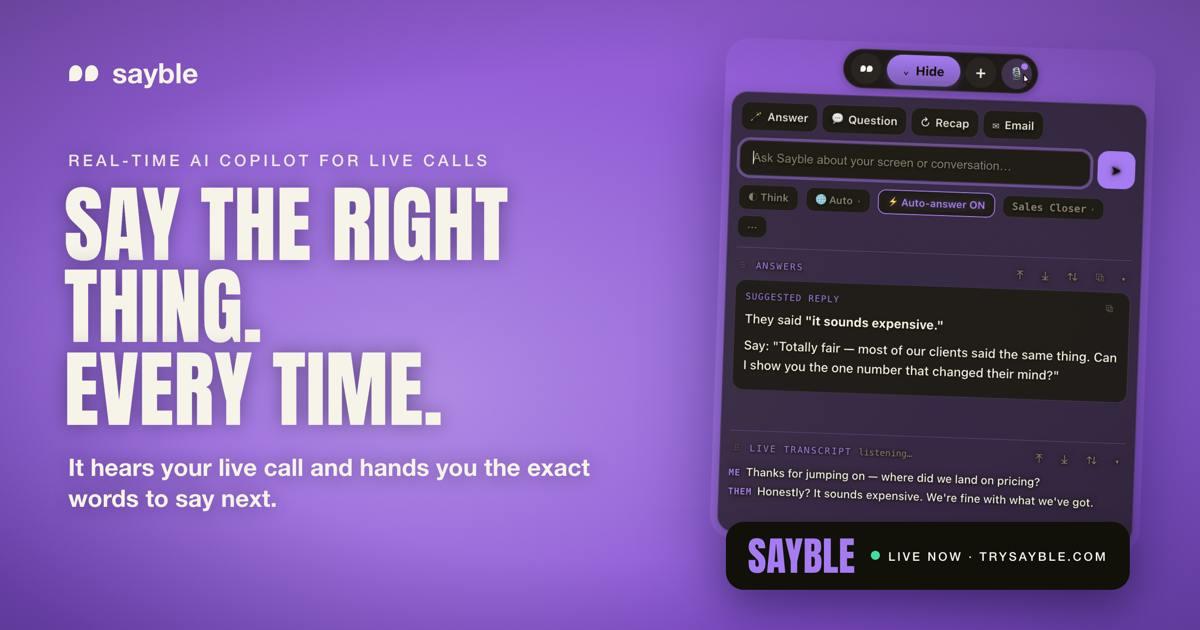
Sayble is a real-time AI sales copilot that suggests what to say next in 0.5 seconds and auto-generates post-call follow-ups.
Sayble is a real-time AI copilot built for sales calls, client meetings, and business negotiations. It listens to conversations and surfaces a ready-to-say response suggestion in roughly 0.5 seconds — along with a backup alternative — minimizing cognitive load during live calls. After each call, it automatically generates a meeting recap and a ready-to-send follow-up email, covering the full sales workflow lifecycle. The product supports Zoom, Google Meet, Microsoft Teams, and regular phone calls across Mac and Windows, with 10 languages supported. While the product logic is clear and the use case compelling, compliance obligations around real-time listening, the accuracy of AI-generated talking points, and the risk of eroding salespeople's own conversational skills remain key questions to validate in real-world use.
In sales calls, client meetings, and business negotiations, the hardest part is rarely the preparation — it's the in-the-moment reaction. Those few seconds of silence when a tough question lands can cost you the deal. Sayble, recently featured on Product Hunt, aims to solve this with a real-time AI copilot that listens to your conversation and delivers a ready-to-say response in about half a second.
What Is Sayble
Sayble is positioned as a real-time AI copilot built for sales calls, client meetings, and negotiation scenarios. Its core logic is straightforward: listen to what the other person just said, then surface a clear, actionable response suggestion in roughly 0.5 seconds — along with a backup alternative.
The brilliance of this design lies in delivering "one sentence" rather than "a block of analysis." Traditional meeting assistants tend to hand you a pile of summaries after the fact, but the real pressure of a conversation happens in the moment. Sayble compresses AI output into a single line you can say out loud immediately, reducing the cognitive load during live conversations — no need to read through long text or extract key points. A glance is enough to keep the conversation going.
Having a backup suggestion matters just as much. Sales and negotiation are highly context-dependent. The AI's first recommendation may not fit the current mood, so an alternative option gives users the flexibility to pivot quickly.
From Real-Time Responses to Post-Call Follow-Up
Sayble's capabilities extend beyond the call itself. When a conversation ends, it automatically generates a meeting recap and drafts a ready-to-send follow-up email.
This covers the back half of the sales workflow. After hanging up, salespeople typically spend time organizing notes and writing follow-up emails — tasks that are prone to quality drops due to fatigue or forgetfulness. Sayble packages "real-time assistance" and "post-call output" into a single, complete pipeline, theoretically reducing the manual effort surrounding each call.
This kind of "full-lifecycle coverage" is exactly where AI sales tools are competing right now. Single-feature products (like transcription-only or summary-only tools) are increasingly hard to differentiate. Products that string together the entire call lifecycle are the ones with real retention value.
The auto-generated follow-up email relies on complete transcription and structured extraction of the call's content. The mainstream approach typically combines automatic speech recognition (ASR) with a large language model (LLM): ASR converts speech to text, and the LLM extracts action items, commitments, and key decisions to assemble an email draft. The quality bottleneck in this pipeline usually sits at the ASR layer — accents, technical jargon, and overlapping speakers can significantly reduce transcription accuracy and, in turn, the usability of the downstream email. The real-world quality of follow-up emails therefore depends heavily on how well the product has been adapted to specialized vocabulary (product names, industry terms) in vertical sales contexts.
Platform Compatibility and Language Support
In terms of coverage, Sayble supports major video conferencing platforms — Zoom, Google Meet, and Microsoft Teams — as well as regular phone calls. The client is available on both Mac and Windows, with support for 10 languages.
Broad platform and language support is critical for tools like this. Sales teams deal with customers using all kinds of meeting software, and an AI copilot that only works on one platform loses much of its practical value. Support for 10 languages also signals that Sayble is targeting cross-border sales and multilingual markets, rather than a single-language region.
Opportunities and Concerns
From a product logic standpoint, Sayble has identified a real, high-value use case. Sales, customer success, and business development are roles where communication directly drives productivity — the immediate value of real-time prompting is easy to quantify. Sign one extra deal, and the tool pays for itself. On Product Hunt, it landed 68 upvotes and ranked 18th for the day — notable traction, though not yet a breakout hit.
That said, real-time call assistance tools face a few unavoidable challenges:
- Compliance and disclosure: Does using AI to listen to calls and generate suggestions require informing the other party? Regulations on call recording and data processing vary significantly by region.
- Response accuracy: Can a suggestion generated in 0.5 seconds truly fit a complex negotiation context, or will it default to generic talking points? Real-world usage will be the test.
- Dependency risk: Over-reliance on real-time prompts may actually erode a salesperson's own ability to think on their feet.
Compliance deserves a closer look. In the US, requirements for "two-party consent" to recording vary by state — California, Illinois, and others require that all parties on a call be informed and consent, with violations potentially resulting in civil liability. The EU's GDPR classifies voice data as personal data, requiring a clear legal basis for any processing. Even if the tool processes data locally, sending call content to a cloud-based AI model for inference already constitutes cross-border data transfer and storage. In B2B sales contexts, enterprise clients often apply rigorous information security reviews. Tools like this typically need third-party security certifications such as SOC 2 or ISO 27001 before they can clear procurement hurdles with large enterprise accounts.
Conclusion
Sayble represents a clear example of AI evolving from "after-the-fact summaries" to "real-time intervention." It distills complex conversational assistance into a single, actionable sentence, then extends that to post-call recaps and follow-up emails — aiming to close the loop on the entire sales call workflow. For salespeople and business professionals who spend hours on calls, the idea of an "on-demand talk-track coach" is genuinely appealing. But the real-world effectiveness, quality of suggestions, and compliance boundaries all still need validation in live environments.
Related articles
LangGraph Crash Course: Building Enterprise-Grade AI Agents and Workflows from Scratch
LangGraph crash course: learn its independence from LangChain, MIT license, FastAPI high-concurrency deployment, human approval, and memory storage for enterprise AI agents.
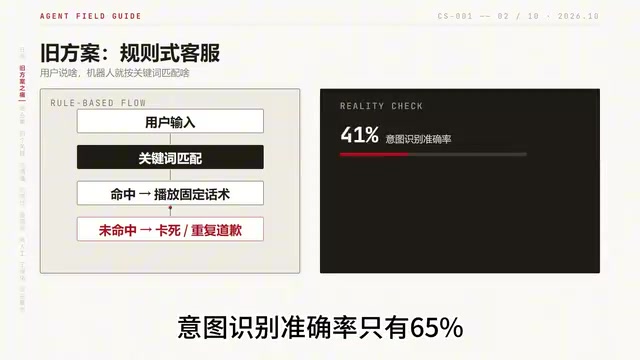
Building an AI Customer Service Agent from Scratch: A 92% Intent Recognition Case Study
A Bilibili case study: building an AI customer service agent from scratch with BERT intent recognition, dialogue state tracking, hybrid vector retrieval, and a weighted handoff model—raising intent accuracy from 65% to 92%, 78% conversation completion, handling 100K conversations daily.
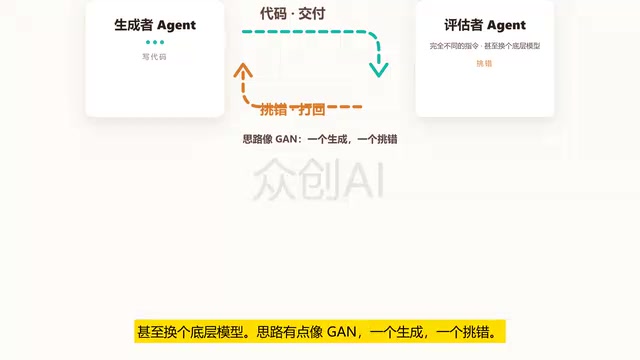
Loop Engineering: An Engineering Paradigm for AI That Writes Code and Merges PRs Autonomously
Loop Engineering is transforming AI development pipelines: Stripe's Minions system merges over 1,300 machine-generated PRs weekly. This article breaks down Loop Engineering's five core actions, six components, five failure modes, and three safety disciplines, explaining why independent evaluators, state files, and budget caps matter more than full automation.