Scaling Laws for Tool-Use Agents: How Environment Synthesis Determines Generalization

The SynthAPI pipeline reveals data scaling laws for tool-use agents through controllable environment synthesis, finding that tool and database diversity are more critical than task count.
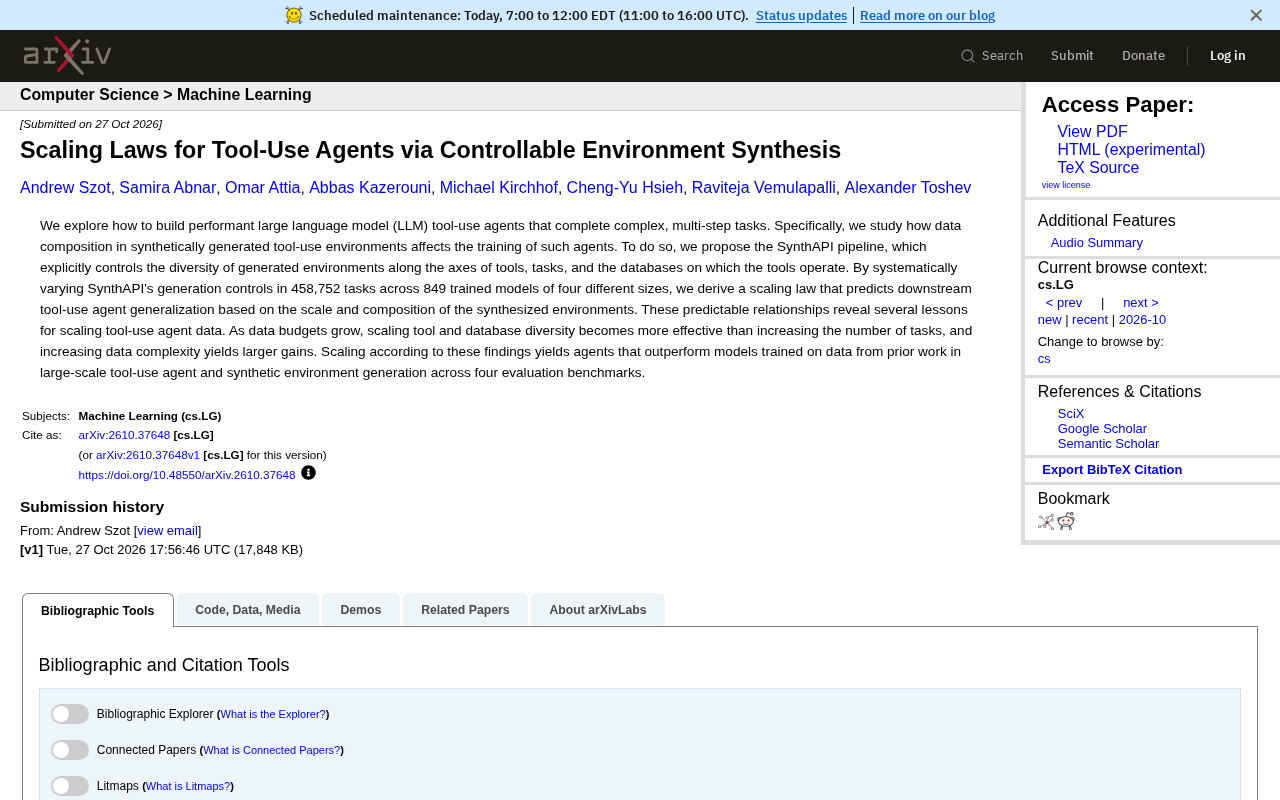
This study proposes the SynthAPI pipeline, which explicitly controls synthetic tool-use environment diversity along tools, tasks, and databases, training 849 models on 458,752 tasks to derive the first data scaling laws for tool-use agents. Key findings: as data budgets grow, gains from task count diminish while tool and database diversity become more effective; higher data complexity yields greater gains; and agents trained with scaling-law-guided data outperform prior work on four benchmarks. This work advances "more data is better" to the computable level of "how to mix data."
Tool-use agents are becoming a key form of LLM deployment, but how to efficiently train them for complex multi-step tasks has lacked systematic data guidance. A recent study proposes the SynthAPI pipeline which, through controllable synthesis of tool-use environments, reveals for the first time the scaling laws between data composition and agent generalization capability.
Core Question: Data Mix Matters More Than Data Volume
The research team focused on: when synthetically generating tool-use environments, how does data composition affect agent training outcomes? Their proposed SynthAPI pipeline can explicitly control the diversity of generated environments along three axes: tools, tasks, and databases. This means researchers can systematically adjust environment complexity rather than blindly scaling up data volume.
To derive the scaling laws, the team trained 849 models of different scales (across four sizes) on 458,752 tasks, systematically varying SynthAPI's generation control parameters to observe patterns in downstream generalization performance. Such large-scale controlled experiments are rare in tool-use agent research.
Tool-Use Agent refers to an LLM agent that can autonomously plan and invoke external tools (such as search engines, calculators, API interfaces, database queries, etc.) according to user instructions to complete complex tasks. Unlike models that only generate text, these agents need to understand the functional semantics of tools, construct valid invocation parameters, parse tool return results, and maintain state and context across multi-step tasks. The core challenge is that the model must not only "talk" but also "act"—making correct tool selection and invocation decisions in dynamic environments. Training such agents typically requires large amounts of interaction data containing tool-call trajectories, but data acquisition in real environments is costly and limited in coverage, making synthetic data a key approach. The emergence of controllable synthesis pipelines like SynthAPI is precisely to address the difficulty of systematically regulating tool diversity and task complexity in training data.
Three Key Findings from the Scaling Laws
Based on experimental data, researchers derived scaling laws that can predict downstream tool-use agent generalization capability. Several counterintuitive conclusions are worth noting.
Tool and Database Diversity Is More Effective Than Task Count
As the data budget grows, the gains from simply increasing task count diminish, while expanding tool and database diversity becomes more effective. This means that rather than having agents repeatedly train on large numbers of similar tasks, it is better to expose them to more diverse tool interfaces and underlying database structures.
Scaling Law was initially widely validated in language model research, referring to the predictable power-law relationship between model performance (such as loss or downstream accuracy) and increases in model scale, data volume, and compute. Transferring this concept to tool-use agent training data means researchers attempt to establish a quantitative functional relationship between data composition (tool diversity, task count, database diversity, complexity, etc.) and agent generalization performance. Unlike the traditional "more data is better" view, data scaling laws focus on the marginal returns of data mix: under a fixed data budget, different dimensions of data expansion contribute unequally to performance. The contribution of this study is the first systematic derivation of such predictable relationships in the tool-use agent setting, moving data engineering from experience-driven toward computable and optimizable directions.
Increased Data Complexity Yields Greater Gains
Increasing data complexity (rather than simply piling on volume) brings more significant performance improvements. Complex environments force agents to learn more robust tool-use strategies, which transfer more easily to unseen tasks.
Scaling Laws Can Guide Data Generation
These predictable relationships translate directly into operational guidelines for data scaling. Training agents by scaling data according to the research findings outperforms models trained with data from prior work on all four evaluation benchmarks—prior work that also involved large-scale tool-use agents and synthetic environment generation.
Synthetic Environment Generation refers to the programmatic automatic construction of virtual interaction environments containing tool interfaces, task instructions, and underlying databases for training and evaluating agents. Compared to real environments, the core advantage of synthetic environments is controllability: researchers can precisely adjust environment complexity parameters (such as number of tools, task type distribution, richness of database schemas), enabling controlled experiments. The SynthAPI pipeline explicitly controls diversity along the three axes of tools, tasks, and databases, turning "environment complexity" from a random variable into an adjustable independent variable. The methodological value is that it allows researchers to isolate and quantify the independent contribution of each data dimension to agent generalization capability, without interference from confounding factors in real data.
Implications for Tool-Use Agent Training
The value of this work lies in advancing the naive notion of "more data is better" to the computable level of "how to mix data." SynthAPI's controlled generation approach makes environment diversity an adjustable parameter rather than a random outcome.
For teams actually training tool-use agents, this means that when planning data budgets, priority should be given to the breadth of tool and database coverage, followed by stacking task counts. Meanwhile, proactively increasing synthetic environment complexity may be more cost-effective than collecting more simple samples.
The research also shows that scaling laws can not only predict performance but also inversely guide the design of data synthesis pipelines. This "predict-guide" closed loop provides a methodological foundation for the systematic application of synthetic data in agent training.
Conclusion
The SynthAPI pipeline and corresponding scaling laws provide quantifiable decision-making guidance for tool-use agent data engineering. Tool diversity, database diversity, and data complexity are more critical scaling dimensions than task count. As agent application scenarios grow increasingly complex, research on controlled environment synthesis and scaling laws will become important infrastructure for improving agent generalization capability.
One-line Summary
The SynthAPI pipeline reveals data scaling laws for tool-use agents through controllable environment synthesis, finding that tool and database diversity are more critical than task count.
Paragraph Summary
This study proposes the SynthAPI pipeline, which can explicitly control the diversity of synthetic tool-use environments along three axes—tools, tasks, and databases—and trained 849 models of different scales on 458,752 tasks, systematically deriving for the first time the data scaling laws for tool-use agents. Key findings include: as the data budget grows, the returns from simply increasing task count diminish while expanding tool and database diversity becomes more effective; increasing data complexity yields greater performance gains than simply piling on volume; and training agents with data generation guided by the scaling laws outperforms prior work on all four evaluation benchmarks. This work advances the naive notion of "more data is better" to the computable level of "how to mix data," providing quantifiable decision-making guidance for tool-use agent data engineering.
Related articles

Last Week Tonight Exposé: The Dangerous Ties Between Politicians and White Supremacy
Last Week Tonight investigates Georgia Senate candidate Mike Collins and Florida candidate Marshall Rawson, exposing their multiple ties to white supremacists and the Republican Party's silent response.
AI Buzz Weekly: GPT-6.5 Leak, New Claude Model, and MiniMax's Cost-Effectiveness
This week's AI buzz roundup: suspected GPT-6.5 leak, Microsoft configs showing GPT-6.1 Tera, Anthropic's new model that can identify entire classes of bugs, disappointing early Gemini 4 Carbon results, and MiniMax M3.1 Flash beating Claude Opus 5 and GPT-5.6 Sol in benchmarks at extremely low cost.

AI Briefing: Gemini 4 Carbon Released, Ant Open-Sources Ling-3.1
AI Briefing: Google releases Gemini 4 Carbon qubit model, claiming to surpass Opus 5.5 with half-price tokens; Ant open-sources Ling-3.1-1019 for real-task Personal Agents; domestic AI drug discovery succeeds in 18 of 19 projects, hitting all 6 GPCR targets; zero-revenue company valued at $20B raises another $1B; Sichuan convenience store robot sales fail.