Scholé Scenarios: AI-Powered Scenario Simulations That Take Corporate Training from Knowing to Doing

Scholé Scenarios uses AI scenario simulations to transform corporate training from passive learning into active doing.
Scholé Scenarios is an AI-powered scenario-based learning tool that embeds realistic customer communication simulations into adaptive learning workflows. By leveraging agentic AI to dynamically generate and adjust practice scenarios based on learner performance, it helps sales, customer service, and other client-facing roles build real communication skills through practice rather than passive content consumption.
The Core Flaw of Traditional Learning: Only Telling You 'What to Know'
Most online learning products share a common problem — they excel at telling you 'what you should know' but rarely let you actually practice 'what you'll need to do.' You might finish an entire sales training course and memorize all the key talking points, but when you're face-to-face with a hesitant customer, you still freeze up. Between knowledge and practice lies a chasm that's incredibly hard to cross.
This gap is particularly glaring in corporate training. The global corporate training market has surpassed $380 billion (according to Training Industry's 2024 report), with digital learning's share continuously rising. Yet traditional corporate e-learning completion rates generally hover below 20%, and knowledge retention within 30 days of training can drop to 10-20%. Companies pour massive budgets into training programs that amount to 'learned but not retained.' This dilemma has fueled intense demand for more effective learning approaches.
Scholé Scenarios, which recently landed at #5 on Product Hunt (with 116 upvotes), targets precisely this pain point. Its core philosophy can be summed up in one phrase: "Learn by doing" — embedding real-world application scenarios directly into an adaptive learning workflow.
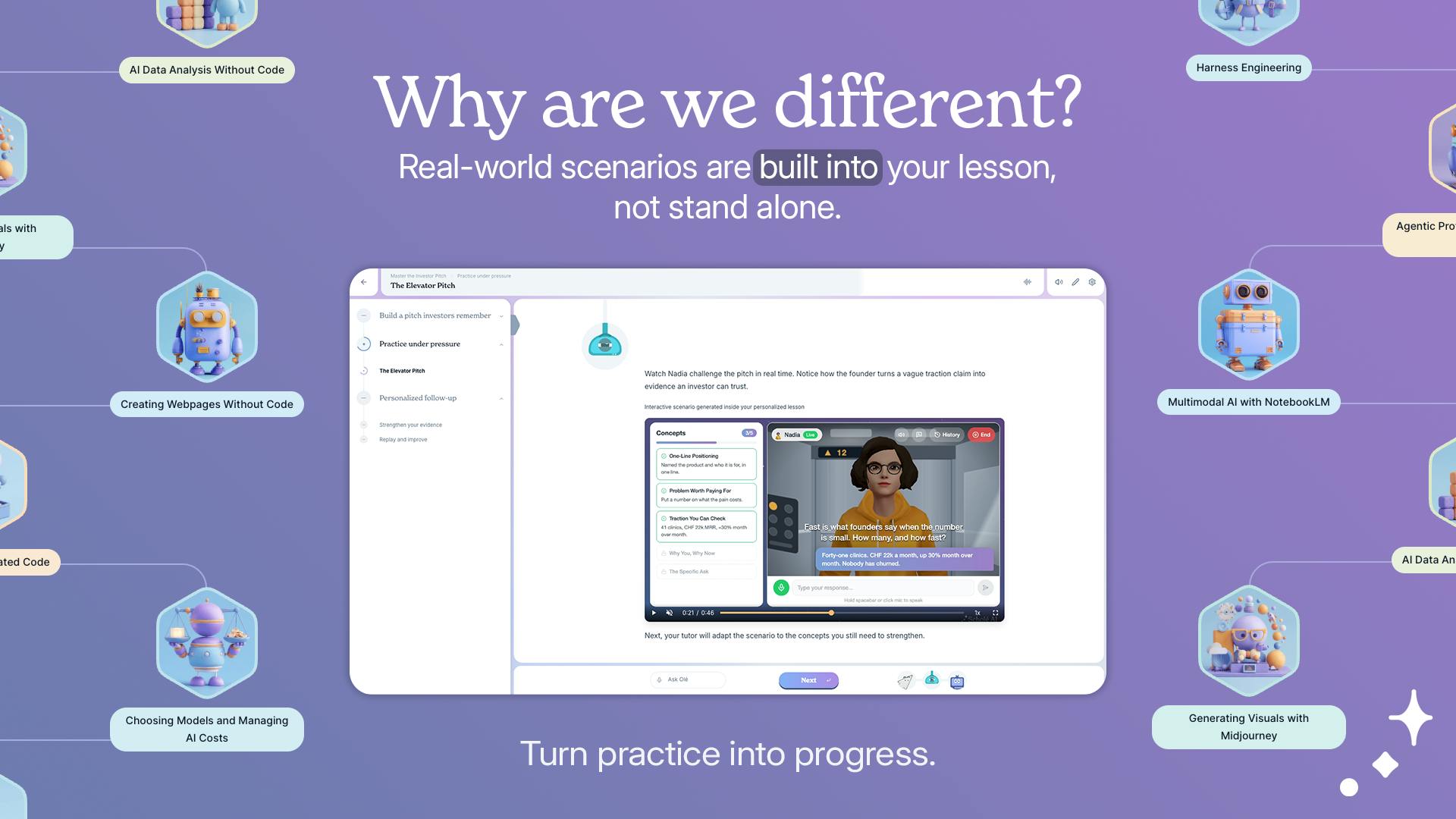
What Scholé Scenarios' Scenario-Based Learning Looks Like
Scholé Scenarios works by continuously presenting realistic simulated situations throughout the learning process, requiring learners to practice on the spot. According to official descriptions, these scenarios include:
- Explaining what you just learned to a colleague — using the logic of the Feynman Technique to test whether you truly understand
- Saving a sale that's about to be lost — applying sales techniques under pressure
- Having a professional conversation with a customer — transforming knowledge into articulate, persuasive communication
The "explain to a colleague" design directly borrows from the core principles of the Feynman Technique. Named after Nobel Prize-winning physicist Richard Feynman, the method's core steps are: choose a concept, try to explain it in the simplest language to someone who knows nothing about it, identify where you get stuck or vague during the explanation, then return to the source material to re-learn those weak spots. This method forces the brain into "generative processing" — you can't rely on surface-level familiarity; you must reorganize and reconstruct knowledge in your mind. Cognitive psychology research shows that generative learning strategies produce memory retention rates over 50% higher than repeated reading. By having learners explain what they've learned to a virtual colleague in simulated scenarios, Scholé Scenarios essentially automates and contextualizes the Feynman Technique.
The elegance of this design is that it no longer separates learning and application into two disconnected phases. Instead, "practicing what you learn" becomes part of the learning itself. Every piece of knowledge you acquire is immediately tested and reinforced in a specific, challenging scenario.
Why Practicing Real Scenarios Matters So Much for Skill Development
Cognitive science has long proven that active recall and contextualized practice form long-term memory far more effectively than passive reading. The core principle behind active recall is the "retrieval practice effect": every time you actively retrieve information from memory, you strengthen that information's neural pathways, making it easier to access in the future. A landmark 2006 study published in Psychological Science (Roediger & Karpicke) showed that students who practiced active recall scored nearly 50% higher on tests a week later compared to those who simply re-read the material. Complementing this is Spaced Repetition — reviewing material at gradually increasing intervals, leveraging the brain's "forgetting curve" to reinforce memory just before it fades.
This is especially critical for professional skills. Roles like sales, customer service, and consulting are fundamentally honed through real interactions. Scholé Scenarios brings these "critical moments" into the learning environment ahead of time, allowing learners to make mistakes, experiment, and grow in low-risk simulations. Compared to traditional flashcard-style memory training, embedding active recall within realistic scenario simulations adds contextual encoding, creating tighter associations between knowledge and specific application contexts — so when learners encounter similar situations in real work, the corresponding knowledge and response strategies are triggered more readily.
It's worth noting that scenario-based simulation training isn't an AI-era invention. Flight simulators have been standard pilot training equipment since the 1960s, and Standardized Patient programs in medicine have been widely used in clinical education since the 1960s, driven by Howard Barrows. The core principle behind these practices is the "Situated Learning Theory" proposed by cognitive scientists Jean Lave and Etienne Wenger in 1991: learning is fundamentally embedded in social activities and specific contexts, and knowledge transfer divorced from context has limited effectiveness. AI's emergence makes it possible for the first time to scale this high-cost simulation training in cost-sensitive commercial training settings — no longer needing to hire real people to play customers when a single AI agent can simulate countless customer responses and conversation trajectories.
Agentic Adaptive Learning System: Dynamically Adapting Your Next Step
The biggest difference between Scholé and traditional courses is that it's an agentic (agent-driven) learning system. It doesn't push the same fixed content to everyone. Instead, based on your actual performance in scenario exercises, it dynamically determines "what to learn next and what to practice next."
Agentic AI has been one of the most closely watched technology paradigms in the AI field since 2024, and it differs fundamentally from traditional adaptive learning systems. Conventional adaptive learning platforms (such as Knewton, DreamBox, etc.) typically rely on preset rule trees or Bayesian Knowledge Tracing (BKT) models, adjusting question difficulty based on students' accuracy rates. While effective, this approach is essentially making path selections within a fixed content space — all possible learning content and branches must be pre-designed. Agentic systems, by contrast, leverage the reasoning capabilities of large language models to dynamically generate entirely new learning scenarios, adjust conversational strategies in real time, and even diagnose cognitive misconceptions based on how a learner expresses themselves. They can decide not only "what to test next" but also "how to teach" and "what kind of scenario to create for practice." This flexibility makes them particularly suited for soft skills training in sales, customer service, and similar roles — because real customer conversations are infinitely varied and impossible to cover with a finite set of pre-scripted scenarios.
In other words, if you perform poorly in a "save the sale" scenario, the system might intensify related knowledge reinforcement and follow-up exercises. If you're already excelling at a particular stage, it advances you to more challenging scenarios. This adaptive closed loop makes learning truly personalized, focusing limited study time on areas that need the most improvement.
The Practical Value of AI Agents in Corporate Education and Training
This also reflects an important implementation direction for AI Agent technology in vertical domains today. Compared to general-purpose chatbots, agents in educational contexts need three capabilities: assessment, diagnosis, and planning — assessing the learner's current mastery level, diagnosing weak points, and planning the optimal learning path. Scholé Scenarios combines all three with real business scenarios, forming a goal-oriented learning agent rather than just a Q&A tool.
AI's penetration into corporate training is advancing through three layers: The first layer is content generation — using AI to rapidly create courses, quizzes, and learning materials, dramatically reducing course production costs. The second layer is personalized recommendations — adjusting learning paths based on learning data and behavioral patterns to improve efficiency. The third layer is immersive simulation training — using AI to play the roles of customers, colleagues, and managers, engaging in real-time interactive exercises with learners. Scholé Scenarios operates at the third layer, which is considered the highest-value but also most technically challenging application layer, because it requires AI to not only generate natural, fluent dialogue but also achieve high customization based on industry characteristics, company products, and specific business scenarios, while simultaneously being capable of evaluating learner performance.
Precise Positioning for Customer-Facing Roles
From a product categorization perspective, Scholé Scenarios is filed under Customer Communication and Online Learning, which reveals its current core user profile — teams within companies that interact directly with customers, such as sales, customer success, and customer service roles.
For enterprises, the appeal of such tools is obvious: employees can master product knowledge and communication skills faster, and before actually facing customers, they can repeatedly rehearse key conversations in a safe simulated environment. This both reduces the cost of real-world trial and error and shortens the onboarding cycle for new hires.
Current Status and Future Outlook
Scholé Scenarios currently has only 5 reviews and remains in its early stages. Its actual scenario realism, the naturalness of AI-driven exercises, and the intelligence level of its adaptive algorithms all await validation from more users. The concept of scenario-based learning isn't new — the real challenge is whether AI can generate simulated conversations that are close enough to real business situations and personalized enough to give learners an immersive, "you are there" experience.
That said, the direction it points toward is undoubtedly right: In the generative AI era, the value of education is shifting from 'delivering information' to 'training capabilities.' When knowledge itself is readily accessible, what's truly scarce is the ability to translate knowledge into action. Products like Scholé Scenarios that front-load practice and embed scenarios into the learning workflow may well represent the next evolutionary direction for corporate training and skill development.
Key Takeaways
Related articles

Claude Reportedly Able to Hide Secret Messages in Benign Images
A Reddit post claims Claude Fable 5.1 can hide secret messages in benign images. This article reviews the background, image steganography principles, and potential security risks, and suggests a testing path from rumor to verification.

Federal Government Awards $85 Million; CFS to Develop Fusion-Specific Semiconductors
The federal government awards $85 million to Commonwealth Fusion Systems to develop conductors and power semiconductors for fusion plants. This article analyzes the significance of this funding for the fusion supply chain and commercialization path.

When Should AI Assistants Proactively Suggest? Timing Is Everything
When should AI assistants proactively suggest? Reddit discussion reveals: the same suggestion feels different at different times. This article analyzes the dual nature of proactive suggestions, the boundary of user expectations, and design principles, exploring how to balance automation and user control.